
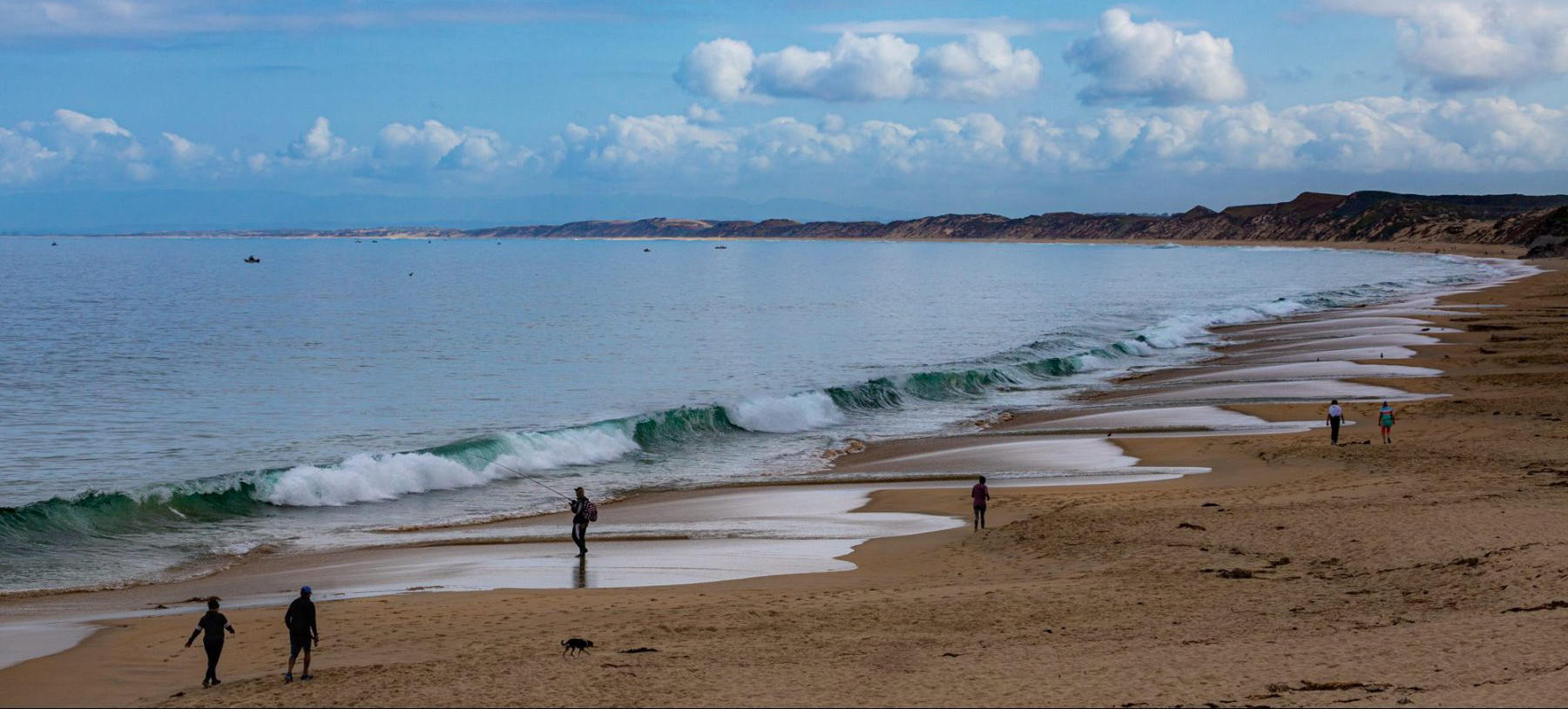
Jelly blobs
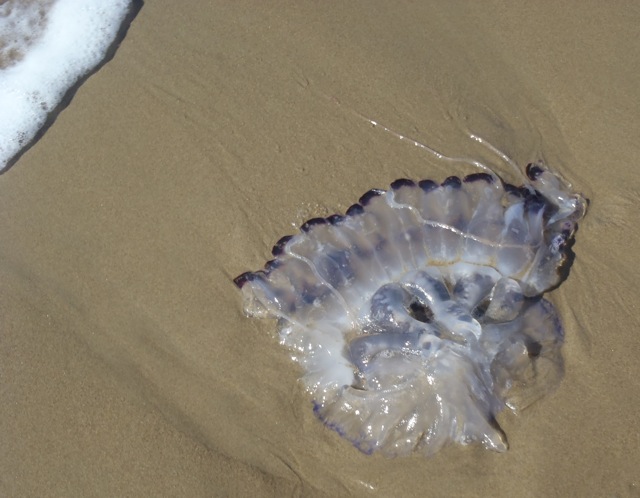
Purple-striped jelly
I’ve written quite a bit about beached jelly blobs (mostly jellyfishes, but also sea slugs, sea butterflies and salps). I never planned to write so much about gelatinous animals, although they’re fascinating. However, new ones keep washing ashore and the postings are popular, so here are links to all of my jellies postings from oldest to newest. I hope this makes them easier for you to find.
Enjoy.
Scrippsia bell jelly
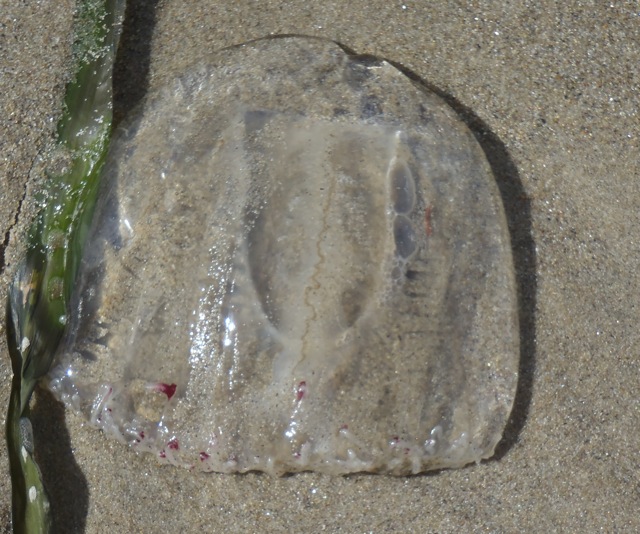 Jelly blobs on the beach are a travesty,
like this one I found recently among wave-tossed seagrasses on Del Monte Beach. Lifeless on the sand, such jellies are void of their pulsating grace, intricate structures and delicate colors. Yet I always watch for them. For a beachwalker, they’re a window into what’s beyond the waves. This new jelly species (for me) is Scrippsia pacifica, or the
giant bell jelly.
The jelly’s bell can grow to 4 inches (10 cm) long, about the size of this one. The purplish-red dots you see are ocelli (simple eyes!). Missing were the bell’s frilly lips and its more than 200 trailing tentacles. Not too much is known about this secretive species. Their tentacles carry nematocysts (stinging cells) and it’s an active predator, but I couldn’t find much detail on how it feeds. Related species (Polyorchis spp.) swim toward the surface and then sink, collecting plankton as they drop. They may also rest on or near the bottom and collect tiny animals with the stinging tentacles. The life cycle is also a mystery. Scrippsia is known from only the medusa (bell) life phase and not its polyp or larval stages (there’s a research project).
This jelly’s lovely scientific name was provided in 1909 by Harry Beal Torrey (1873 – 1970). He was a zoologist and a medical doctor working for a while at the Marine Biological Association of San Diego. During his long life, he published quite extensively on Coelenterata, the animal group at the time that included comb jellies along with true jellies and their relatives (these days that group is two phyla: Ctenophora and Cnidaria). He spent much of his later career in Berkeley and Oakland working in public health, even spending time as the director of Children’s Hospital of East Bay (he had a diverse career).
My picture certainly doesn’t do this giant bell jelly justice. For a full-figure shot and to learn more, visit The JelliesZone, or follow one drifting through a kelp forest off San Diego in this short YouTube video. And, next time you find a jelly blob on the beach, look to the water and think about the real life of the amazing creature at your feet and how little we know about so many.
~~~~~~~~~~
Sources
Calder, D.R. (2013). Harry Beal Torrey (1873–1970) of California, USA, and his research on hydroids and other coelenterates. Zootaxa 3599: 549-563.
Wrobel, D. & Mills, C. (1998). Pacific Coast Pelagic Invertebrates: A guide to the common gelatinous animals. Monterey, CA: Sea Challengers and Monterey Bay Aquarium.
Sea lions stranded
 A lone sea lion on a busy Monterey Bay beach is in serious, and potentially dangerous, trouble. It’s also a sad sight. When they’re sick, malnourished or injured, sea lions will haul out onto land to rest, recouperate or die. When one chooses a beach traversed by humans and dogs on a sunny Saturday, it’s seriously sick and faces overheating in the sun and the danger of human harassment. Unaware people can be in danger, too. (Last summer I had to stop a young boy from reaching out to touch the nose of a beached sea lion while his parents were watching!) If it can, a sea lion will bite. It’s a nasty wound for people or pets.
If you encounter a sea lion stranded on the beach, as I did this morning, please do not get close, keep dogs away and do not touch or try to assist the animal (a well-meaning but misguided person had piled kelp on this young sea lion to shade or cool it). Call for help!
Along the Northern and Central California coast we’re fortunate to have The Marine Mammal Center, which rescues and rehabilitates stranded marine mammals. They also will, if absolutely necessary, humanely euthanize. The website lists tips for what to do when you find a stranded animal. When you call — available 24/7 — they’ll ask for details about the animal, its condition and location.
From Mendocino thru San Mateo counties, call (415) 289-SEAL (7325).
In Monterey and Santa Cruz counties, call (831) 633-6298.
In San Luis Obispo County, call (805) 771-6298.
 Wait until rescuers arrive, if possible. This make take a while. The Marine Mammal Center is staffed mostly by volunteers, the need is never-ending and resources are always limited. You can also help by donating to this great group even if you don’t find a stranded animal on the beach.
A final note: It’s harbor seal pupping season around the bay. If you find a harbor seal pup on the beach (they’re shaped like fat sausages and have no external ear flaps like the one you see on this sea lion), leave the pup alone. Its mother is probably close by. If you’re unsure, your first action is to call The Marine Mammal Center.
Other Monterey Bay rescue centers
For sea otters, contact the Monterey Bay Aquarium at (831) 648-4800.
For birds and other wildlife emergencies, contact the SPCA for Monterey County at (831) 264-5427 during business hours and (831) 646-5534 after hours, or Native Animal Rescue of Santa Cruz at (831) 462-0726.
Breakwater spring melee
See my new post on the fence blocking the view of the cormorants at Breakwater blues.
 Now is the time when California sea lions and Brandt’s cormorants battle for control of the Monterey Breakwater. The breakwater is a favored hauling-out hangout for male sea lions during most of the year, but in the spring, Brandt’s cormorants gather for displaying, mating, nesting and rearing young (pelagic and double-crested cormorants choose more private rookery sites).
Right now you can watch the cormorants starting to stake territory with nests while slowing moving the sea lions off the rocks. (It’s a king-of-the-hill game and eventually sea lions lose to the jabs of the cormorants’ pointy bills.)
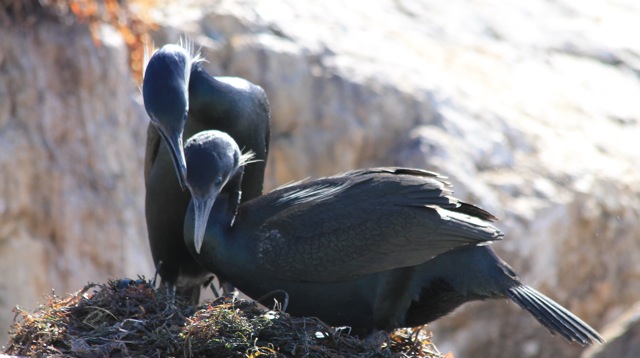 Over the next several months, if this year is typical, the top of the breakwater will change from mostly brown (sea lions) to nearly all black and white (cormorants and guano-covered nests). You can get a great close-up view by taking a short walk from the parking lot down the paved lane to the end where a fence separates people and wildlife.

Surfbirds
While you stroll, observe the divers and anglers, surfbirds, black turnstones, an occasional sea otter and the spectacular view.

Black turnstone

Sea otter
Sea ducks by the seashore
 Just beyond the breakers, dark blotches appear on Monterey Bay during winter (December to March). Sometimes they’re widely scattered, sometimes in patches. Sighted from shore, they’re a monochromatic, homogenous, nondescript sprinkling of floating birds. At least that’s what I thought until I looked closer and found a delightful diversity of sea ducks. Generally, ducks don’t excite me, but this year these captured my curiosity.
 Sea ducks spend much of their time (especially winter) in coastal marine environments and are active diving birds pursuing crustaceans (sand crabs, etc.) and molluscs (clams, etc.). A few species dive for fish and some eat plant material. They visit the bay in winter for the gentle weather and plentiful fresh food (like most of our visitors). During recent walks, I’ve watched and photographed surf scoters, greater scaups, common goldeneyes, buffleheads, red-breasted mergansers and an aerial aquatic predator (more about that later).
 Surf scoters (Melanitta perspicillata) are one of the easiest sea ducks to identify. In this photo a female is bookended by males. As you can see, they’re an all-black bird with a distinctively swollen bill, like a large schnoz. The male’s multi-colored bill brightens up for breeding season and he develops white display patches on the forehead and back of the head. Females remain a nondescript brownish-black with a bit of white at the base of the bill and just below the eye, like a touch of highlighter.
 I especially enjoy watching a surf scoter dive beneath a breaking wave and then surface with a sand crab in its bill (surfacing with food makes watching sea ducks interesting). These birds travel in small groups and very big ones. The worldwide population is large — maybe over a million birds (no one’s sure) — but has been declining. There’s not a lot of concern (see IUCN Conservation Status below), but not a lot is known about them (surprising to me). Researchers are working on tracking birds from wintering sites to forested breeding grounds in Alaska and Canada to learn more about them and determine the reason(s) for the decline. Quality Arctic breeding habitat, food availability and pollution are likely contributing factors.
 Greater scaups (Aythya marila) look like typical ducks to me. In this photo, the female is in the fore and males in back. A mature male has a nearly black head, breast and tail with a whitish body. Female are grayish-brown. You can identify her by the white around the base of her bill. A closer shot (the second photo above) shows the bill is a lovely bluish-gray.
 Greater scaups are omnivores (eating whatever’s edible, like us). I see them diving for sand crabs (abundant along our sandy beaches), but they’ll also take mussels, clams, worms and plants. Because they feed close to shore, they’re susceptible to oil spills and polluting urban runoff. As with the surf scoter, the worldwide population of this species is large (over 1 million) and is in decline.
 Common goldeneye (Bucephala clangula) is one of the lovelier sea ducks, but I’ve found it challenging to get good shots (not their fault although they seem to spend less time here than the others). The male’s body is mostly white and the head is black with a round white spot below the eye. The female’s body is gray and her head is chocolate-brown. While here, they appear to dive for molluscs and crustaceans mostly, but can eat a variety of prey. The estimated population is 2.5 to 4.6 million individuals (wow) and is regarded as stable (nice to relay good news). This species lives throughout the northern hemisphere, breeding around the Arctic then migrating south for the winter.
 The bufflehead (Bucephala albeola) is the smallest bird on this list of sea ducks. I see them on the ocean and in local lagoons. They’re very distinctive, especially the male, and easy to identify. Both males and females have a large rounded head. On the back of the male’s head is a white patch, like ear muffs, and his face is masked in reflective green and purple feathers. His back is black and the rest of the body is mostly white.
 Females are plain gray-brown and adorably petite (not very scientific, I know, but they are). They’re easy to identify by the small white highlight patch on the cheek just below the eye. Buffleheads are very active. As soon as I get one or more in my viewfinder, they quickly disappear, diving for crustaceans, molluscs and fishes. I’ve recently learned that they swallow their food whole while under water, which explains why I don’t usually spot them at the surface with a catch. The good bufflehead news is that the worldwide population is large (more than 1 million) and increasing.
 The red-breasted merganser (Mergus serrator) looks nothing like a duck. However, its behaviors are very much like those of the other sea ducks. They look different because they’re built for spear fishing. Red-breasted mergansers have a sleek, slender body and a long, sharp red bill. They’re easy to identify by the shaggy, spiky crest of feathers that sticks out wet or dry (like a bad haircut). Adult males and females look very similar during the winter. In the spring, breeding males develop a darker head and white neck bank. The global population is estimated at about half-a-million individuals (which helps explain why we see fewer of them than the other sea ducks) and is considered stable.
 These sea ducks aren’t usually alone on the bay. Among them are often grebes (also busy diving for sand crabs), cormorants (diving for nesting material very early this year) and gulls (just chilling). On a January walk the view included an aerial aquatic predator, an
 osprey (Pandion haliaetus) circling overhead. No matter how many times I see one, I’m impressed. The osprey is a fish-eater and so the sea ducks have nothing to fear, except maybe a little competition. They didn’t seem disturbed by this large hawk’s presence. (I have seen a peregrine falcon go after a grebe on the water, but that’s another story.) Ospreys catch fish with their feet. I didn’t get to see a catch on this day, but just watching it circle overhead was a treat. The osprey population has, and continues to, rebound since the U.S. ban on DDT use in 1972, along with efforts to reintroduce birds and provide nest platforms. From a conservation perspective, this is a great success story.
The current conservation news for all of these species is relatively good. Their IUCN Conservation Status is listed as “least concern.” However, the future may not be as bright. Any birds that spend considerable time near urban areas are vulnerable. Ocean diving birds run into deadly problems with fishing nets, lines and other equipment. I’m sure that birds that rely on Arctic breeding grounds are very vulnerable to the changes there due to warming. In a 2011 PLoS One article, buffleheads and osprey were included on a list that ranked California shoreline birds vulnerable to climate change. We all need to be vigilant to keep habitats healthy and to reduce our carbon use/production. I’d like to be able to witness the bay’s winter sprinkling of sea ducks well into the future.


 WordCraft.NatureFocus