
Sea lions vs. cormorants update
See my post on the fence blocking the view of the cormorants at Breakwater blues.
The cormorants are gaining ground. Today while kayaking I spotted lots of courting birds, some mating and one early nester on the Monterey breakwater. And as you can see, comparing these two photos, cormorants are taking the top rocks and more sea lions are occupying the lower rocks.
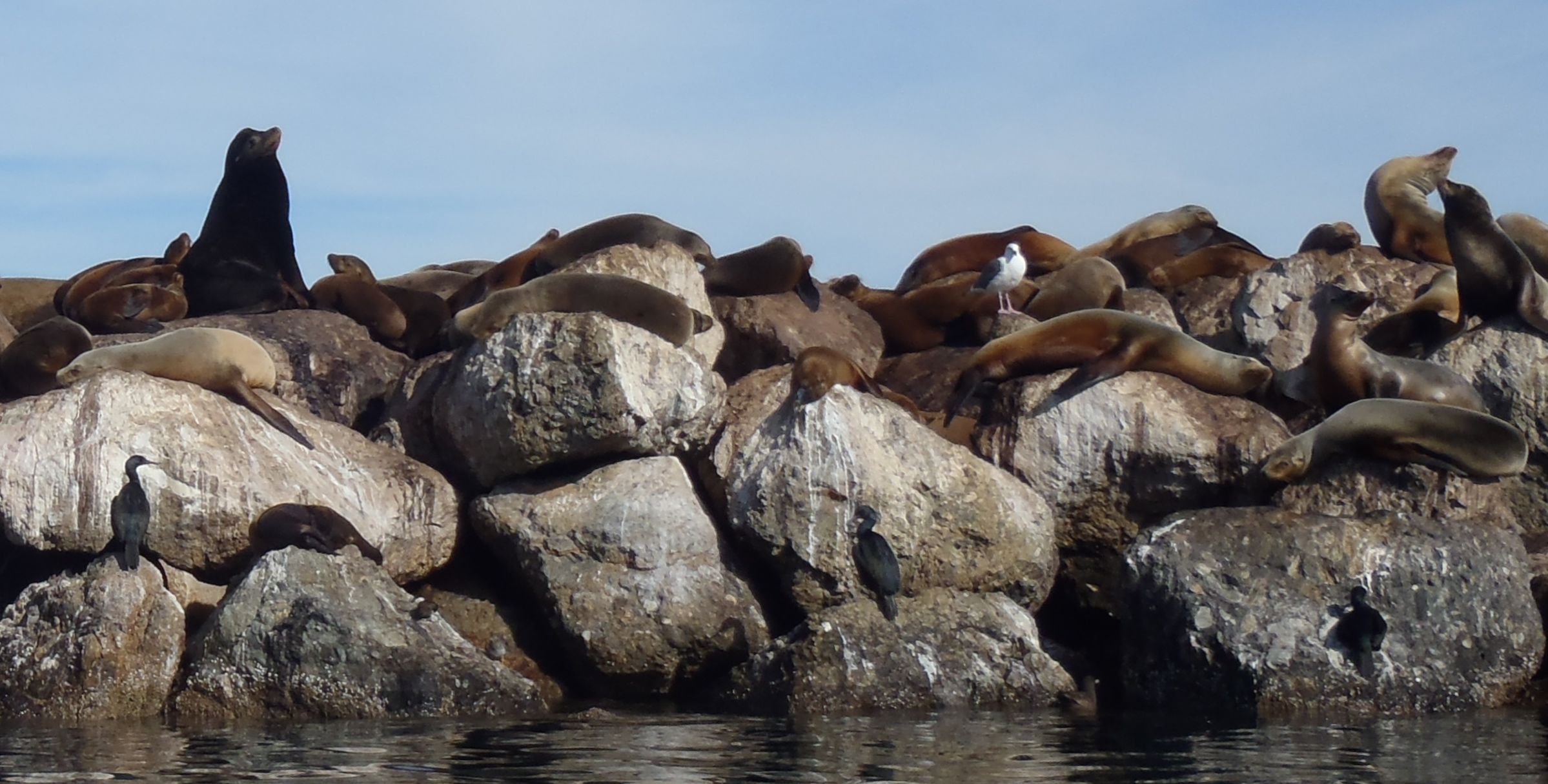
January 2013
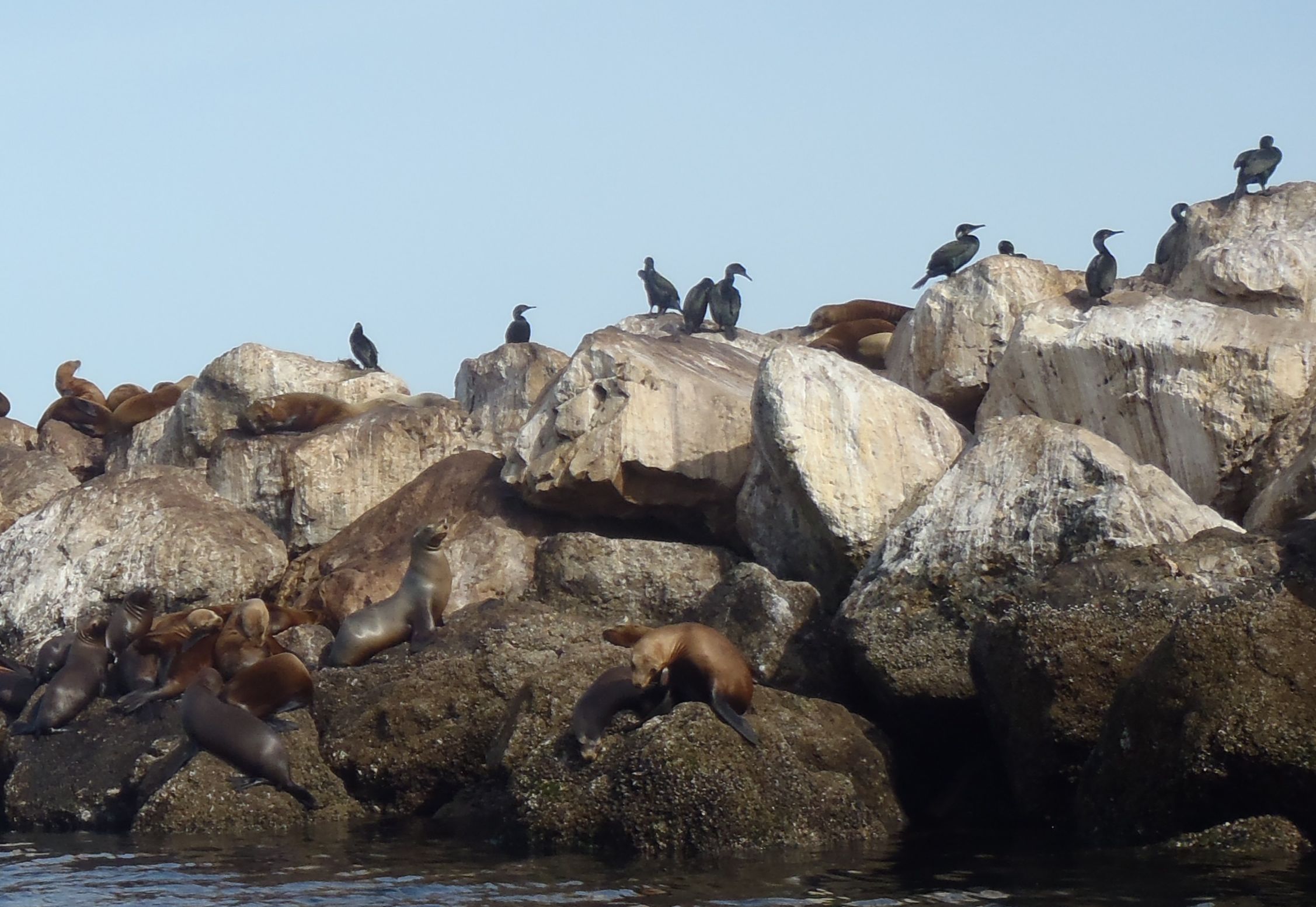
March 2013
It’s spring.
Do you know your gulls?
All winter I’ve been working on learning to identify our local gulls. So far I’ve learned that it’s really challenging! The difficulty comes from not only recognizing different species (15+ commonly visit our area), but also different year classes within a species (there are 3 or 4 four classes each with different plumage, bill and leg colors). In addition, individuals vary and gulls crossbreed (mixed species really confuse matters). But like all challenges, I’m taking fledgling steps and tackling one gull at a time. (I’ve always called these birds seagulls, but it’s more correct to use the term gulls because not all live near the sea, so I’m using gull/gulls in this post.)
To identify a gull, according to local birding instructor Brian Weed, start by identifying the age of the bird — Is it an adult or immature, and if immature, of what age class? (This isn’t intuitive. I want to start with what it is, not how old it is.) Once the age is pinpointed, then work on identifying the species (all before the bird flies off). Brian provided a simple illustrated guide showing the characteristics of age classes of species that mature over four years — years 1, 2 and 3 are immature and year 4 is an adult. (Of course, some species mature over 3 years instead of 4, a complication I’m ignoring here.)
And now show-and-tell time.  Along this railing are three gulls that look different. They are, in fact, birds of different ages. The farthest is a year 1 gull: It’s all brown from head to wing covers (coverts) to underside. The rump (which you can’t see) is the same color as the back, and the wingtips are a solid brown. The bill and eyes are dark. The closest gull is a mature (year 4+) gull: Its head, neck and underside are all white (no dark streaks or smudges). The tail and rump are also white (easier to see in the photo at the start of this post). The back and wing coverts are dark gray. The bill is yellow and legs pink. The bird in the middle is of an age class between the other two birds (nice of them to line up this way for me). It’s head, neck and underside are mostly white. The back is dark gray, but the coverts are brown. The bill is pale with a darkish tip and legs pink. This middle bird is between the ages of the other two, either a year 2 or year 3 bird (I know, not exact, but this isn’t rocket science). It’s probably closer to year 2 because the back and coverts are different colors.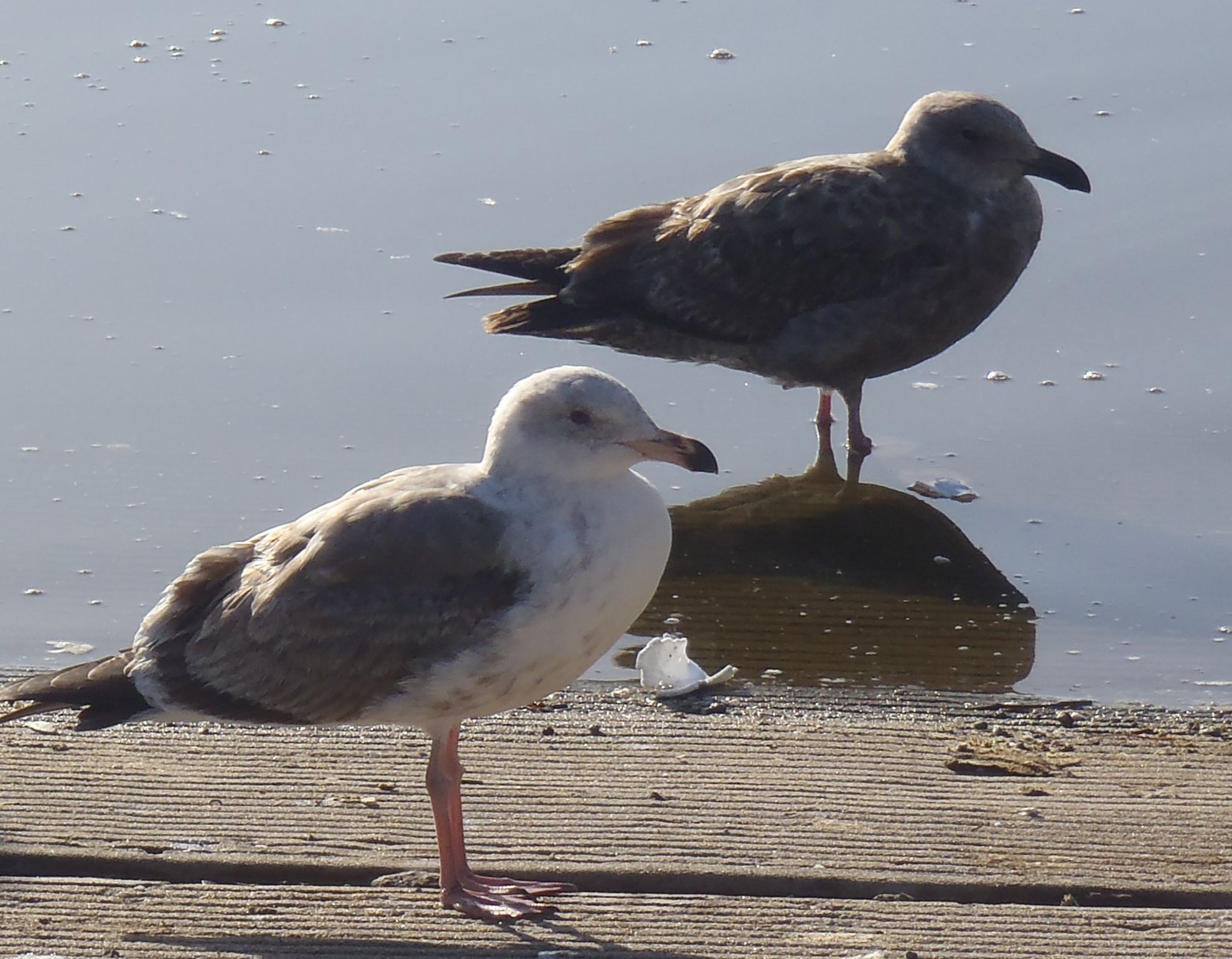
Here’s another shot of two immature birds at the same location. The farthest is a year 1 bird. The closest has the back and coverts characteristic of a year 2 bird. (Making an ID is so much easier when they’re standing than when on the fly.)
If you haven’t guessed already, all of the birds shown so far are western gulls. The giveaway for me was the similar size of the adults and youngsters in this group, and the adults’ white head, yellow bill, dark gray back and pink legs. Also, they’re the most abundant gulls here.
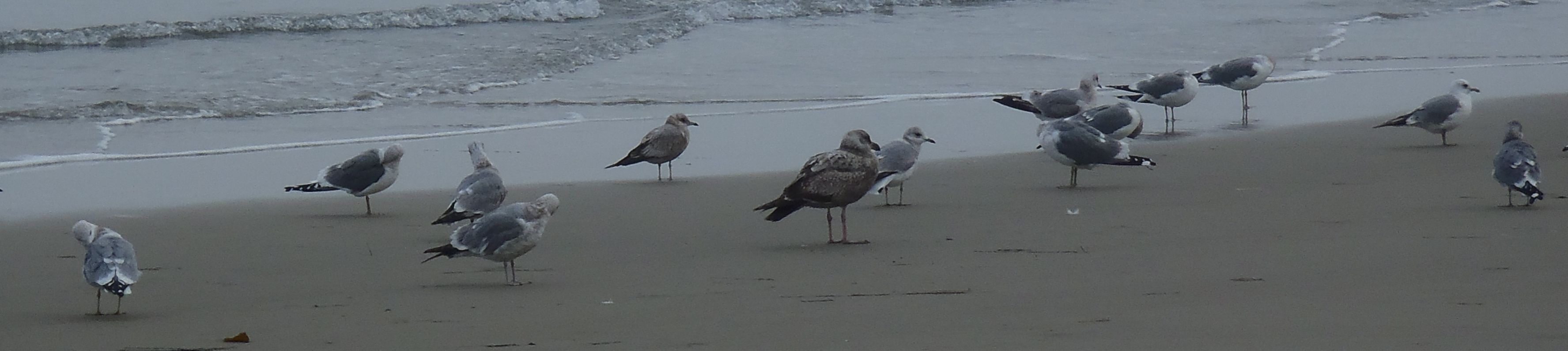
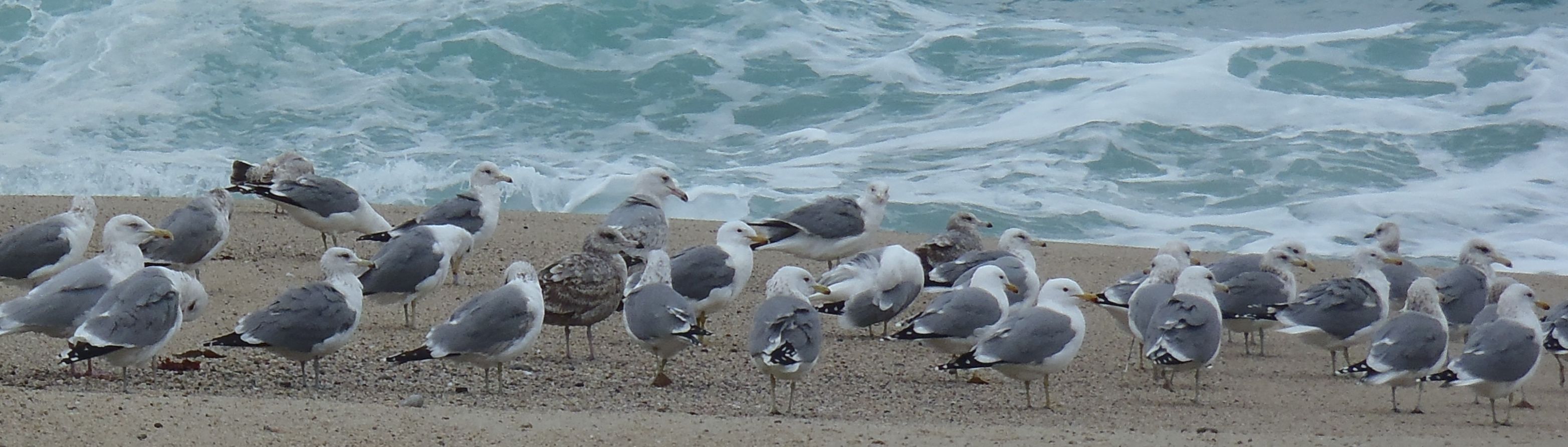
Now it’s your turn (if you want to join my challenge). Remember: Age first, then species. Can you distinguish between the adult and immature birds in these shots? Click on them to get a closer look. (Unfortunately, they didn’t cooperatively line up by age.) To help you focus on age, I’ll divulge that there are California gulls, western gulls and mew gulls in these shots.
~~~~~~~~~~~~~~
Resources
Don Roberson’s Creagrus website: Gull Subfamily
Also, Creagrus California List (with photos): California gulls
Santa Cruz Bird Club: Identifying Gulls
Also via Santa Cruz Bird Club, Morlan’s Flowcharts for Identifying Gulls (without pictures though)
Another odd goose
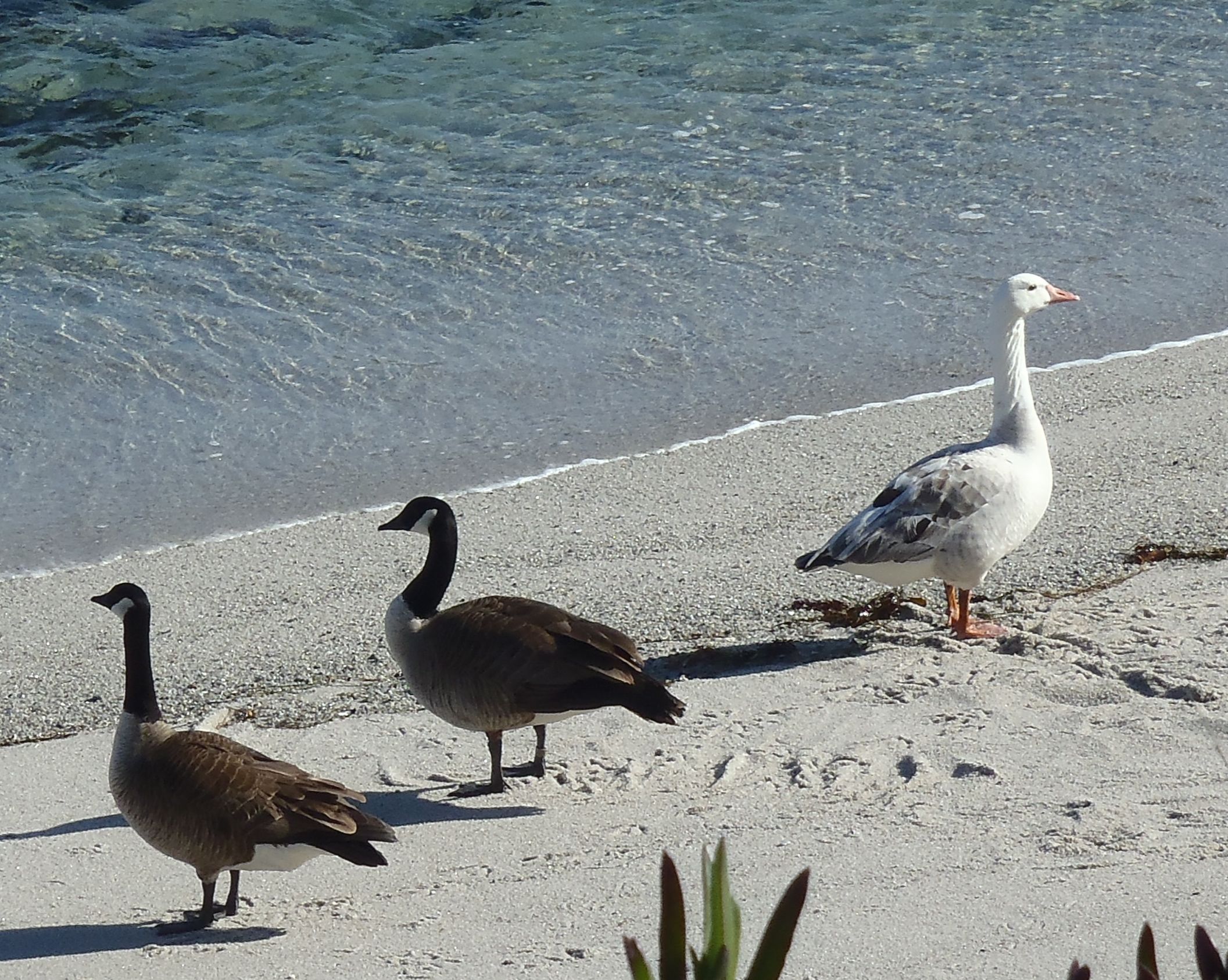 This is the second goose in a week that has tested by fledgling bird identification skills. I took this shot at the Hopkins Marine Station beach while watching the snoozing harbor seals. This goose, as you can see, is about the size of the Canada geese, but is more white than those birds or the one I showed you in my Carmel Bay walk post. Another Canada goose hybrid maybe, or an escaped domestic?
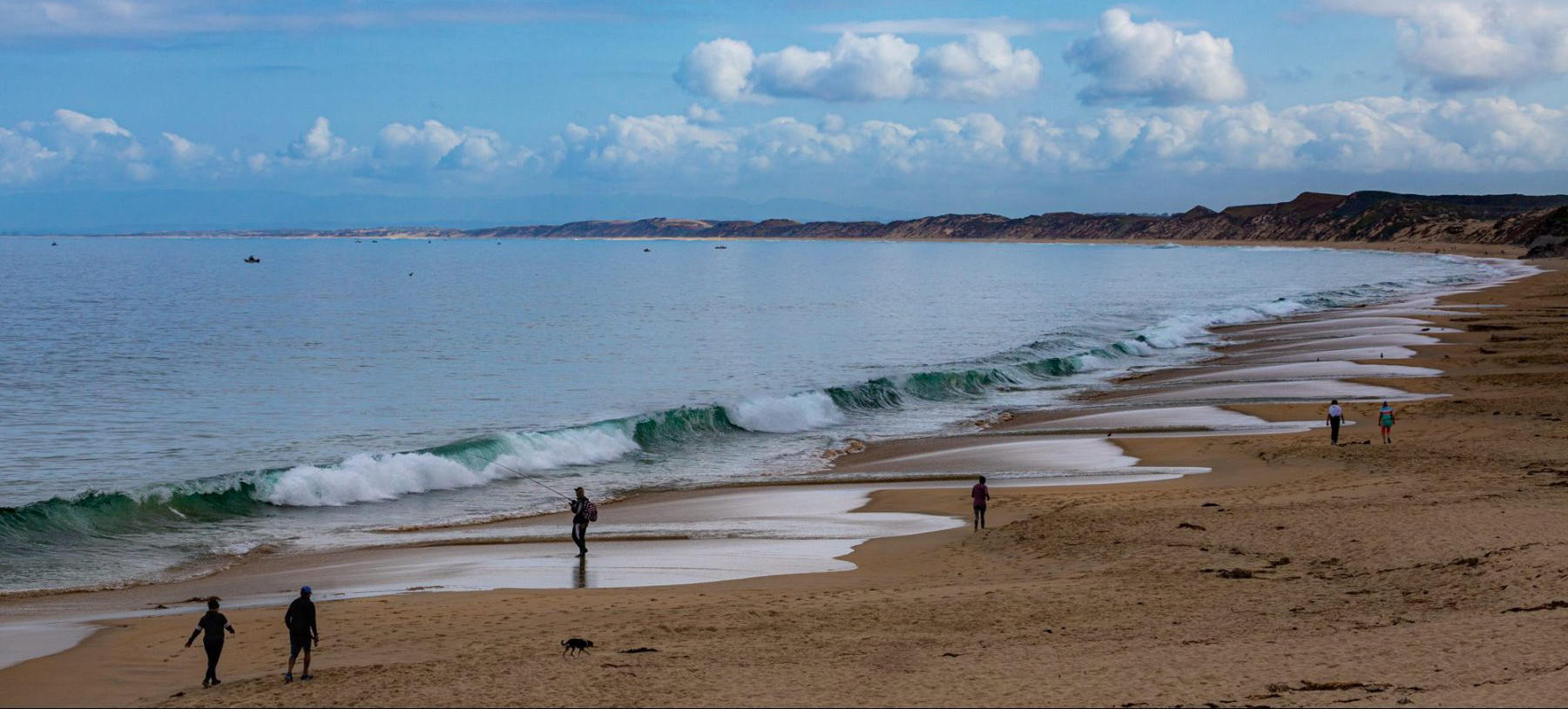
A long walk at low tide
Rain is on its way (winter has barely visited this year) and so I took a long walk to enjoy a pre-stormy bay and this week’s daytime low tides. It was cool, and the sky and ocean were soft gray (not unusual here). 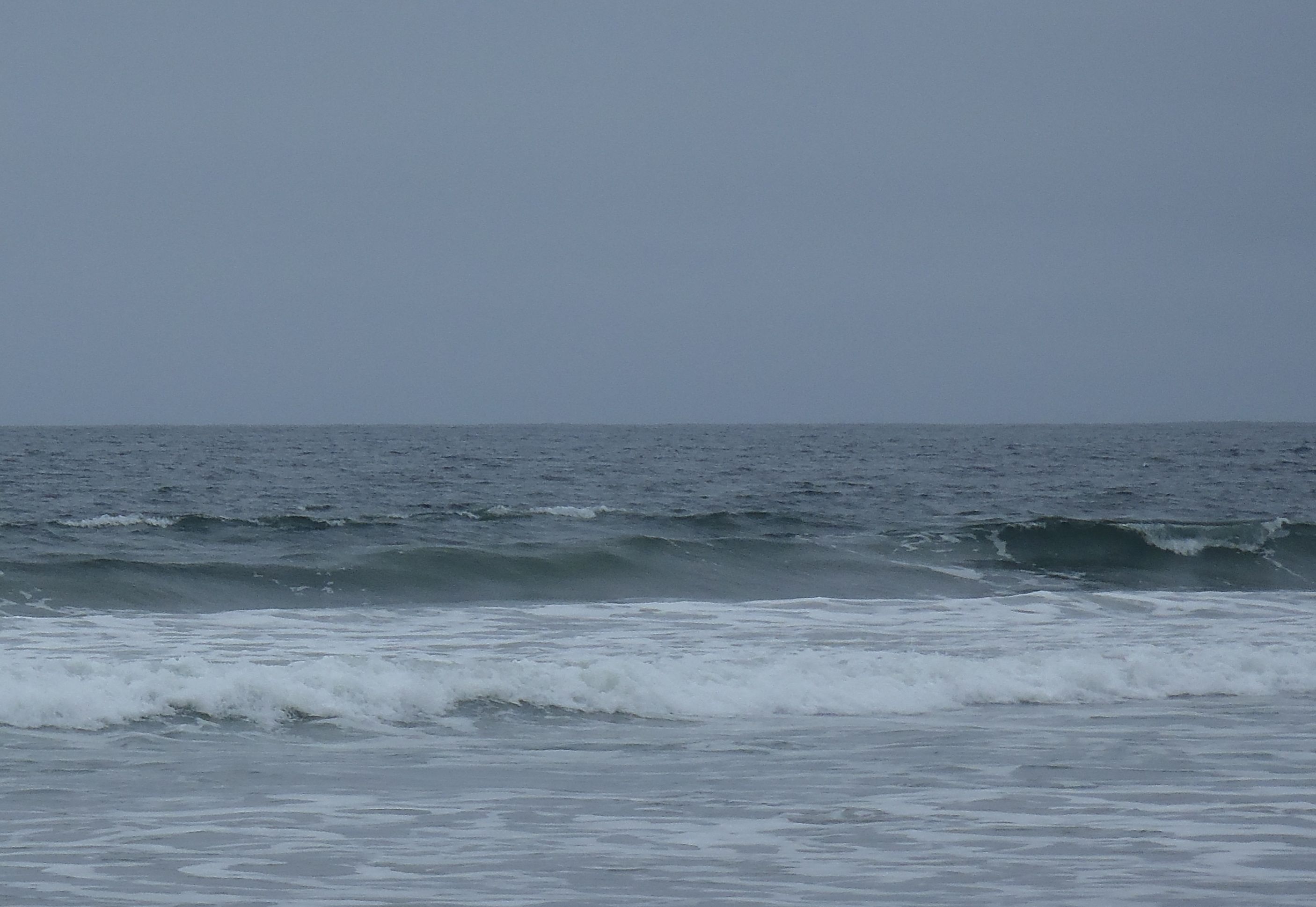 My walk started on the sandy beach below Del Monte Dunes in Monterey and ended on Moss Beach (where Asilomar State Beach meets Spanish Bay) in Pebble Beach — a lovely, easy 10-mile trek. Between the two stretches of beach are the rugged, rocky shorelines of Monterey and Pacific Grove.
The joy of a cloudy Monday in March is that the beaches and shoreline paths are mostly devoid of people. When bay beaches are deserted, turkey vultures are busy inspecting the coastline for a meal. Today was no exception. I happened upon one vulture working on a seal carcass and I stopped to watch it for a while. (Visit an earlier post for more about vultures.) I’m fascinated by such a scene because of its tenuous thread to a time when large animals frequented these beaches, when condors and bears scavenged beached whales. Not that I’d want to encounter a bear on the beach, but I feel the loss of such scenes forever gone. The mood was soon broken when a jogger bounced by, oblivious to the interruption, and the vulture took flight.
At the Monterey Harbor I walked down the Coast Guard pier and breakwater (see an earlier post for more about the harbor) to check on the sea lions and cormorants. 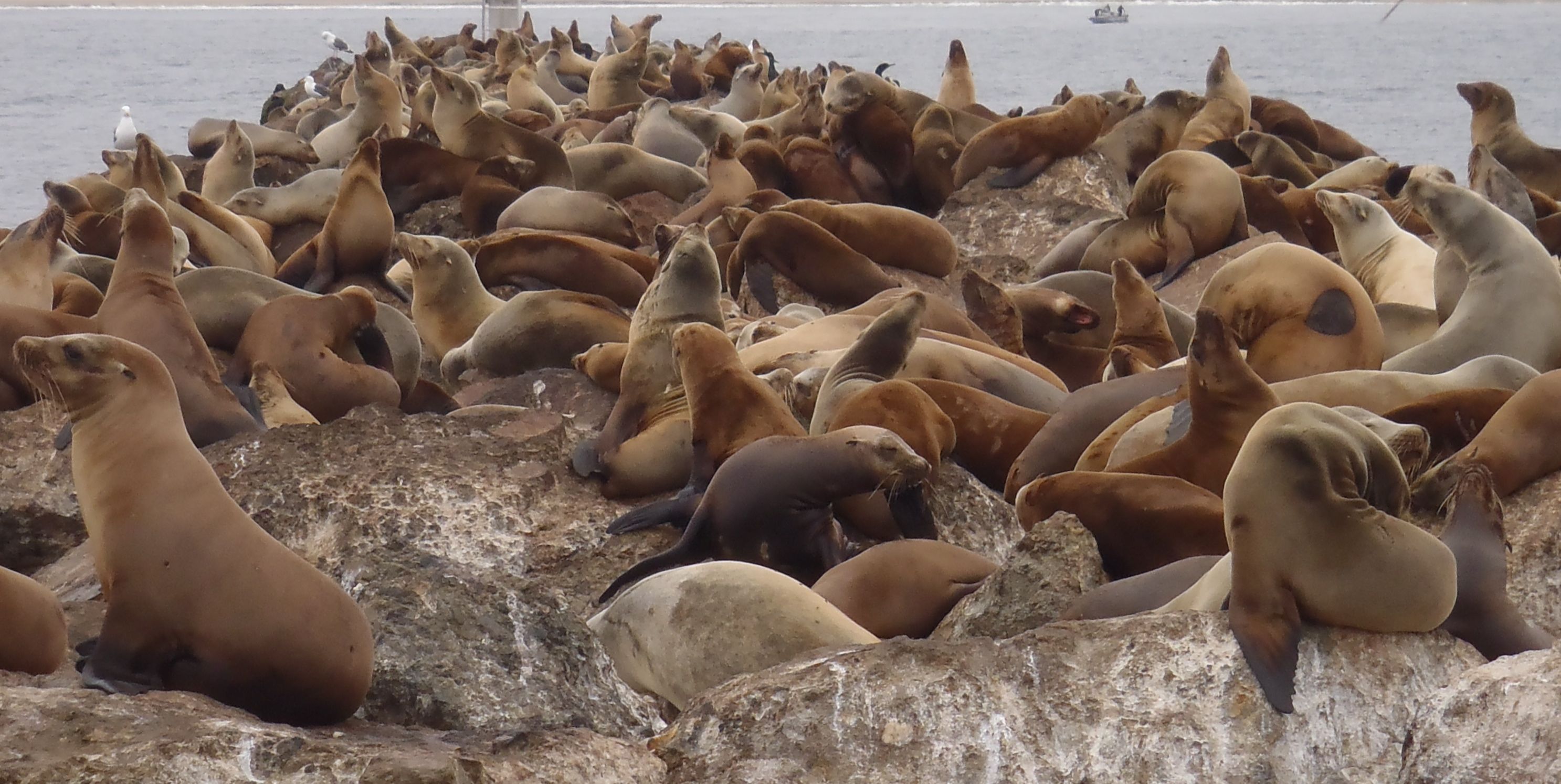 As usual, there was a roiling sea of sea lions, edgily jockeying for space and position. Unlike past weeks though, the rocks sported more gulls than cormorants. This was true for my entire walk and I’m still wondering were the cormorants had gone.
As the tide ebbed all along Monterey’s rocky shoreline, birds searched among rocks for tidbits —  turnstones and surfbirds along the breakwater, snowy egrets in harbor shallows, gulls and crows everywhere. With predators afoot and life-supporting water temporarily gone, sea anemones had collapsed, muscles shut tight, and snails and barnacles closed their doors. It would be a few hours before the invertebrates would be free of the pesky, poking birds. But it offered me great glimpses into the rough and tumble world that I seldom see on the wave-washed rocks.
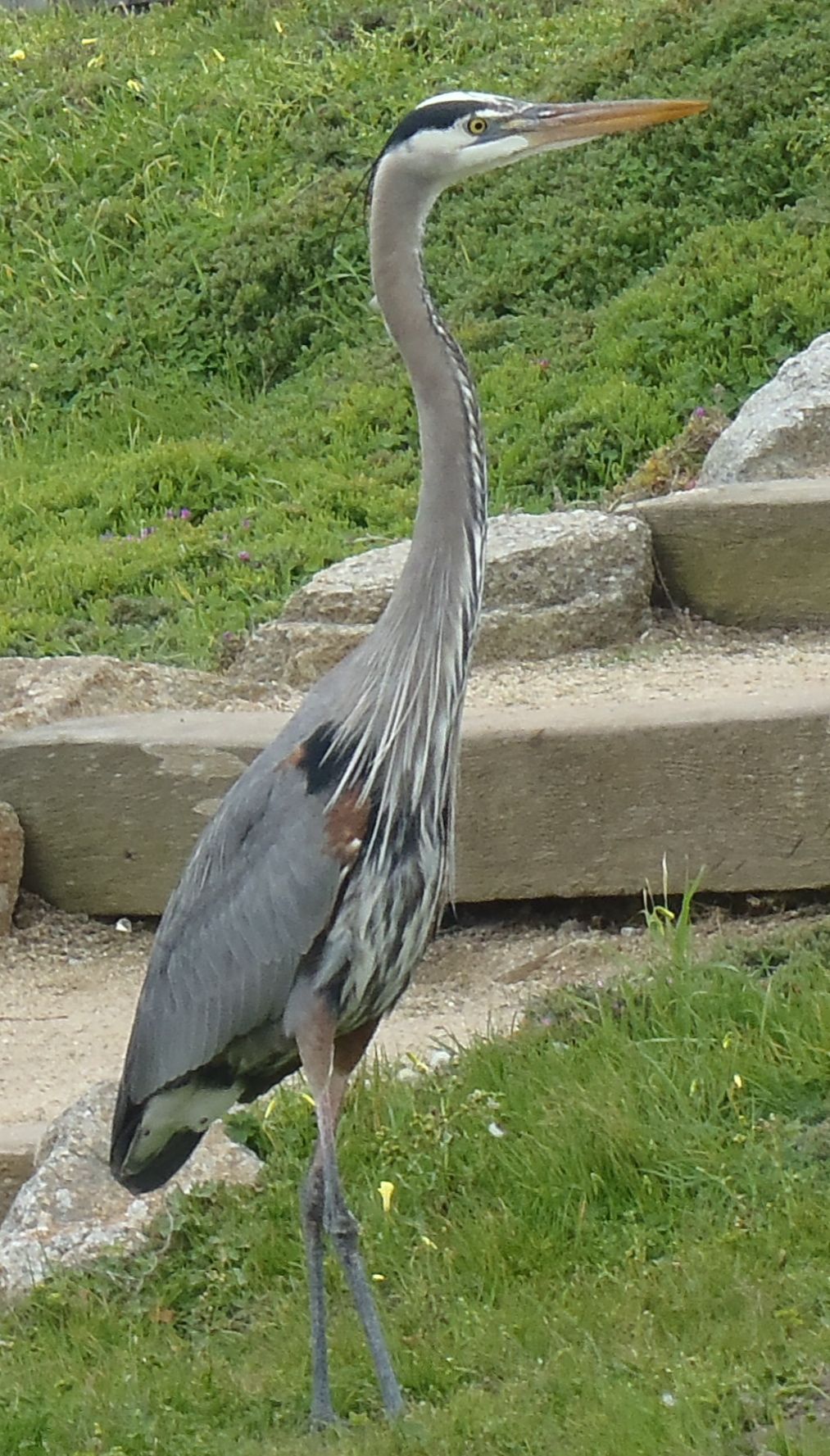 Farther along in Pacific grove, while watching the waves crashing on the rocks to my right, I was surprised by a great blue heron between my path and the coastal road on my left. It strolled majestically, noticing me, but showing no alarm. Cars stopped and took photos. I stopped and took photos. It didn’t seem to mind any of us, as if this was an everyday occurrence. I was delighted to have such a large stately bird beside me. They’re surprisingly tall — growing to 46 inches (117 cm). Normally when I see one, its neck is pulled in and it’s flying away after I’ve interrupted a hunt or disturbed a resting spot.
  The other impressive bird that I encountered was at the Pacific Grove Golf Links, which has a freshwater pond (Crespi Pond) at Hole 17. The pond is normally a haven for American coots, but today a graceful great egret stood at the pond’s edge. I often see them fishing atop the kelp beds as I paddle past in my kayak. Getting this close was a treat. This walk was becoming a great one for sighting wading birds.
Just past the golf course, I officially walked out of Monterey Bay. Point Pinos marks the southern end of our “sheltered” bay (although much of the bay isn’t very sheltered) and the start of a shoreline exposed to the full force of the Pacific.  On a hill overlooking the point is the Point Pinos Lighthouse, the oldest operating lighthouse in California, which began warning seafarers in 1855 and is still working. Around the point and past a few amazingly expensive houses, I picked up a great coast walk trail, part of Asilomar State Beach, that meanders along one of the most beautiful sections of the Monterey Peninsula’s coastline. At low tide, the coves and pools are delightful; at high tide, the winter surf is spectacular. At the end of the trail I was tiring and a chilling wind started to blow, and so, on Moss Beach I ended my walk.
I encourage you, wherever you are, to go out and get to know all that lives around you. Take a short or long walk and a long look. 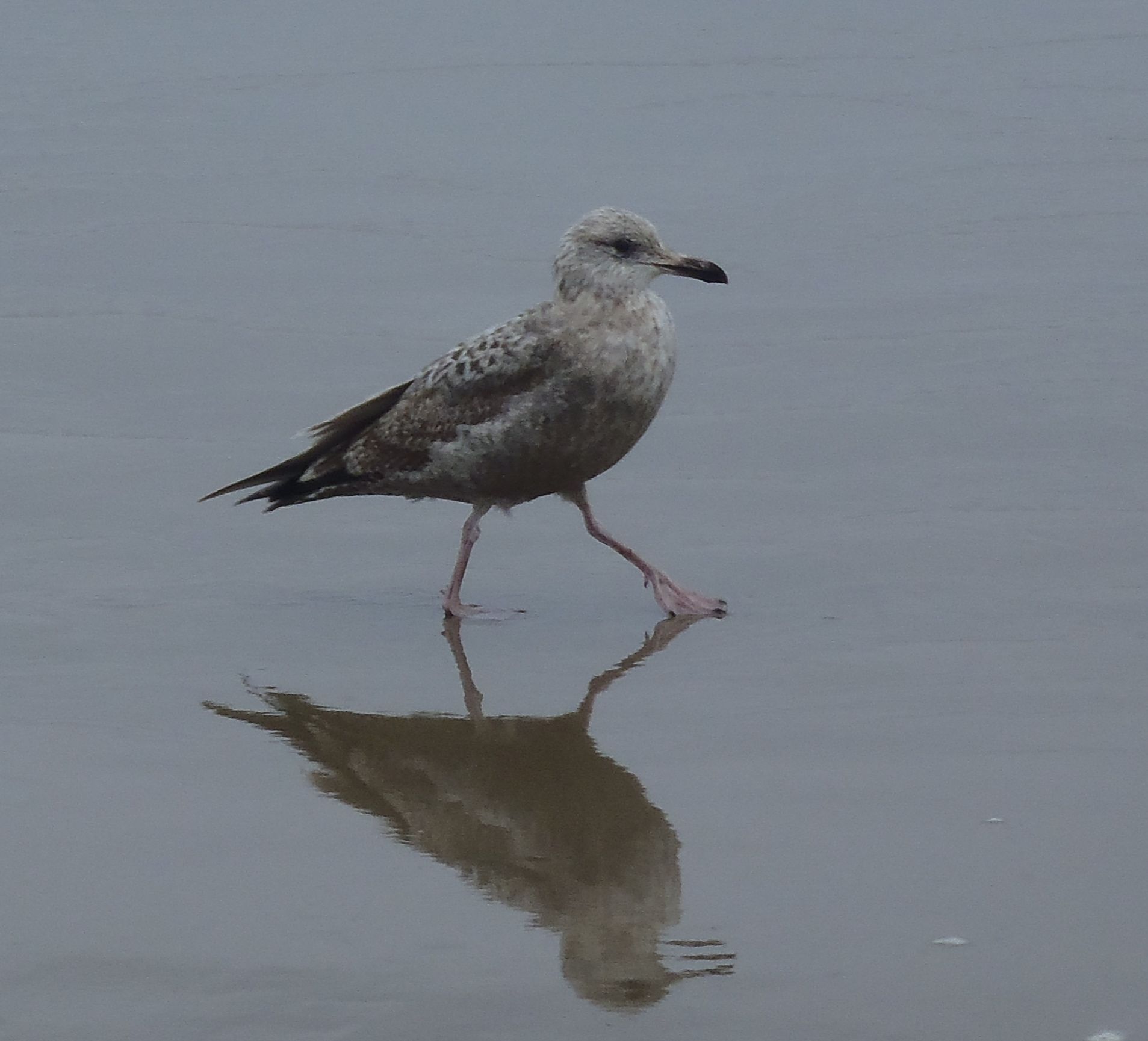 I’ve lived here for nearly 30 years, but with each walk and paddle, I see animals and interactions that are new to me. That’s exciting. Although it’s great to learn about wildlife via books, images, lectures and blogs, it’s not the same as having a heron stand before me, a baby sea otter cry for mom next to me, or a seal catch a fish in front of me. Cherishing our wild neighbors (whether we like them or not) and protecting their homes (which is also our home) is the best hope we have for our future on this planet.
~~~~~~~~~~~~~~
Resources
Monterey County Parks & Beaches: List and interactive map
No news update
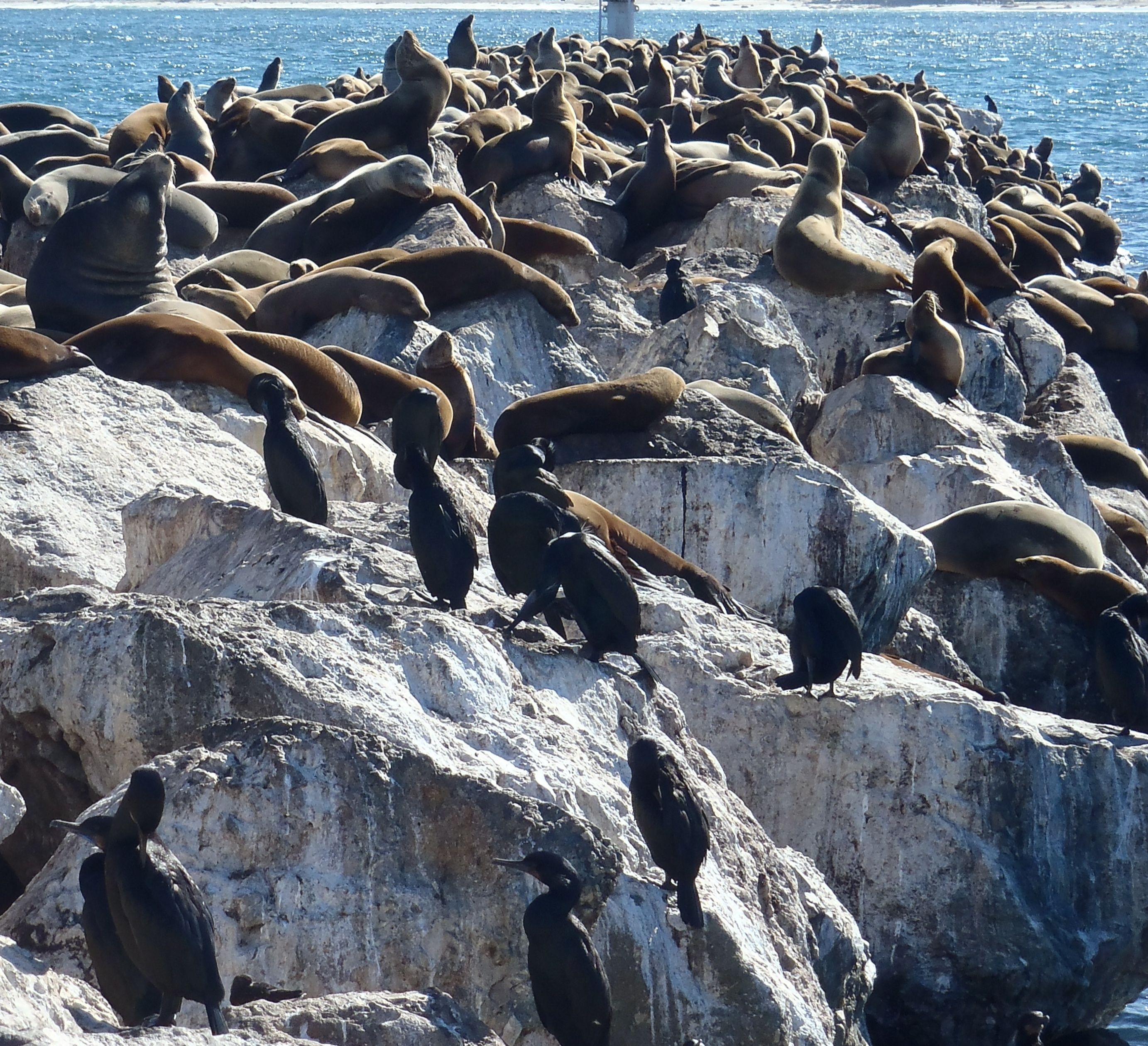 Spring has blown into the bay with strong northwest winds (our springtime signature). For more than a week winds have been fairly steady – at up to 30 mph (26 knots or 48 km/hr). It’s been nice for sailing and kite-flying. Not so for kayaking, hence I enjoyed a beach walk yesterday. First, I checked the breakwater for progress on the sea lion-cormorant tussle, and not much has happened since my last post.
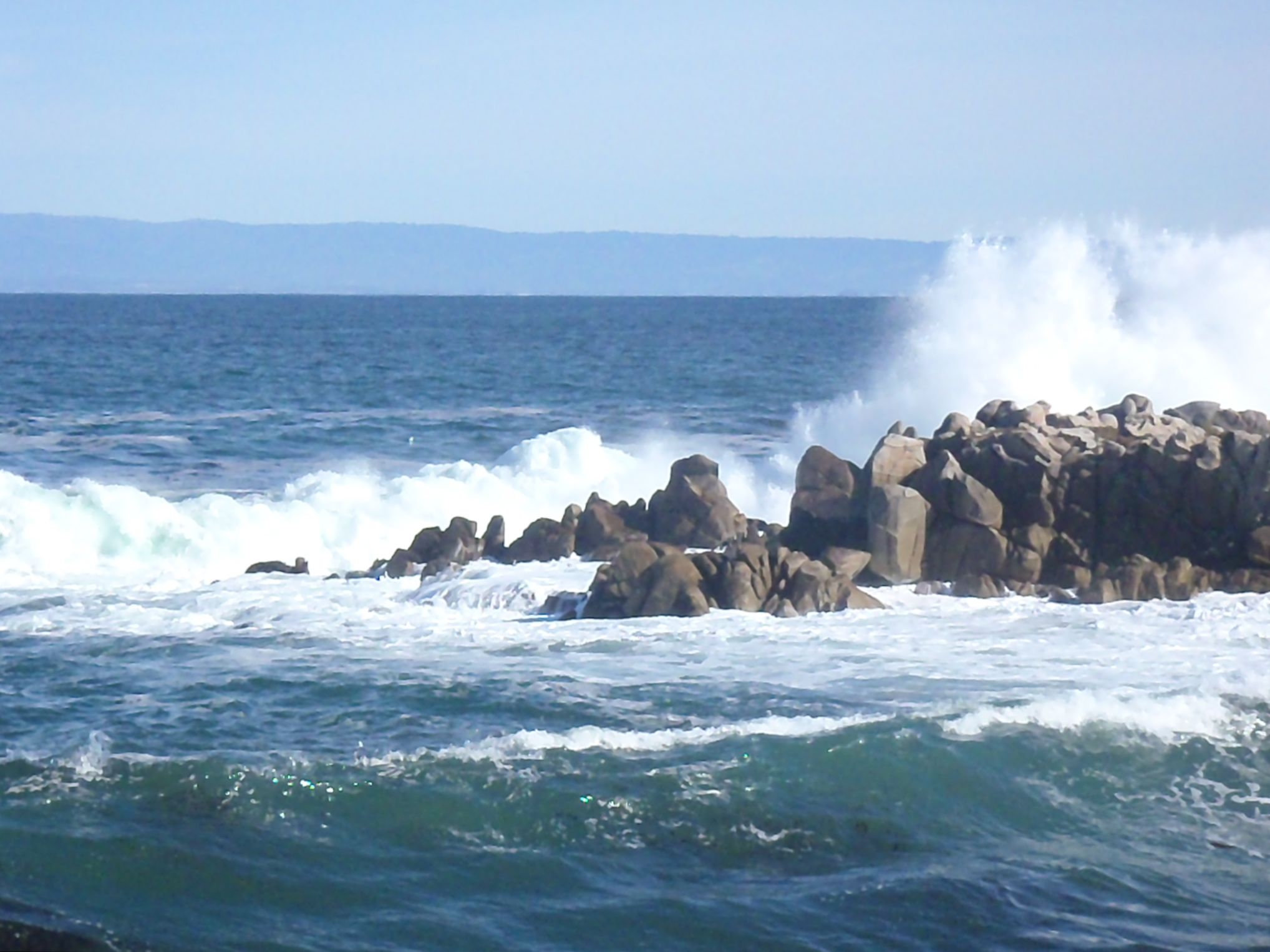 The steady blow, along with large swells, has ruffled the bay, and I think kept the birds grounded. They haven’t been able to gather nesting materials. Winds will be calmer this week, closer to 10 mph (about 9 knots or 16 km/hr). It will also be sunny and there’s no rain in the forecast for a while. The cormorants should be able to get back to work.
I also strolled by the harbor seals on the west beach at Hopkins Marine Station. 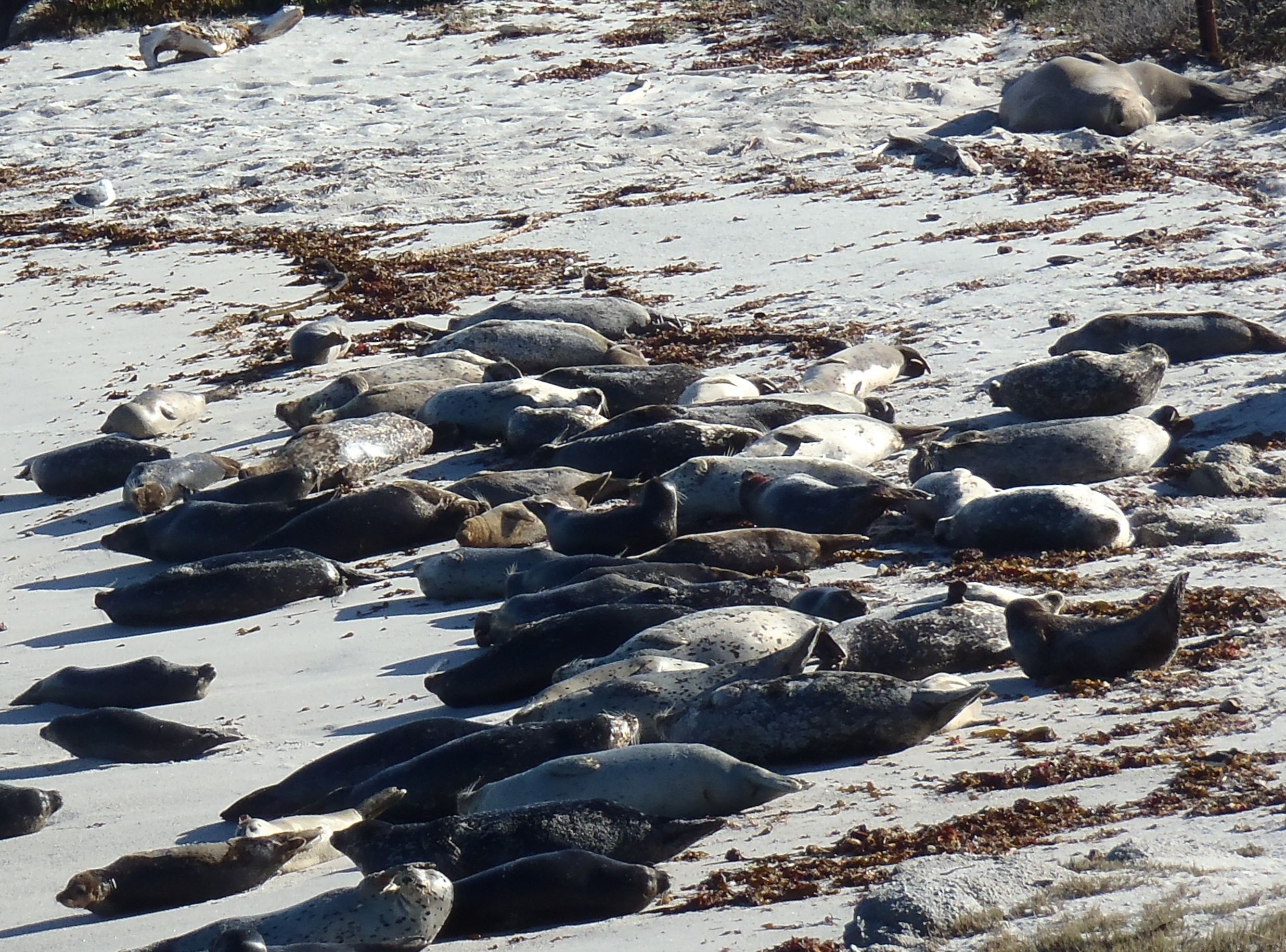 No births yet. It’s still a bit early, but with the sunny, rainless winter we’ve been having, who knows? Sharing the warm beach was the regular lone elephant seal (in the upper right corner), snoozing away. The much smaller harbor seals give him plenty of space.
Even though not much had changed since my last visit, it was a good day for a walk.


 WordCraft.NatureFocus