
Latest jelly mystery
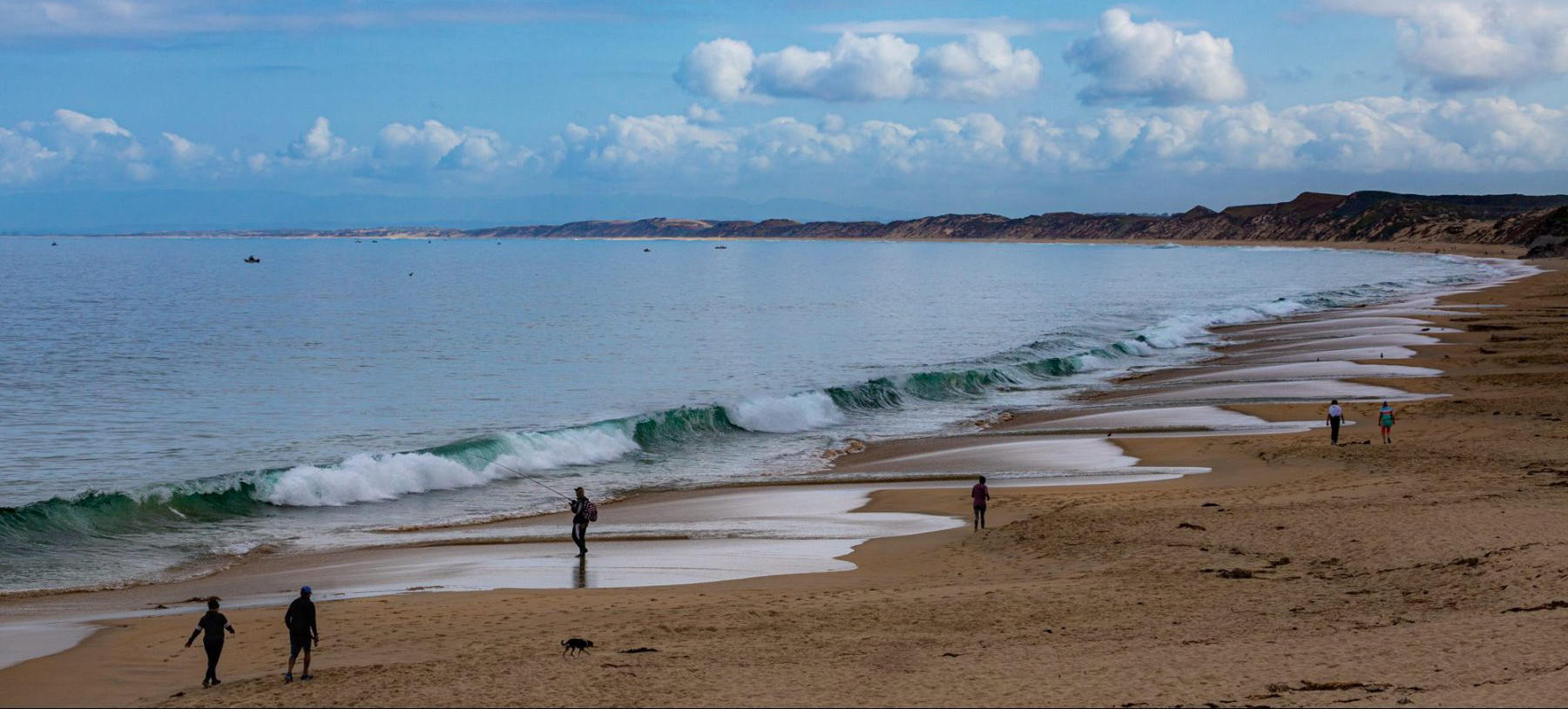
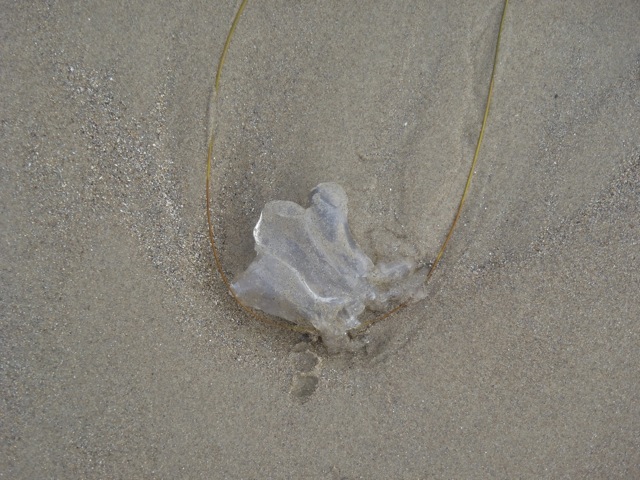 I didn’t expect to write so much about jelly blobs, but they’re common on beach walks and the mystery of what each is when alive fascinates me. (Here are links to my earlier blogs about not all beach blobs being jellies and more jelly blobs). Because I seldom find the entire animal, I must do some detecting and use the clues at my feet to figure out what I’m seeing. The latest gelatinous bits showed up in late summer and have continued to wash onto the beach (mostly Monterey’s Del Monte Beach). The mystery — what are they?
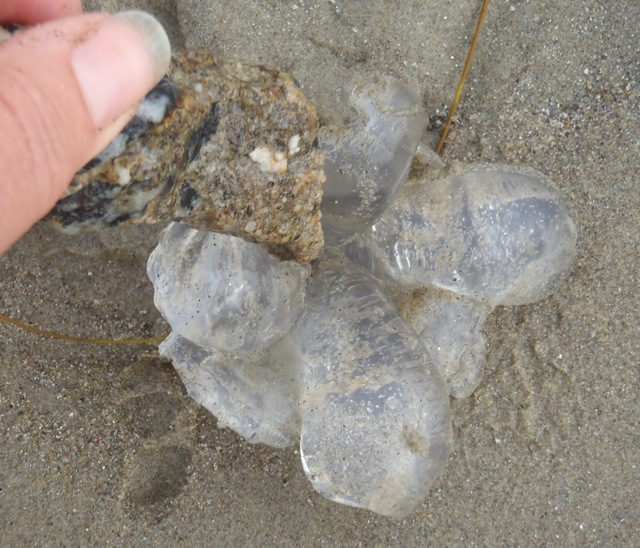 These blobs are unusual in that they’re not loose jelly. They have substance, like silicone, and structure, like the petals of a gel flower. At first I thought they were human-made refuse (common on our beaches, too), but as I encountered more over the weeks, I began to think their origin was organic. Yet the shape and structure were foreign to me and the clues as to the creature were minimal.
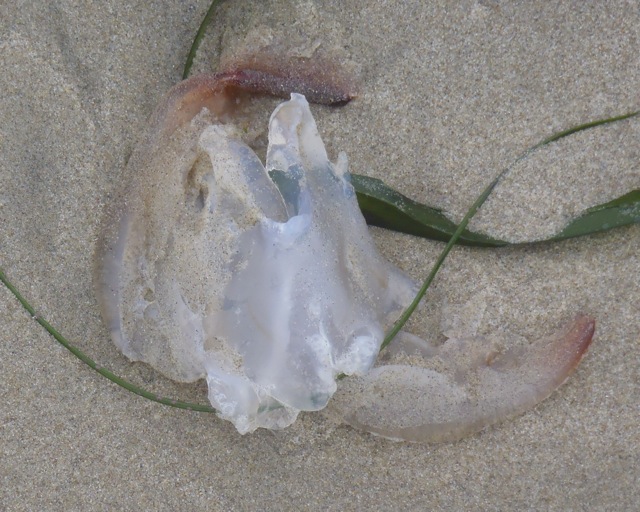 Then I happened upon a few that were more than just flowerlike cups — they had flaps with color. Helpful clues. The flaps were more jelly-esque and the color was brownish. I started to conclude that I was seeing some part of a jelly (jellyfish). But which part? And which animal? A golden-brown jelly common in Monterey Bay is the sea nettle (Chrysaora fuscescens). Could that be the source?
The “true” jelly (class Scyphozoa) appears to be mostly bell, arms and tentacles. On the beach, I usually find bits of bell. However, there’s much more to a jelly. As hard as it is to imagine, jellies have senses, muscles and a digestive system.
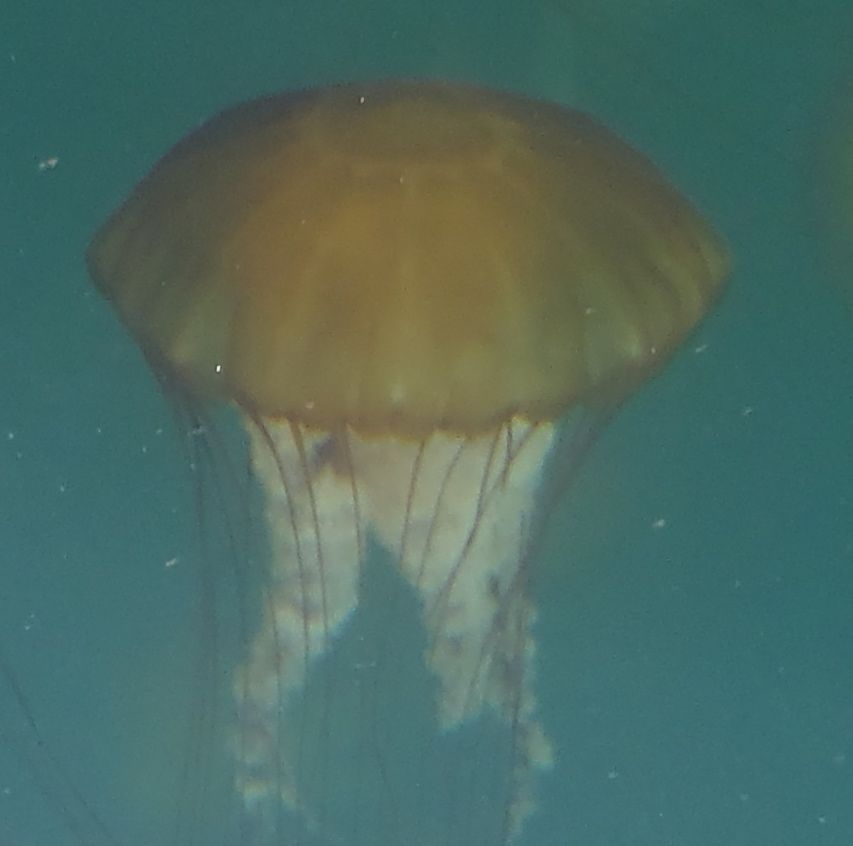 They’re adept predators. Once prey are zapped by tentacles covered in nematocysts (stinging cells), the jelly digests and absorbs the nutrients for distribution to the rest of the body. The body of the sea nettle has frilly oral arms, which transport food toward a mouth inside the center of the bell, or if the food is too large, the arms digest it and transport the nutrients. Such a jelly has an amazing digestive (gastrovascular) system for catching and distributing necessary nutrients.
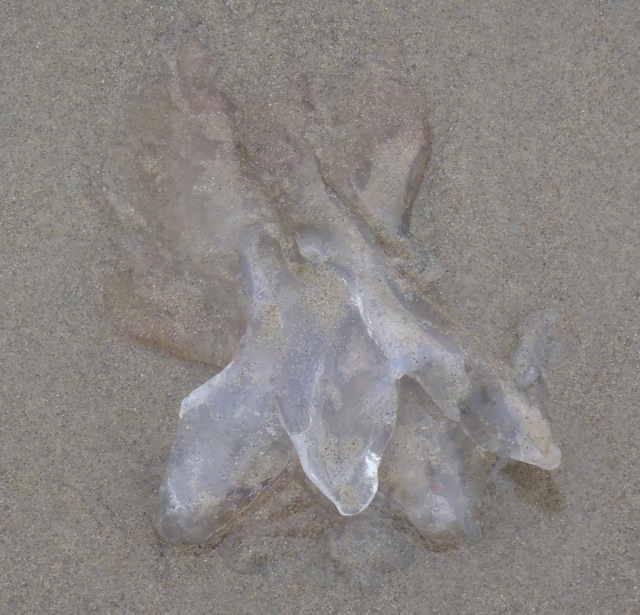 I think what I’m looking at is the central stomach structure (manubrium) from inside the bell that’s connected to the oral arms. Because of the color of what’s tossed on the beach, I’m guessing these are manubria from sea nettles. But, I could be totally wrong. I’m not a jelly morphologist and interpreting clues doesn’t always lead to a correct conclusion. If any marine gelatinous-life experts read this, I’d love to hear what you think these are. (Thanks.)
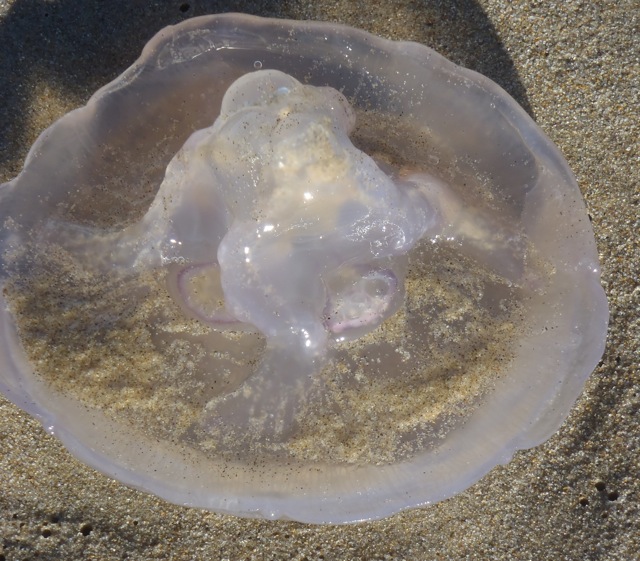 Update 12/22/13: Today I took this photo of a mostly intact moon jelly (Aurelia sp.) on Monterey State Beach. This animal is upside-down (top of bell on sand with underside up). You can (at least I can) clearly see the parts that hang under the bell and include the mouth area and manubrium structure. This looks very much like the mystery structures that I’ve been finding on the beach. Mystery solved!
~~~~~~~~~~~~~~~~~~~~~~
Sources
Note: Errors in this post are my own misinterpretations of these excellent sources. CP
Cronodon: Building Bodies of Jellies/Jellyfish
The JelliesZone
Wrobel, D. & Mills, C. (1998). Pacific Coast Pelagic Invertebrates: A guide to the common gelatinous animals. Monterey, CA: Sea Challengers and Monterey Bay Aquarium.
Resources
Abbott, D. P. (1987). Observing Marine Invertebrates. Stanford, CA: Stanford University Press.
Aquarium of the Pacific: West Coast Sea Nettle
Brusca, R. C. & Brusca, G. J. (1990). Invertebrates. Sunderland, MA: Sinauer Associates, Inc.
Monterey Bay Aquarium: Sea nettle
Monterey Bay Aquarium: Moon jelly
Wasted. What is happening to the sea stars of the NE Pacific Ocean?
Great overview and important information to know about sea star wasting. Chris
Bonaparte’s gulls on the wing
 This week I’ve been practicing with my new camera on a lively group of Bonaparte’s gulls (Chroicocephalus philadelphia). They’re great subjects — gliding, banking, dropping to the water, rising with a morsel — doing it all close to me, elegantly and not too quickly.

Bonaparte’s gulls have migrated from Alaska and northern Canada to spend the winter along the U.S. west coast to Baja (also in the U.S. southeast). The group I’ve been photographing has taken up residence in Monterey at El Estero (a small lagoon on the coast). These birds don’t have the black heads of breeding season.
 Adults are in non-breeding plumage with pale heads and gray backs and the first-winter birds have dark streaking on wing coverts. (Can you find them in the photos?)
These little gulls may stay a while or move on. In the meantime, here they are on the wing.


Dungeness crab season
Dungeness crab
Credit: NOAA MBNMS
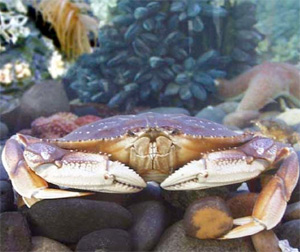
Today is the opening day of California’s sport fishery for Dungeness crab. The 2013-2014 season runs from November through June. We don’t get much happy environmental news these days and so it’s nice to write about an abundant local animal whose population is healthy and fishery sustainable. Dungeness crab (Metacarcinus magister, formerly Cancer magister) is a favorite of mine, not so much for the eating (which is good), but for observing. This summer thousands (my rough estimate) dotted our beaches. They were a constant companion that fascinated me during long beach walks.
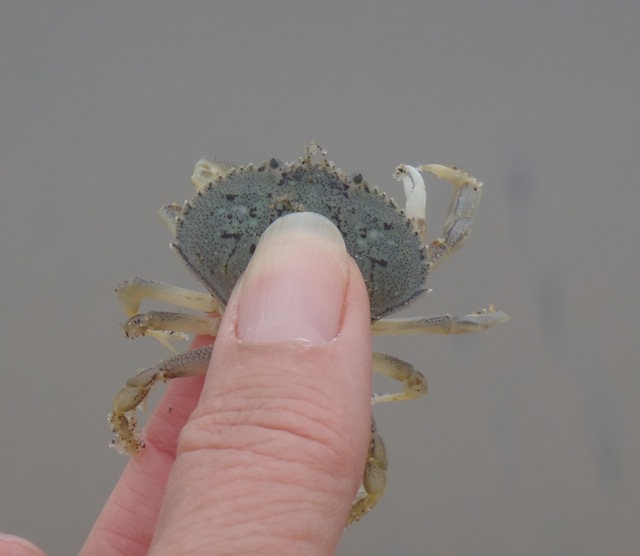 Most of the “dungies” that I encountered on sandy beaches were small — the carapace about an inch (2.5 cm) across. That’s nowhere near the 5.75-inch (14.6 cm) minimum size for the fishery or the full-grown 9-inch (23-cm) adults. These little dungies were juveniles somewhere around 1 to 2 years after hatching.
 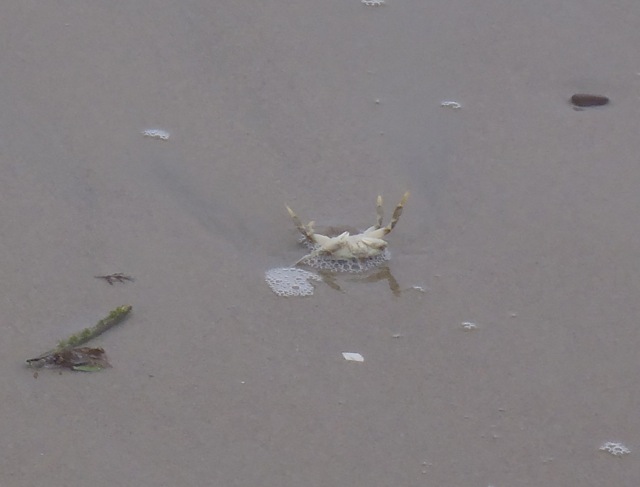 Littering the beaches I found mostly live hard-shells and soft-shells, and later in the summer, discarded molts (it’s sometimes hard to tell the difference without handling them – carefully). Little crabs on their backs kicking wildly appeared very much out of their element.
What were all these lively crabs doing on the beach at my feet?
Dungeness crabs hatch from eggs — a mature, berried-up female may carry as many as 2.5 million. Upon hatching, they drift as oceanic plankton for the first year or so, and develop into forms that appear nothing like an adult crab.  During the first two years they may molt (discard the old and grow a new shell) as much as six times a year. Upon reaching maturity, at about three years, the molts tend to decline to once a year. They can live six to ten years.
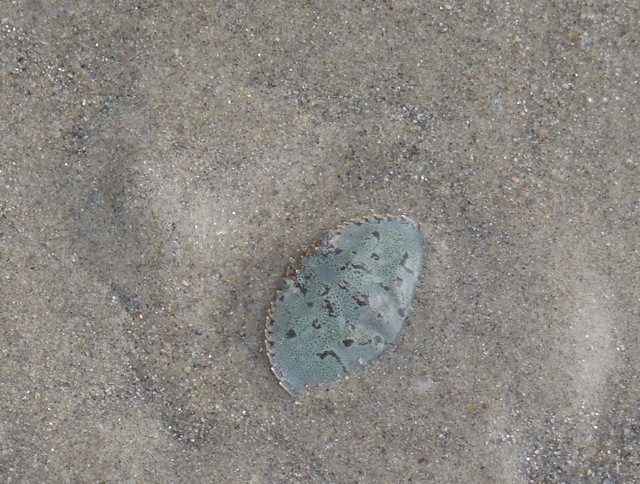 Juveniles live in protected, shallow waters of estuaries and sandy beaches with pier pilings and eelgrass beds. They find shelter by burying themselves in the sand. (I discovered that if I scooped out a little trench behind a live crab on a wet beach, it would quickly back into it and disappear. This proved easier, and safer, for me than tossing pinching crabs into the water.)
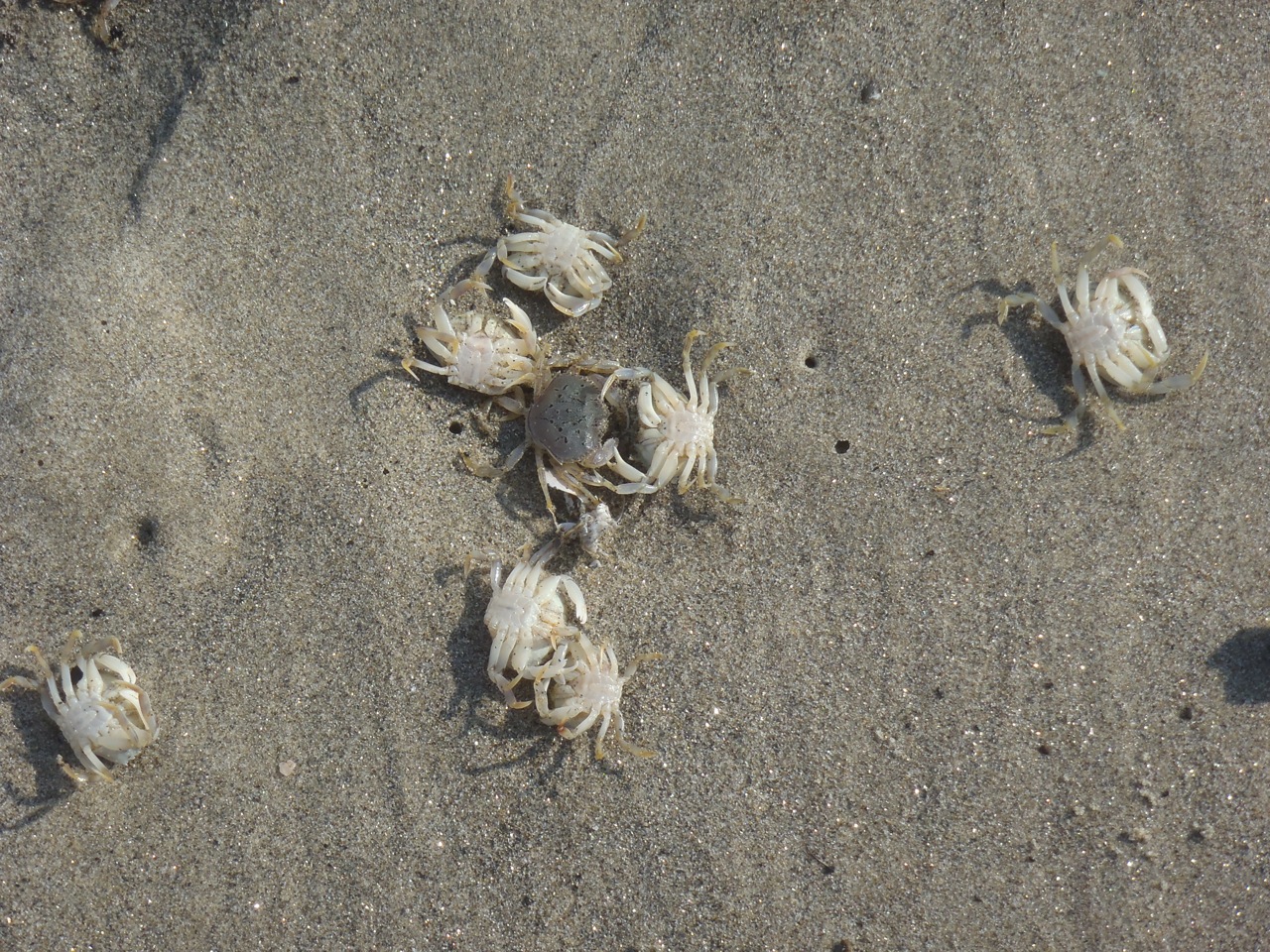 I think what happens along our beaches is that during the molt season the little crabs in the shallows get picked up by waves and tossed onto the beach or an ebbing tide leaves them high and dry. On the sand they’re vulnerable to hungry crows and gulls, the drying sun and playful children (although the claws even at that size are a great deterrent, speaking from a painful experience).
 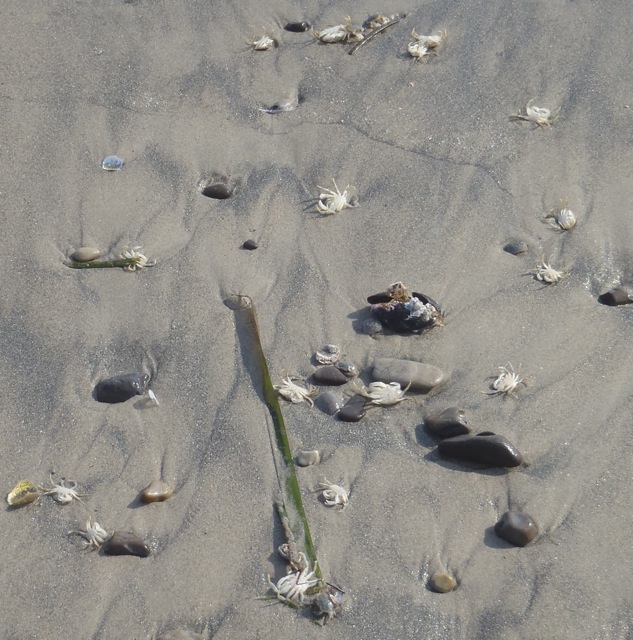 How a population can handle this kind of carnage, I don’t know. I can understand if the beach were littered with molts and a few live crabs were among them. The process must be grueling. It was obvious that there were a lot of molting juvenile crabs just off the beach, and synchronizing their molting surely helps individuals among so many to avoid predation. But I saw more struggling crabs on the beach than I did molts (until late summer). Maybe it’s an adolescent test, but it seems like a wasteful strategy. I’m looking forward to next summer (even with the fog). I want to see if this was the usual or an unusual year.
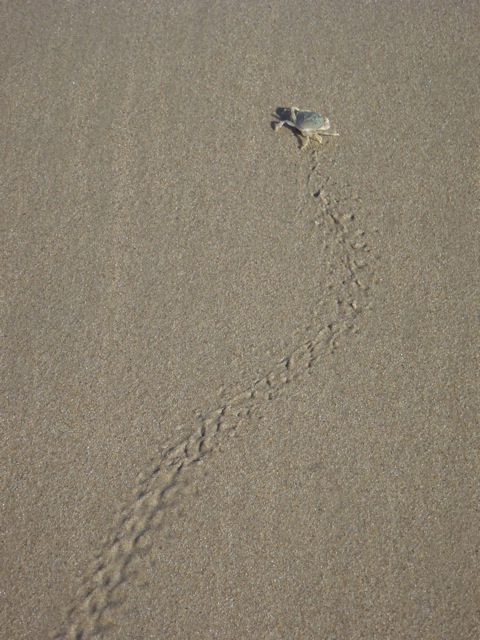 All summer the dungies kept me curious and entertained. I watched them, watched people interacting with them, photographed them, tossed them into the surf and dug many little trenches for them. On each walk I learned something new (like how to tell a Dungeness crab from a graceful crab – but that’s another post). Even though November is the start of Dungeness crab season for many here, as you can see, my favorite crab season is a summer watching dungies.
~~~~~~~~~~~~~~
Sources
California Department of Fish & Wildlife. Dungeness crab of California and its close relatives.
Encyclopedia of Life: Metacarcinus magister – Dungeness crab
Monterey Bay Aquarium Seafood Watch: Dungeness Crab
Morris, R., Abbott, D. & Haderlie, E. (1980). Intertidal Invertebrates of California. Stanford, CA: Stanford University Press.
Oregon Department of Fish & Wildlife: Life of a Dungeness Crab
Sept, J. D. (2002). The Beachcomber’s Guide to Seashore Life of California. Madeira Park, BC Canada: Harbour Publishing.
SIMoN (Sanctuary Integrated Monitoring Network). Species database: Cancer magister – Dungeness crab
Delights at a regional park

Great blue heron
I love walking the shoreline and taking in what the ocean has to offer each day, but sometimes I find delights elsewhere. Not far from the coast near me is Laguna Grande. It’s a 34.8-acre (14-ha) park with a 12-acre (5-ha) “lake” (most would consider it a pond) established in 1950, and defines part of the Monterey-Seaside boundary. I’m guessing that at one time it was a tidal estuary connecting to Roberts Lake (just across the street) and the ocean about a half mile (.8 km) away, but the building of Highway 1 cut off that flow. It’s now a mostly freshwater laguna.

Pied-billed grebe
The area around Laguna Grande is an unassuming urban neighborhood park that offers a walking trail, playground, picnic areas and summer concerts. It’s also a local birding hotspot. Here are some delightful residents and migrants observed on a foggy day this past week with my Wednesday birding group (thanks!).

American coot
Pied-billed grebes are residents, as are great blue herons and American coots.

Clay-colored sparrow
Clay-colored and Brewer’s sparrows are visiting and may stay for the winter. Look at the collar to help tell them apart.

Brewer’s sparrow

White-crowned sparrow
The white-crowned sparrow is a resident.

Townsend’s warbler
The lovely Townsend’s warbler is a winter visitor and hopefully will stay for a while.

Young red-shouldered hawk
All of us were watched over by a young and handsome (or lovely since you can’t tell the gender) red-shouldered hawk.
There’s evidence that people are more likely to support exotic wildlife and parks across the globe than those nearby. These delights show that we’re all connected (so many migrants all year) and that we should value and protect what’s in our own backyards.


 WordCraft.NatureFocus