
Americans love to dine out. Each week 83% of us visit “fast food” restaurants and about 68% visit casual dining restaurants (2013 data). We like some variety, eating mostly “American” food, but also Italian, Mexican and Chinese, but we’re generally not adventurous eaters.
All wildlife — 100% — dine out daily. They have no other option. Many animals, especially those that live in close association with humans, eat a variety of foods, but some animals are very particular. These photos show a variety of animals photographed while they were dining out wild style locally.
This presentation was part of an assignment for a photography course I’ve been taking with Heather Angel (Heather Angel Photography) through My Photo School. Hers is my second of their online courses. I’ve found the assignments challenging and tutors (the school is UK based) very helpful, and I’ve learned a lot from them, plus the course format and timing has been convenient. Since the course is finished, I thought I’d share this with all of you.
A note of caution: Not everyone is a dainty eater and some can be gross (last photo).
 Painted lady butterflies feed on the nectar of a variety of host plants, but they especially like Asteraceae (composite) flowers. Since they live only a few weeks, they have to get a lot of eating pleasure into a very short life. If you look closely, you can see the proboscis (tube mouth) sucking up the flower nectar.
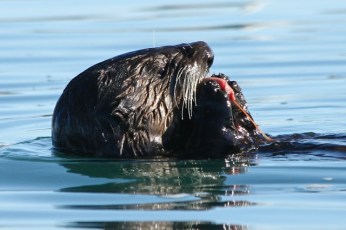
Sea otters were thought to be generalists when it came to eating — dining on whatever local invertebrates were handy. Research has shown that individuals have specific tastes and choose their foods based on what they like (as well as what’s available). This sea otter at Elkhorn Slough is eating what looks like an innkeeper worm. I got this shot using a telephoto lens while sitting in a kayak. When photographing wildlife it’s good to mind your manners and not disturb them. Getting close enough to change behaviors is rude, and with marine mammals, it’s illegal.
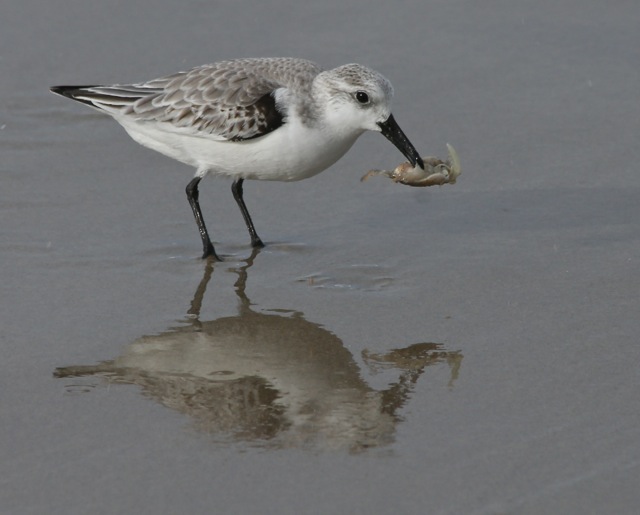
 Sanderlings eat the small invertebrates they find on or in beach sand. Their comical scurry up and down beaches following the waves is in pursuit of exposed sand crabs or sand fleas. This one seems to have found a meal too big for its bill.
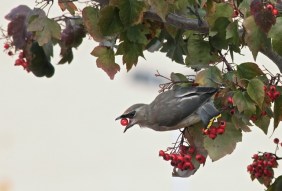 Cedar waxwings feed mostly on fruit year-round but also snack on protein-rich insects in the spring and summer. I photographed a group of waxwings dining on pyracantha berries across from my office on a cool November morning. The whole scene appeared fall festive.
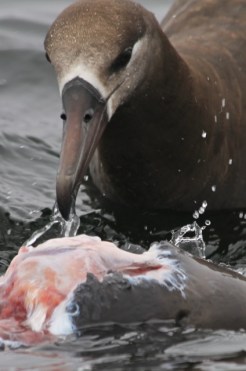 The seagoing black-footed albatross is a predator that catches flying fish and their eggs, as well as squid. However, like most of us, they don’t pass up a free meal. A group of albatrosses came upon (or were attracted to) a harbor porpoise killed by a group of orcas (killer whales). On a whale-watching trip, we happened upon the albatrosses. The orcas took only a bite out of the porpoise (you can see the porpoise’s blowhole). This gave the albatrosses access to a large amount of fresh meat, and the whale-watchers access to a feeding fest.
Dining out is different for everyone, as you can see.
If a photographer is diligent, patient and knows wildlife, she (or he) can capture great photos of locals enjoying a wild meal.
Elkhorn Slough birds
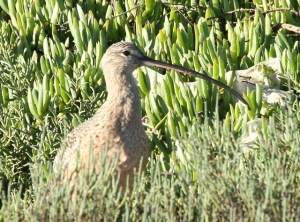
Long-billed Curlew
This continues my post on Elkhorn Slough during an incredible “We Paddle, You Photo” tour with Kayak Connection. This is a sampling of the bird photos I took on this trip.
Since these shots were taken on the morning of Halloween, the last photo celebrates that “scarey” day. (It was actually a gorgeous day on the water.)
If you live near a wetland, take some time to enjoy the beauty of the water and wildlife. There are always surprises.
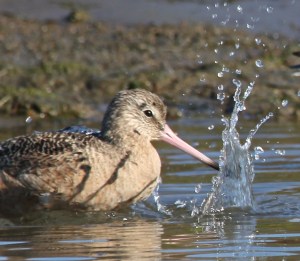
Marbled Godwit
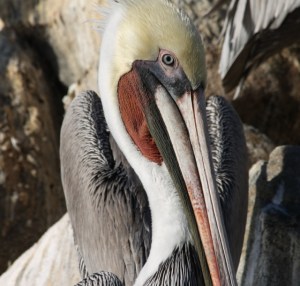
Brown Pelican
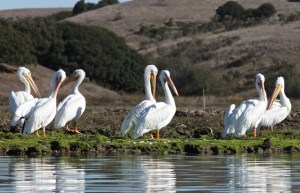
White Pelican
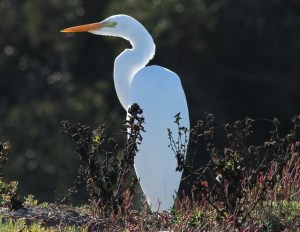
Great Egret
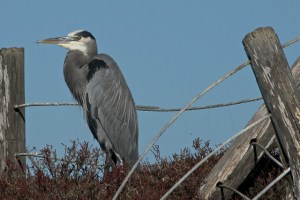
Great Blue Heron
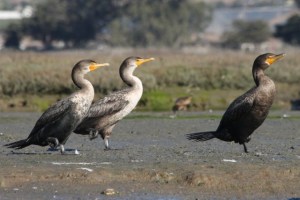
Double-crested Cormorant
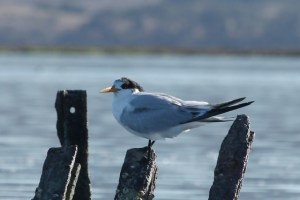
Elegant Tern
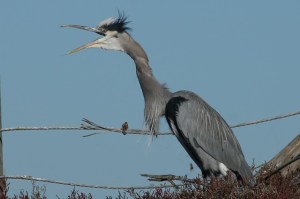
Great Blue Heron for Halloween
Elkhorn Slough mammals

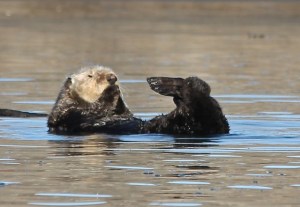
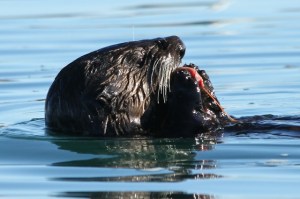
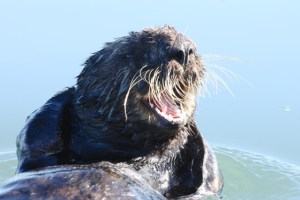
 Our local sloughs (pronounced slews) are precious coastal wetlands (once extensive along the California coast, now about only 10% remain). The largest is Elkhorn Slough (officially the Elkhorn Slough National Estuarine Research Reserve). With partners, the Elkhorn Slough Foundation and other local individuals, groups and agencies, the Reserve protects about 1,700 acres (687 ha) of oak woodlands, tidal creeks and freshwater marshes.
Elkhorn Slough’s trails are great to walk, but I especially enjoy kayaking its waters. Each trip is amazing and unique, with varied weather, tidal changes and the comings and goings of wild residents and visitors.
I recently received as a birthday present a special “We Paddle, You Photo” tour with Kayak Connection, Brian, my guide, did the kayaking work, while I focused on the wildlife. The day was perfect — clear sky, calm water, low tide, no wind. I had a wonderfully lazy (for me) view of the slough.
Here are shots of the harbor seals and sea otters we spotted. (Note: I used a telephoto to take the shots. Kayakers and other boaters are required to stay far enough away from these protected marine mammals so that the animals don’t change their behaviors. That’s tough when a friendly joins the tour and disregards the regulations, as this young sea otter did.)
And check out the cute curls on this harbor seal’s whiskers. I’ve never seen that before.
Next the birds will get to show off.
Monterey Bay Walk #2
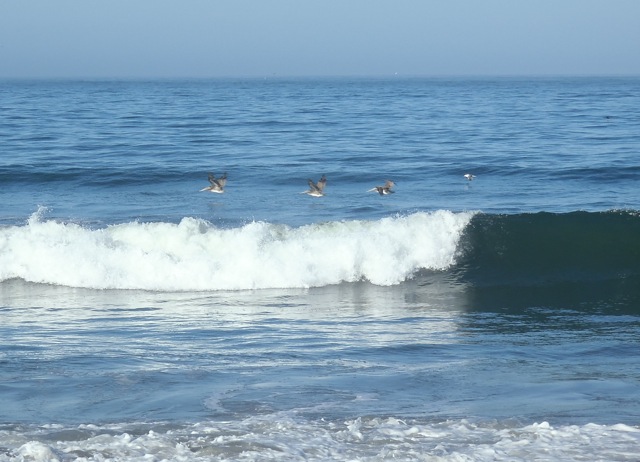
Zmudowski State Beach
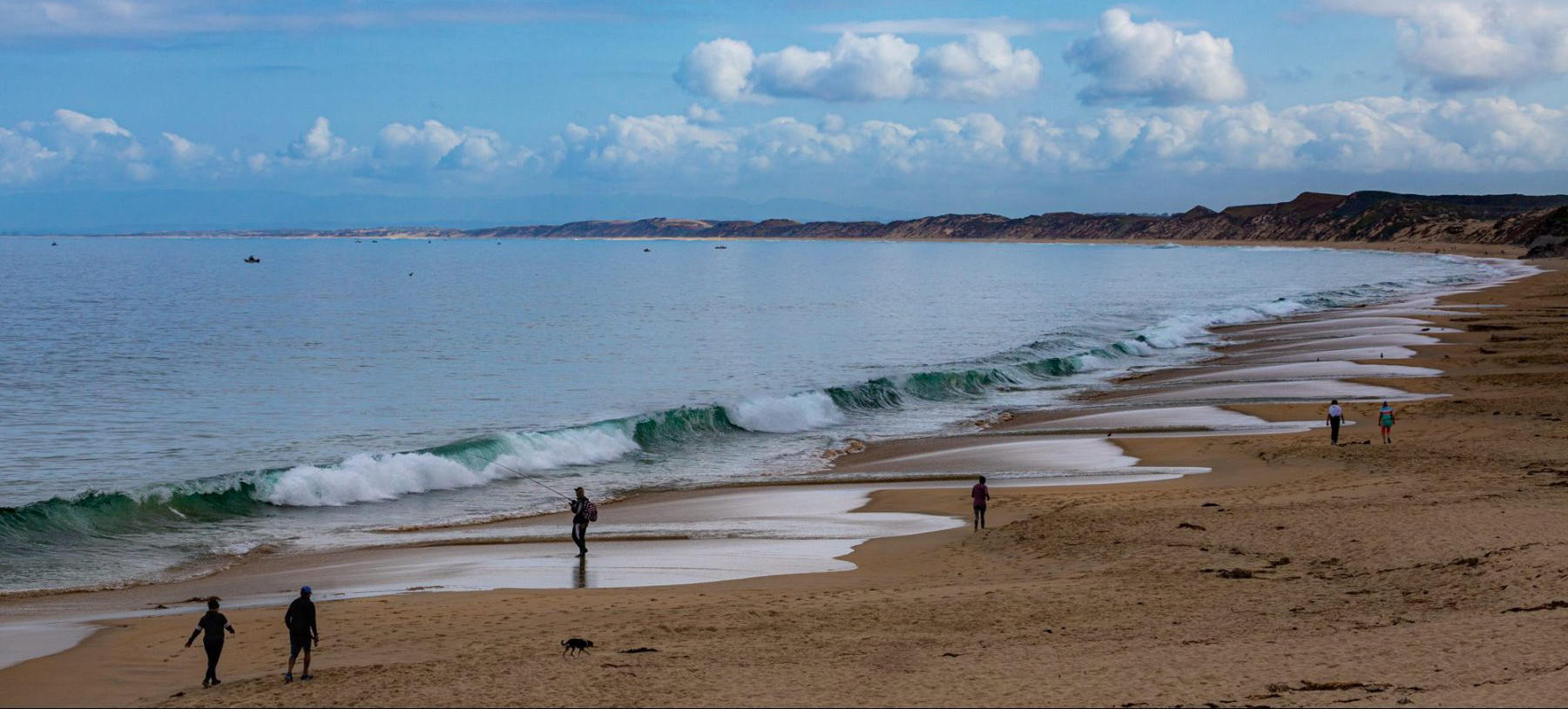
Yesterday was a lovely Monterey Bay day. It was also the second leg of my walk with 25 other local walkers guided by historian Sandy Lydon. We started at Zmudowski State Beach north of Moss Landing (about mid-point on the bay’s shoreline) and were headed to Marina State Beach about 10 miles (16 km) to the south. (This day closely followed the third day of my walk last year with Slow Adventure. See my earlier post about walking the north part of the bay.)
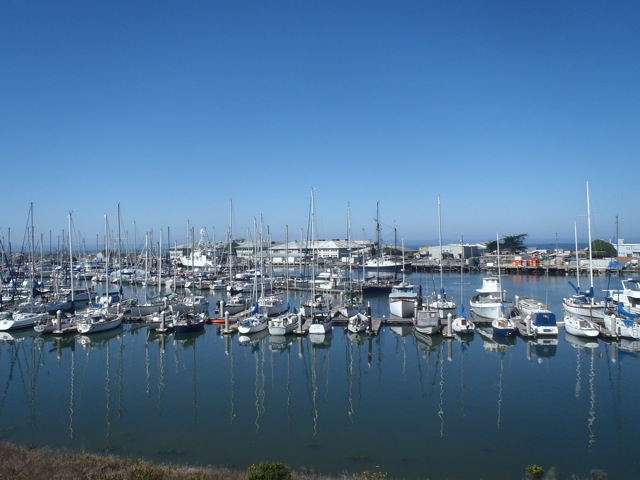
Moss Landing
We were expecting a warm day (near 80°F/27°C — actually hot for us) so enjoyed the cool morning air. Zmudowski Beach is named after Mary Zmudowski (pronounced mud-us-key), a local teacher who donated the property to the state in 1950. After about an hour of walking, our first big stop was Moss Landing. This harbor is home to an active fishing community, the esteemed Monterey Bay Aquarium Research Institute (MBARI) (started in 1987), and Phil’s Fish Market & Eatery, a fairly famous spot for fresh seafood. The town got its start when Charles Moss built wharves here in the 1860s to ship grains from the Salinas Valley. This spot was also home to a whaling station (where MBARI currently sits) from 1918 to 1927. The harbor district was established in 1945.
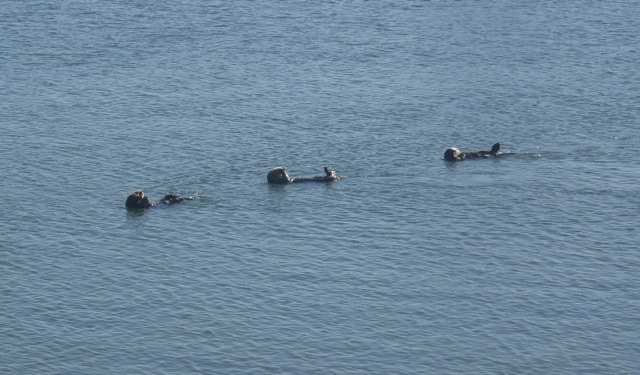 For me the most interesting part of Moss Landing is the north end of the harbor (because of the sea otters, harbor seals and sea lions) and the entrance to Elkhorn Slough (one of my favorite places for kayaking and birding on Monterey Bay). This morning about 30 sea otters (Enhydra lutris) rested and groomed just below us as Sandy talked about the flow of the Salinas River north and south of Moss Landing at various times. To get beyond Moss Landing we detoured from the beach to Highway 1, passed the harbor (over the water), and then walked with the Old Salinas River. This is an interesting section because you can choose to walk along the old river and its marshes or along the beach and its dunes. Both paths are pleasant and unique.
Salinas River State Beach
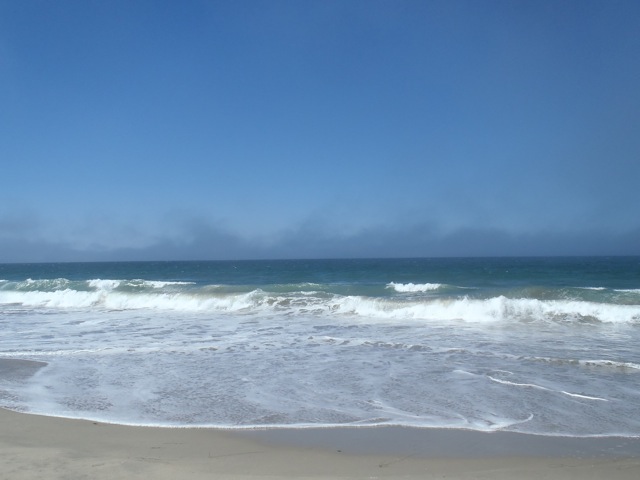
We stopped for lunch at the Molera end of the Salinas River State Beach where you can rent horses for a beach ride and get a professional photo taken. (I know this is sounding like a travelogue, but our California State Beaches are really wonderful ways to connect to the outdoors and they desperately need our support. Plus the horses were a surprise and Sandy arranged for a group photo.) At this time we were joined by a familiar local — fog. The temperature dropped and the wind added a chill. (Most days I would have been bummed to lose the sunshine, but I must say I wasn’t sorry to see a cooling fog bank roll in. We still had 4 to 5 miles [7 km] to go!)

Mulligan’s Hill and the Salinas River
About a mile (1.6 km) south of the horses there’s the mouth of the Salinas River, Mulligan’s Hill and the barge. The Salinas River is our largest local river and runs about 150 miles (240 km) from southeast to northwest creating the Salinas Valley, certainly one of California’s most productive agricultural regions (I thrive on the fresh vegetables and fruits we have here year-round). This year a sand bank barred the river from reaching the ocean, and so our crossing was easy. (Last year I had to wade across through knee-high waves washing over the sand bank and into the river mouth.) At the river mouth there’s a huge sand dune (about 58 feet/17 m high) called Mulligan’s Hill (after an Irishman). But long before Mulligan, Gaspar de Portolà and his expedition in 1769, on a trek from San Diego in search of the fabled Monterey harbor, climbed this hill and decided to continue north.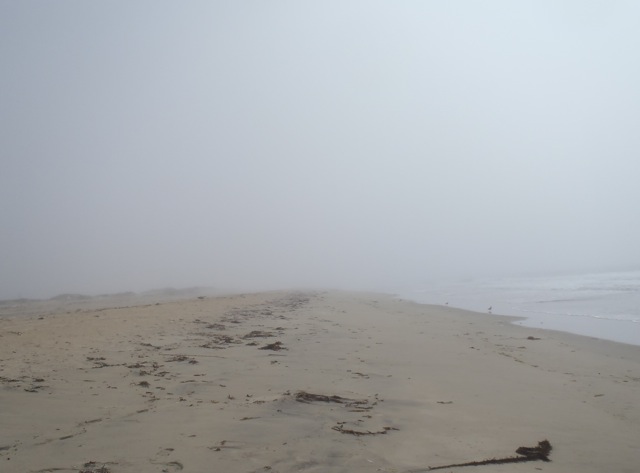 (Looking at Monterey Bay, they probably couldn’t see it well, which is understandable given what we were able to see from the beach at this point.) Even though they didn’t find Monterey, on their travels north, they did find what would later become Santa Cruz and San Francisco. (Some would consider that pretty good success for a failure. The next year he did find Monterey.)
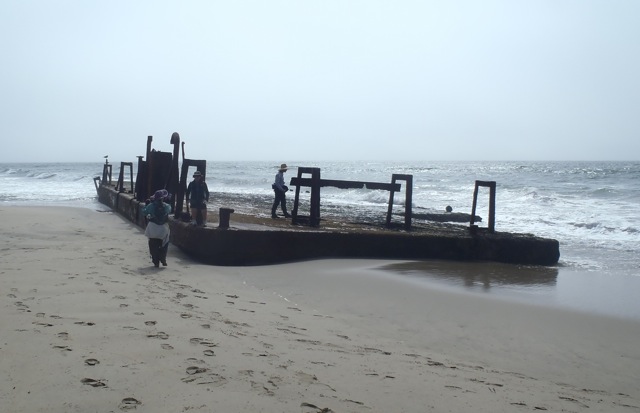 Our next beach sighting was an old barge that no one seems to know much about except that it’s on the beach. This is a rough section of coast and supposedly someone was towing this barge and somehow it got loose and ended up here. This year most of it was exposed; last year most of it was covered by sand and I almost missed it when I walked past. I’m amazed how much the sand along these beaches can move. This stretch of beach is more for wildlife than people and is designated the Salinas River National Wildlife Refuge. We saw large flocks of gulls (mostly Western gulls of various ages) and sanderlings. This is also home to the Western snowy plover (Charadrius alexandrinus), designated a threatened species due to loss of nesting habitat (they nest on the sand) and human disturbances (people, pets and their activities on the sand). This remote spot is hopefully a good place for them.
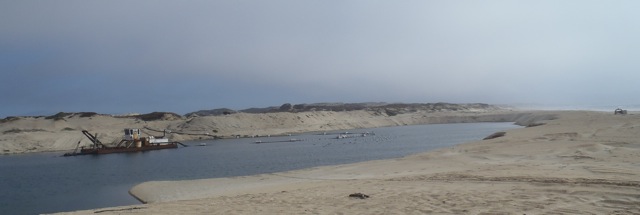 The big surprise to me the last time I walked this stretch of beach was our next stop. It’s an active sand-mining operation on the beach. Although our beaches have a long history of being commercially mined (since 1906), I didn’t realize any were still operational. This is the Cemex Lapis Plant (Cemex is the current owner, but there have been many others). The high-quality sand is used by golf courses, in filtration systems, on construction projects and in gardens and nurseries. There’s controversy associated with the plant’s operation. Some claim it’s responsible for the erosion that’s been occurring along south bay shores for decades, while others aren’t so sure if that’s the only or primary cause. Some people just don’t like the operation on the beach even if it does bring much-needed revenue to the city of Marina. It’s an interesting site and operation to watch. It certainly provides a view of what was once a major industry along our beaches from Marina to Point Lobos.
Marina State Beach
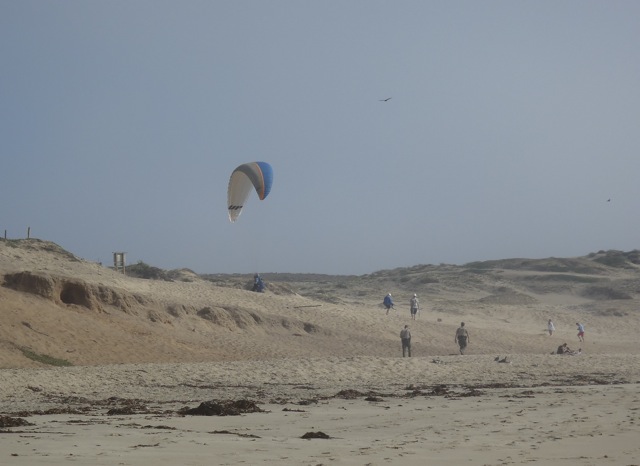
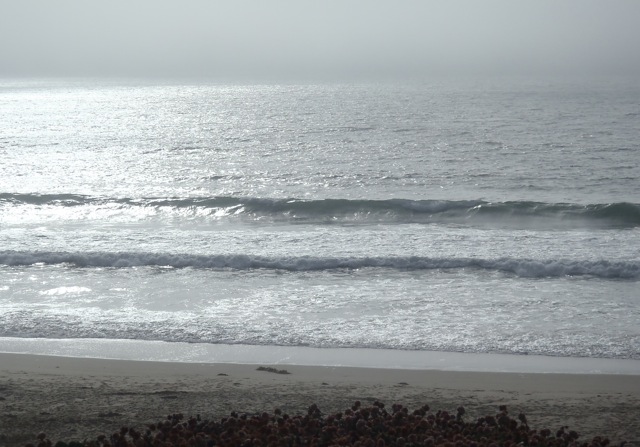
The walk from the Cemex plant to Marina State Beach (our final destination) was a quick mile (we were exhausted and in need of bathrooms). Marina is nearly always windy and well known for hang gliders and kite fliers. Today didn’t disappoint. A paraglider was circling overhead when we arrived. We scurried up the dune to use the facilities, said our goodbyes and ended the day agreeing to meet in the same spot in two weeks for the final leg of our bay walk.
Marina State Beach
My thanks to Sandy Lydon for all of the great information (errors are mine),
his logistics team (especially Annie) for keeping us organized, and the beach walkers who shared the day with me.
Freezing fingers riding the tide
I don’t kayak much in January — it’s often stormy, windy, wet and cold. But despite this week’s freezing overnight temperatures (had to clear ice from inside my kayak before launching in the morning), conditions have been perfect: sunny skies, small swells and light winds. I’ve been on the water three times this week. First, the slough.
Saturday was ride-the-tide at Elkhorn Slough. If you don’t know the slough, it’s an estuary midway along the Monterey Bay coastline (at Moss Landing). It’s the second largest tract of tidal marsh in California; San Francisco Bay is the largest. The slough, pronounced slew, is a nearly 7-mile (11-km) channel with associated aquatic and terrestrial habitats. In short, it’s a beautiful, life-rich place to visit.
For the ride I joined my long-time friend Ava and some of her friends — about a dozen of us, guided by David from Kayak Connection. We launched at Kirby Park (about 4.5 miles, or 7.2 km, up the slough) after noon on the ebbing tide (a 6.3-feet or 1.9-m high tide was at 10 a.m.), which carried us toward the mouth of the slough at a pretty good clip. For the first hour or so of the ride it was sunny and calm. 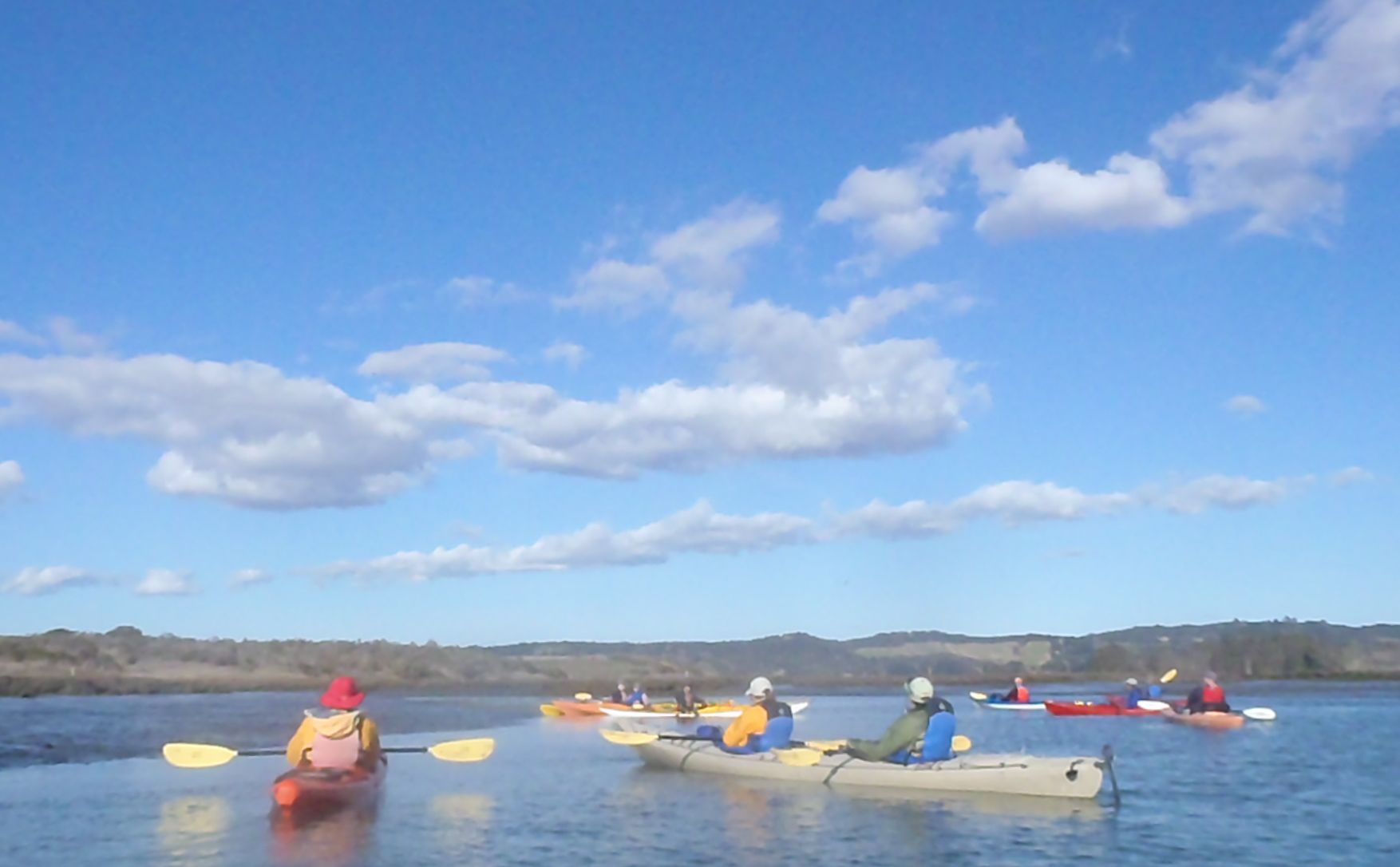 As the water receded, the mudflats were exposed. The shorebirds’ focus on feeding allowed us to gawk at diving Forster’s terns, fishing herons and egrets, probing godwits, plucking avocets, squirting clams, and circling flocks of sandpipers.
While enjoying what seemed like a rare, vibrant, minimally disturbed environment, our guide shared stories about the dramatic changes to the slough since the Ohlone people settled here thousands of years ago. What we were seeing was nothing compared to what was. And even now, though much of the slough is protected and carefully watched over, it’s losing ground from tidal erosion and threatened by invasive non-native species, pollution and future sea level rise.
Our footprints are everywhere.
About two hours into the ride, near Seal Bend, the wind picked up, blowing in off the chilly ocean, and my fingers turned numb — a reminder that it’s January. We paddled (instead of drifted) past sea otters diving and dining, sea lions crowded on a dock, and harbor seals snoozing on a sand bank near hundreds of resting seabirds (mostly gulls). We quickly disembarked to seek warmth, but were left with the glow of a great day.
Click on the links to find out more about threats to Elkhorn Slough and what you can do to help. If nothing else, visit — whether by paddle or by foot.


 WordCraft.NatureFocus