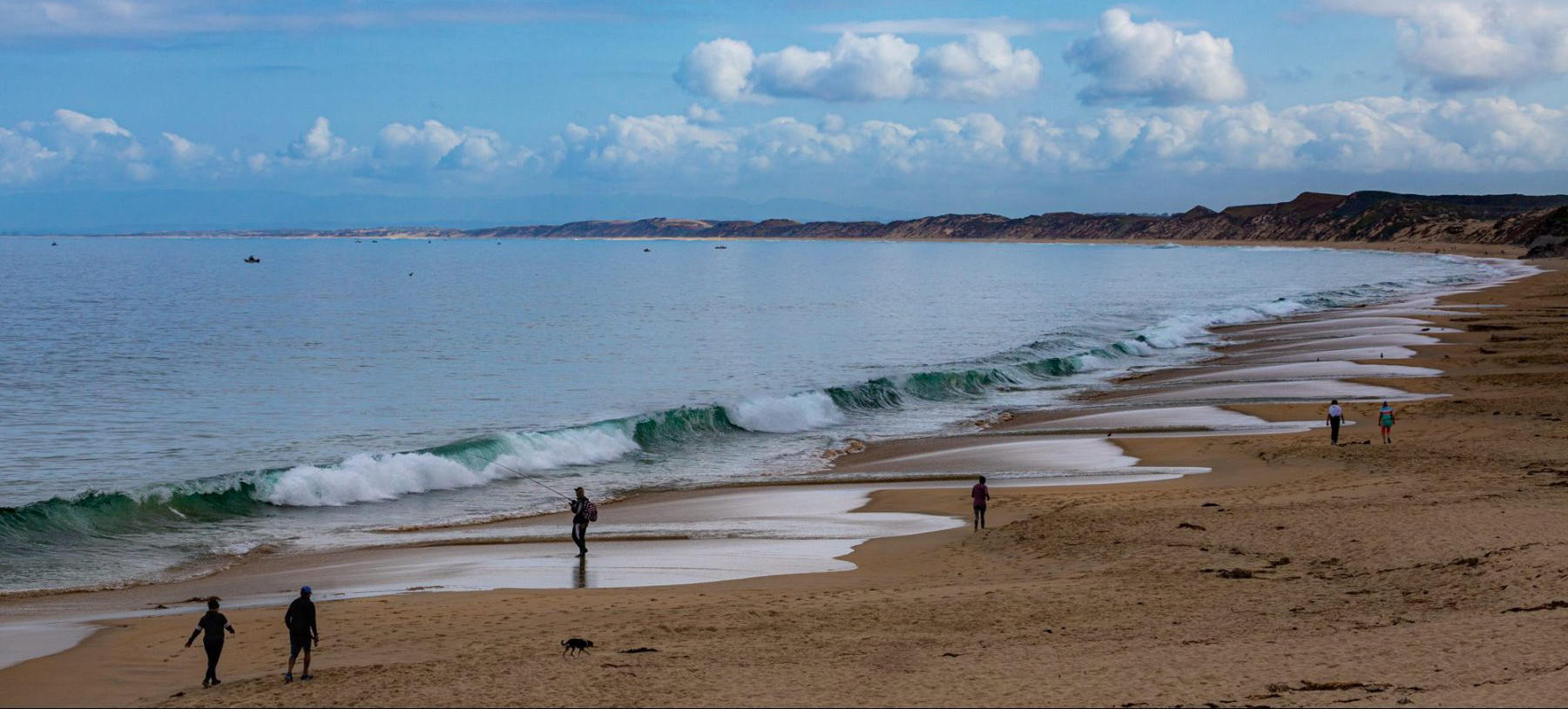
 Just beyond the breakers, dark blotches appear on Monterey Bay during winter (December to March). Sometimes they’re widely scattered, sometimes in patches. Sighted from shore, they’re a monochromatic, homogenous, nondescript sprinkling of floating birds. At least that’s what I thought until I looked closer and found a delightful diversity of sea ducks. Generally, ducks don’t excite me, but this year these captured my curiosity.
 Sea ducks spend much of their time (especially winter) in coastal marine environments and are active diving birds pursuing crustaceans (sand crabs, etc.) and molluscs (clams, etc.). A few species dive for fish and some eat plant material. They visit the bay in winter for the gentle weather and plentiful fresh food (like most of our visitors). During recent walks, I’ve watched and photographed surf scoters, greater scaups, common goldeneyes, buffleheads, red-breasted mergansers and an aerial aquatic predator (more about that later).
 Surf scoters (Melanitta perspicillata) are one of the easiest sea ducks to identify. In this photo a female is bookended by males. As you can see, they’re an all-black bird with a distinctively swollen bill, like a large schnoz. The male’s multi-colored bill brightens up for breeding season and he develops white display patches on the forehead and back of the head. Females remain a nondescript brownish-black with a bit of white at the base of the bill and just below the eye, like a touch of highlighter.
 I especially enjoy watching a surf scoter dive beneath a breaking wave and then surface with a sand crab in its bill (surfacing with food makes watching sea ducks interesting). These birds travel in small groups and very big ones. The worldwide population is large — maybe over a million birds (no one’s sure) — but has been declining. There’s not a lot of concern (see IUCN Conservation Status below), but not a lot is known about them (surprising to me). Researchers are working on tracking birds from wintering sites to forested breeding grounds in Alaska and Canada to learn more about them and determine the reason(s) for the decline. Quality Arctic breeding habitat, food availability and pollution are likely contributing factors.
 Greater scaups (Aythya marila) look like typical ducks to me. In this photo, the female is in the fore and males in back. A mature male has a nearly black head, breast and tail with a whitish body. Female are grayish-brown. You can identify her by the white around the base of her bill. A closer shot (the second photo above) shows the bill is a lovely bluish-gray.
 Greater scaups are omnivores (eating whatever’s edible, like us). I see them diving for sand crabs (abundant along our sandy beaches), but they’ll also take mussels, clams, worms and plants. Because they feed close to shore, they’re susceptible to oil spills and polluting urban runoff. As with the surf scoter, the worldwide population of this species is large (over 1 million) and is in decline.
 Common goldeneye (Bucephala clangula) is one of the lovelier sea ducks, but I’ve found it challenging to get good shots (not their fault although they seem to spend less time here than the others). The male’s body is mostly white and the head is black with a round white spot below the eye. The female’s body is gray and her head is chocolate-brown. While here, they appear to dive for molluscs and crustaceans mostly, but can eat a variety of prey. The estimated population is 2.5 to 4.6 million individuals (wow) and is regarded as stable (nice to relay good news). This species lives throughout the northern hemisphere, breeding around the Arctic then migrating south for the winter.
 The bufflehead (Bucephala albeola) is the smallest bird on this list of sea ducks. I see them on the ocean and in local lagoons. They’re very distinctive, especially the male, and easy to identify. Both males and females have a large rounded head. On the back of the male’s head is a white patch, like ear muffs, and his face is masked in reflective green and purple feathers. His back is black and the rest of the body is mostly white.
 Females are plain gray-brown and adorably petite (not very scientific, I know, but they are). They’re easy to identify by the small white highlight patch on the cheek just below the eye. Buffleheads are very active. As soon as I get one or more in my viewfinder, they quickly disappear, diving for crustaceans, molluscs and fishes. I’ve recently learned that they swallow their food whole while under water, which explains why I don’t usually spot them at the surface with a catch. The good bufflehead news is that the worldwide population is large (more than 1 million) and increasing.
 The red-breasted merganser (Mergus serrator) looks nothing like a duck. However, its behaviors are very much like those of the other sea ducks. They look different because they’re built for spear fishing. Red-breasted mergansers have a sleek, slender body and a long, sharp red bill. They’re easy to identify by the shaggy, spiky crest of feathers that sticks out wet or dry (like a bad haircut). Adult males and females look very similar during the winter. In the spring, breeding males develop a darker head and white neck bank. The global population is estimated at about half-a-million individuals (which helps explain why we see fewer of them than the other sea ducks) and is considered stable.
 These sea ducks aren’t usually alone on the bay. Among them are often grebes (also busy diving for sand crabs), cormorants (diving for nesting material very early this year) and gulls (just chilling). On a January walk the view included an aerial aquatic predator, an
 osprey (Pandion haliaetus) circling overhead. No matter how many times I see one, I’m impressed. The osprey is a fish-eater and so the sea ducks have nothing to fear, except maybe a little competition. They didn’t seem disturbed by this large hawk’s presence. (I have seen a peregrine falcon go after a grebe on the water, but that’s another story.) Ospreys catch fish with their feet. I didn’t get to see a catch on this day, but just watching it circle overhead was a treat. The osprey population has, and continues to, rebound since the U.S. ban on DDT use in 1972, along with efforts to reintroduce birds and provide nest platforms. From a conservation perspective, this is a great success story.
The current conservation news for all of these species is relatively good. Their IUCN Conservation Status is listed as “least concern.” However, the future may not be as bright. Any birds that spend considerable time near urban areas are vulnerable. Ocean diving birds run into deadly problems with fishing nets, lines and other equipment. I’m sure that birds that rely on Arctic breeding grounds are very vulnerable to the changes there due to warming. In a 2011 PLoS One article, buffleheads and osprey were included on a list that ranked California shoreline birds vulnerable to climate change. We all need to be vigilant to keep habitats healthy and to reduce our carbon use/production. I’d like to be able to witness the bay’s winter sprinkling of sea ducks well into the future.
~~~~~~~
Sources & Resources
Avibase (Avian database)
Birds of North America: Waterfowl: Sea Ducks
Gardali, T. et al. (2011). A Climate Change Vulnerability Assessment of California’s At-Risk Birds. PLoS ONE 7(3): e29507.doi:10.1371/journal.pone.0029507.
IUCN (International Union for Conservation of Nature and Natural Resources) Red List of Threatened Species

 Jelly blobs on the beach are a travesty,







 WordCraft.NatureFocus