
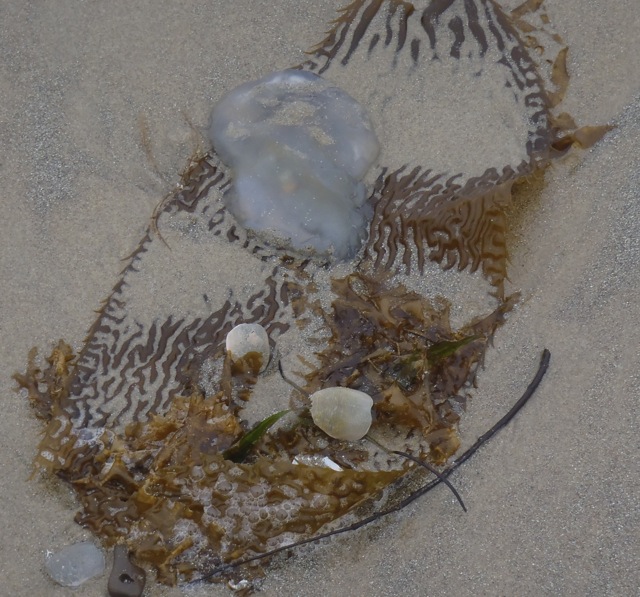
 My local beach the past few weeks has been littered with jelly blobs of various sizes from tennis balls to tennis shoes. While I was looking closely at one, a man walking by told me they were just jellyfish. They looked like they could be, but they weren’t.
Upon careful inspection you see these blobs are certainly gelatinous like jellyfish, but they don’t have long tentacles (oh, you say, must have washed away). There’s no round bell (not all jellies are round you respond). The body is long with flaps of flesh (just the way it landed you offer). On some there’s 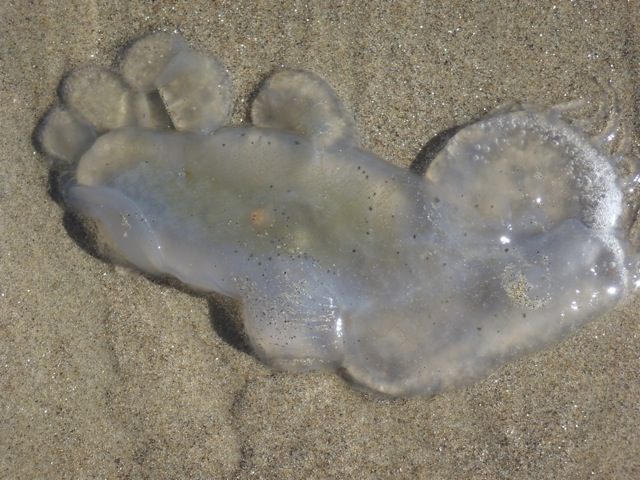 a hoodie with fringe (ahh, there are the tentacles you defend).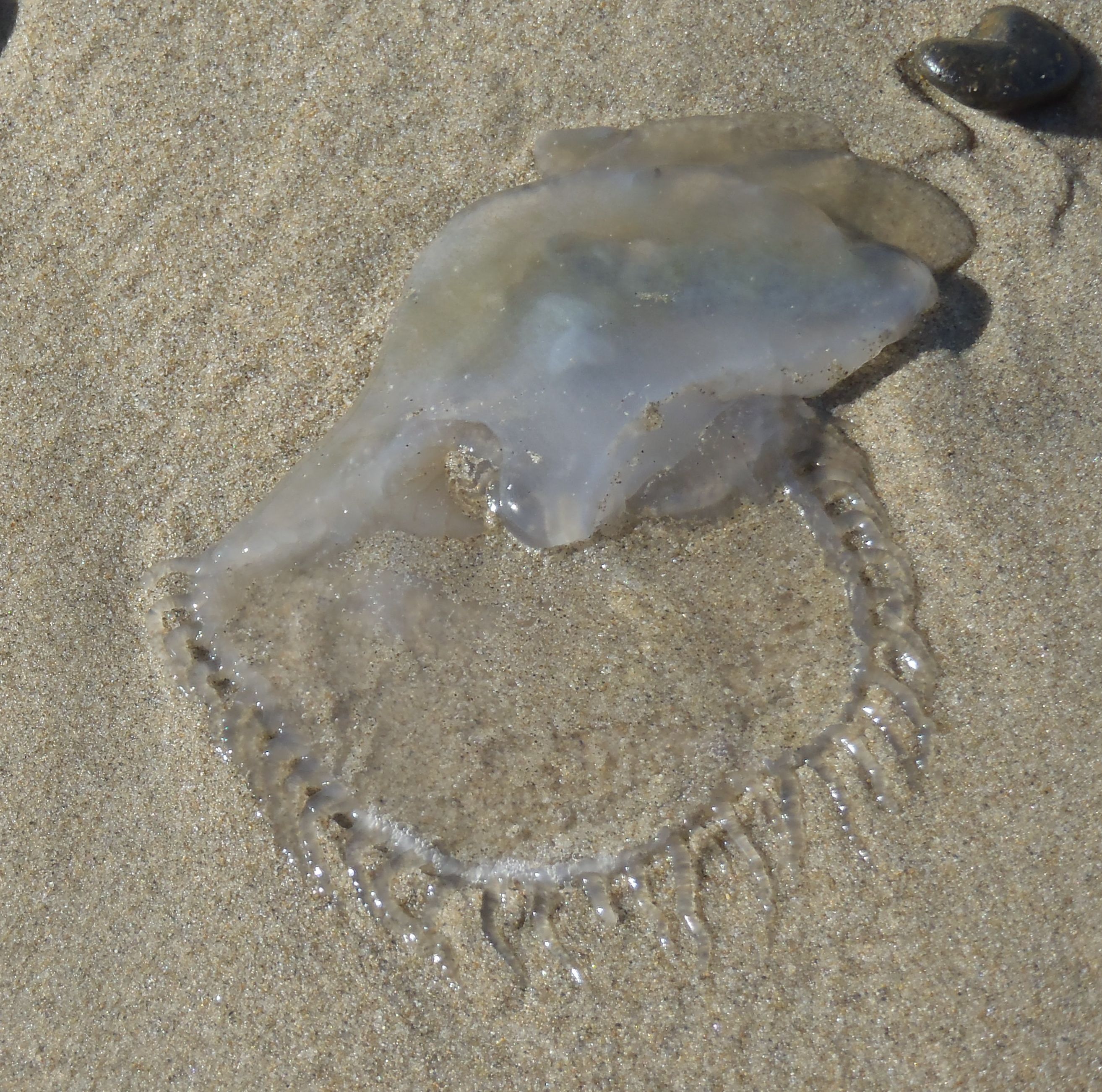
In the transparent body of some, I’ve seen little orange dots and fine opaque threads.
These blobs aren’t very attractive and I understand why most people ignore them thinking they’re jellyfish. But they’re distinctive (not the typical blob on the beach) and in their living condition in bay waters just offshore, these animals are amazing in their beauty and grace.

Photo via Shutterstock
So what are they? Meet the hooded nudibranch, or sea slug, Melibe leonina. This animal hangs out, literally, on a narrow slug foot attached to brown kelp (Macrosystis sp.) and sometimes eelgrass (Zostera sp.). It can grow to 6 inches (15 cm) long. The “hoodie” is a giant mouth — an oral hood rimmed with small tentacles (cirri) that sweeps the water for zooplankton, mostly crustaceans. When it catches something, the hood closes and cirri lock in the prey.
Inside the clear body, the orangish dots and the fine threads (called diverticula) are parts of the digestive system. The paddlike flaps of “flesh” are called cerata and grow in two rows along the back. Cerata increase the surface area of an animal and aid with the exchange of gases (respiration). The Melibe can shed these, possibly to deter predators just like a lizard dropping its tail. It can continue to evade a predator by detaching from its post and swimming with slow undulating body strokes. Maybe it’s the swimming Melibe caught in a current that gets washed ashore.
YouTube has many Melibe videos, but I like this video which shows a vast number of Melibe feeding in a kelp forest. It’s a beautiful sight and the one I keep in mind when I happen upon these blobs on the beach.
Note: For jelly blobs that are actually jellyfish, see More jelly blobs post.
For other beach blob posts, see Sea butterflies or Salps on the beach.


 WordCraft.NatureFocus
Hi Madyson
These beach “blobs” are long dead and you did no harm. Sea slugs don’t regenerate (as far as I know). Looks like jellies might have some regeneration ability: https://www.nationalgeographic.com/news/2015/06/150615-jellyfish-symmetry-animals-science-oceans/
Chris
LikeLike