
Surprising structural color
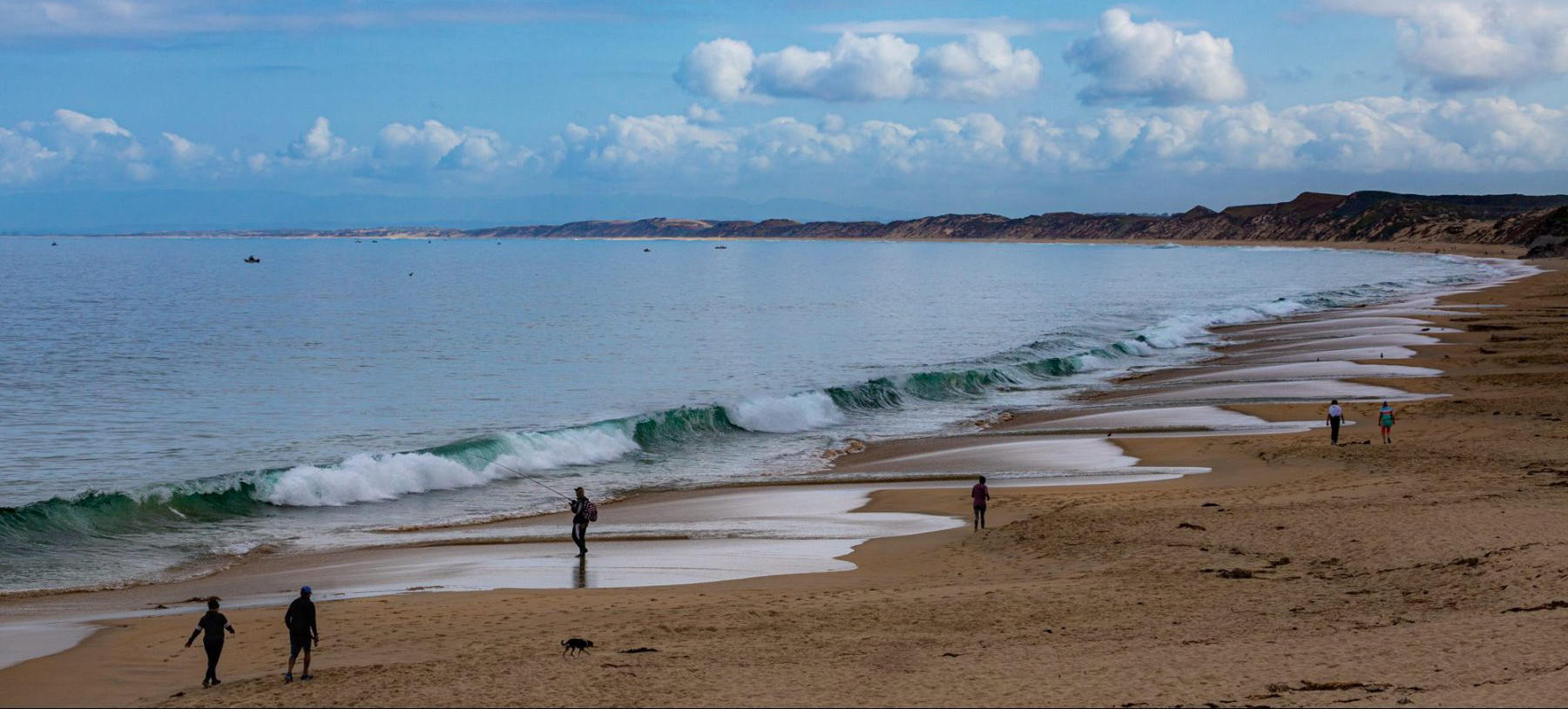
 I love when I download a set of shots from camera to computer and find surprises — pictures I didn’t know I had. It’s what keeps me going as I delete hundreds of bad shots.
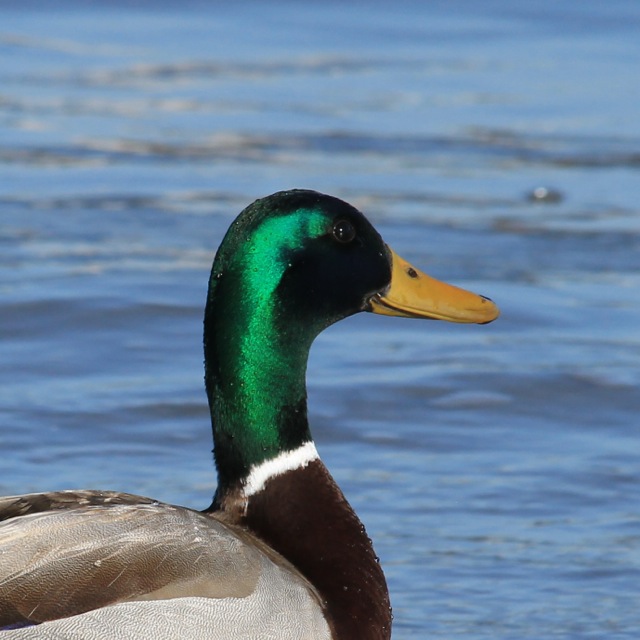
This set of three shots is a perfect example.
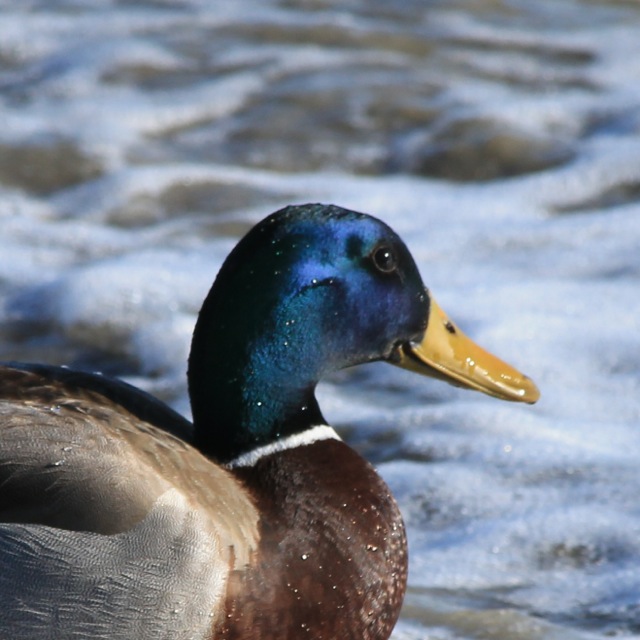 Just to practice I photographed this male mallard as he walked by me up the beach toward the sun. Mallard shots are easy to get so I wasn’t expecting anything special. To my surprise and delight, I got a stunning example of the structural color of feathers.
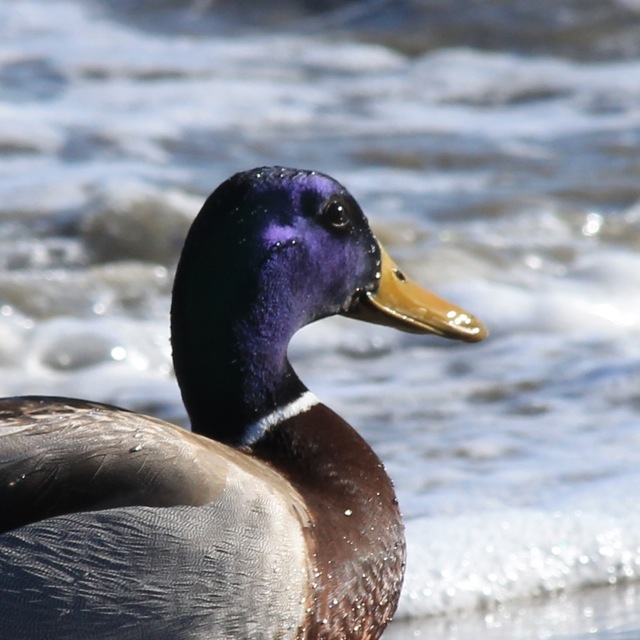 There’s no true color here. It’s the structure and layout of the feathers and their reflection of light that create what looks like three different bird heads. But this is the same bird all within a minute’s stroll. No photo or color adjustments on my part.
Nature is amazing!
Dead on a beach
 I haven’t posted much lately, and I’m going to blame the sunshine. This is the first rainstorm that we’ve had this year, and only the second of our winter rainy season. It’s just been too nice outside to sit inside and write. So here I am today.
Given the gray and gloom, I thought I’d write about why I like walking Del Monte Beach so much. It’s considered by some to be the “trash” beach of the Monterey Peninsula. Maybe it’s the currents or the harbor breakwater, but it seems that most of what dies at this end of Monterey Bay ends up on Del Monte Beach. That, for me, is what makes it so interesting. I love being witness to the cycle of life and getting a glimpse, sometimes an unpleasant one, of what’s happening in the bay and along the coast.
 Caution: This post contains pictures of dead and decaying animals. If that sort of thing bothers you, you might want to move to a more lively post.
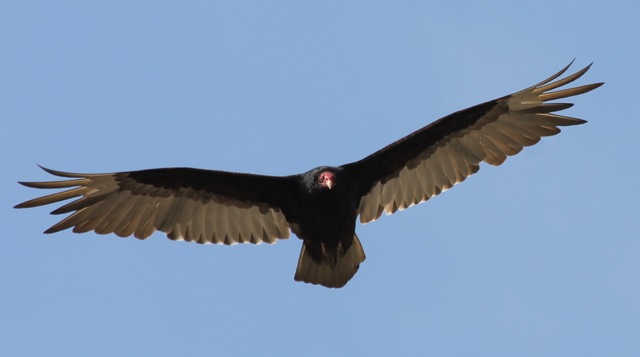
A signal that there’s something interesting on the beach are the turkey vultures (Cathartes aura). I grew up calling them buzzards and have always been fascinated. Sometimes I see them overhead, but I usually find them working on whatever has landed on the sand. Even though I’m walking only a few hundred yards from a major road, the sight of them always transports me to another age when large vultures were as common on beaches as joggers and dog walkers today.
Turkey vultures don’t seem fussy about what they eat. I’ve seen them eating mammals, birds and fish. I commonly spy them dining on dead sea lions.  If you stand still, you can watch them for quite some time (if no one else scares them off). This winter is shaping up to be like those of the last two years with weak, hungry and sickly young sea lions stranding themselves on beaches. Right now Southern California is getting more of them than we are. Experts believe the young sea lions are not finding enough food, but aren’t sure why. Warmer water conditions (possibly related to climate change) are often blamed. NOAA (National Oceanic and Atmospheric Administration) sometimes declares a mass die off as a Unusual Mortality Event (UME), as was done in 2013, which scientists investigated. The cause of that event is still undetermined, according to the NOAA website. I’ve found no UME declared for this year’s sea lion strandings — maybe the rescues are high and deaths are low.
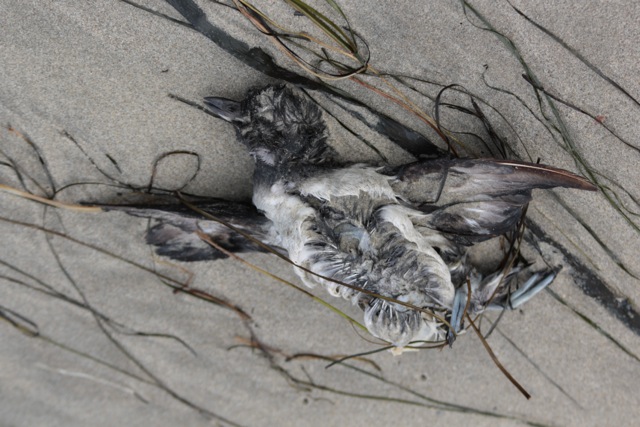 There’s definitely a UME happening this winter. Thousands of young Cassin’s auklets (Ptychoramphus aleuticus) have washed onto beaches from Canada to Southern California. On one short beach walk I counted 50 dead birds. This is very unusual. These are seabirds that I’ve seen on whale-watching trips, not on beach walks.
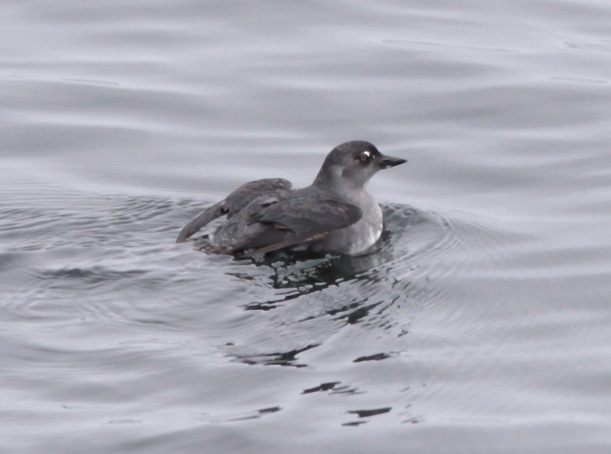
Photo by Sophie Webb / NOAA SWFSC
Necropsies have shown that the birds are starving — not enough zooplankton (tiny drifting animals) to eat. Again, no one’s exactly sure why. This past year we’ve had little upwelling (shifting currents allowing deep, nutrient-rich water to come to the surface). Without the nutritious water, there’s less zooplankton, and so less food for auklets. It’s sad to see so many emaciated feathered bodies with blue feet littering the beach.
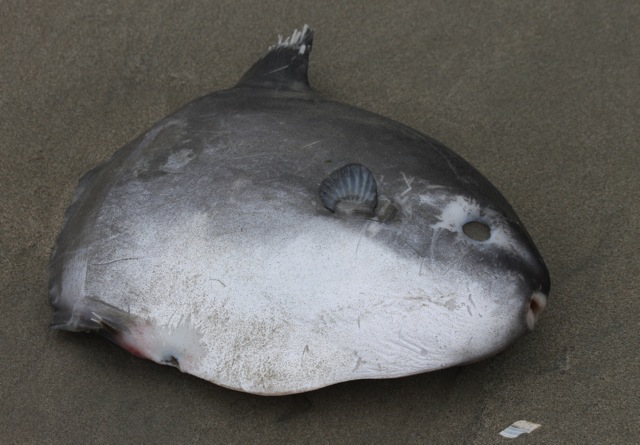 A common sight every year, usually in the fall, are dead ocean sunfish (Mola mola). These fish are without fins and eyes. They’ve been victims of a tough frisbee game — a sea lion grabs a fin and throws the sunfish to tear it off (presumably to eat). Without fins, the fish are unable to swim, get caught in currents and tossed onto the beach.
 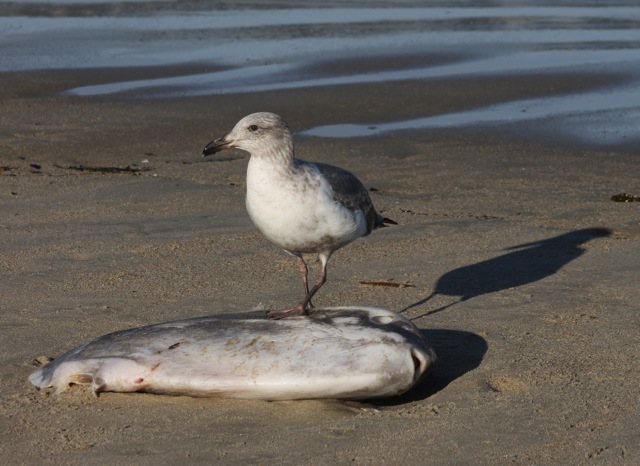 Gulls are responsible for removing the eyes. The beached sunfish are always young and about the size of a hubcap. The adults are much larger and likely too big or too tough for sea lions. In January I saw more sunfish than usual, and that also may be attributed to the winter’s warmer water.
 Dead crabs and crab carapaces (shells) are very common, especially during the summer. To grow, crabs molt (shed the old shell) and this litter traces the tideline. Most of the crabs are less than an inch (2.5 cm) in size. This sheep crab (Loxorhynchus grandis) was the exception at nearly a foot (30 cm) across. This was a rare sighting — I’ve only seen one like this so far. I was sure it was dead, but too chicken to test if it was the whole crab or only the carapace encrusted with barnacles.
 This last animal was a very unusual sighting — a thresher shark on my beach. I couldn’t believe it. The gulls and vultures were enthusiastic, too. I’m not sure of the species: a common thresher or pelagic thresher (Alopias sp.). The fish was intact and had no bite marks or other open wounds on it, but it was, as you can see, bruised and bloody. If I were to guess at the cause of death, I’d say that it was caught, and died in the net or after it was released. I don’t know what else would cause those bruises. It’s a beautiful animal (as are all of these, especially when alive in the water). I’m sad they died, but glad they ended up on my beach, making my walks more interesting and enlightening me to what lives in the bay, while worrying me about how our ocean is changing.
Tern dodges gull
On a recent beach walk I spotted pelicans, terns, gulls and sea lions feeding in the shallows just beyond the surfline. For a while I was entertained by a tern as it actively dodged a pursuing gull. The gull did a great job of keeping up with the tern’s aerobatic maneuvers. Was this a game of chase or something more nefarious?


Tidepool sea anemones
 Tidepool living has to be tough. Each day cycles through wet, cold and sheltered to dry, warm and exposed, then repeats. Last week I spent some time photographing and exploring tidepools during morning low tides. Amazing what’s there, and the closer you look, the more there is to see. In this photo the obvious species are sandcastle worm tubes surrounding mussels dotted with barnacles. I’m sure you’d find more if you looked closely — maybe algae, limpets, tunicates or hidden crabs. But that’s for another time.
For this post, I’m focusing on the shots I got of sea anemones in tidepools that still contained water (without water they close up or droop and wait for the tide to wash back in). I found three species during my morning ventures.
 The giant green anemone (Anthopleura xanthogrammica) is a wow green and stands out in the sand or a shallow pool. This species grows to 8 inches (20 cm) across. Sea anemones look like flowers but are animals closely related to jellies, complete with tentacles and stinging cells for capturing food. (These stinging cells are typically too light duty to harm people.)
 The sunburst anemone (Anthopleura sola) is not as brightly colored as the giant green, but is distinguished by lovely lines on a pale blue-green oral disc (the flat mouth side). This species grows to 6 inches (15 cm) across. Sea anemones keep their distance —they have special stinging clubs and will do battle with anemone neighbors to keep them away.

The third species in our area is smaller and more cozy than the other two. The aggregating anemone (Anthopleura elegantissima) grows to 2.5 inches (6 cm) and is found in groups (members of the group are clones). Clonal communities keep separate from one another — you can spot a demilitarized zone between them. At low tide aggregating anemones create a squishy carpet. In several places I had to be very careful not to step on them as I moved between the rocks.
If you get a chance, visit a tidepool at low tide to discover its wonders, but walk carefully and don’t disturb the residents. Tidepool life is vulnerable at low tide, especially to foot traffic and exposure. If you’re interested in more about Monterey Bay sea anemones, look at the Monterey Bay National Marine Sanctuary SIMoN Species Database or Hopkins’ Seanet Common Intertidal Organisms of Monterey Bay website.
Northern & Central California kayak visit

I recently received an email from a researcher, who studies climate impacts on birds in Sweden, asking for trip recommendations for an upcoming 10-day visit to California. As a biologist and kayaker, he said he was looking for “places where I could go for a paddle and see interesting wildlife.” He’s starting in Sacramento, and this is what I suggested (edited for this blog post).
Paul:
Welcome. Since I prefer the coast and inland gets hot this time of year, I’d leave Sacramento as soon as possible and head west (however, I’m sure there’s great kayaking in the area on the rivers that flow into San Francisco Bay — I’ve just never tried it).
Driving down the coast, my first stop would be the Tomales Bay/Point Reyes National Seashore area. There’s great hiking all around the Point Reyes peninsula and it’s beautiful. You could kayak Tomales Bay or Drakes Estero. I’ve rented and taken tours through Blue Water Kayaking (two locations on the bay). The bioluminescent night tour was amazing and the guides were all great. You could stay in Inverness (a lovely small town with very friendly people), or for easy access to kayaks, at the Tomales Bay Resort (where Blue Water rents kayaks).
Next on the trip would be San Francisco Bay. On the bay’s north end, Sea Trek offers a fun kayak trip viewing Sausalito houseboats and great wildlife. Sausalito is quaint and cozy (and expensive, but so is all of the California coast).
In San Francisco, if you’re a baseball fan and the Giants are playing, San Francisco Kayak & Adventure offers trips to McCovey Cove to watch the game and catch home runs (it’s a scene that I’ve not experienced personally).
Continue your trip south along Highway 1 — it’s gorgeous (if not foggy) this time of year. On the north end of Monterey Bay is Santa Cruz, and Kayak Connection offers a variety of short or long interesting trips (including humpback whale watching).
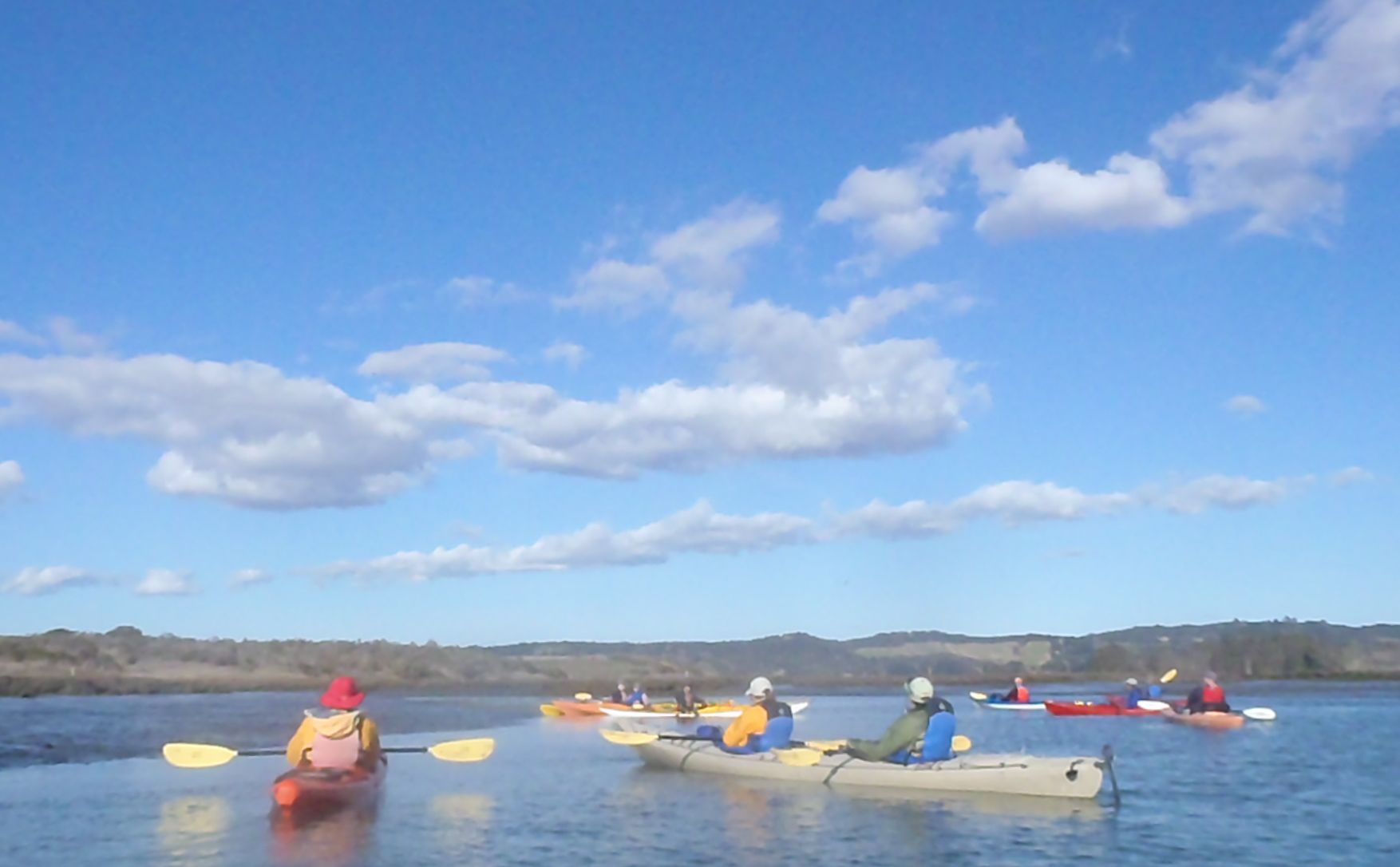 At the midway point of Monterey Bay is Elkhorn Slough and some of the best kayaking in our area. You can get close to sea otters, seals & sea lions, and a multitude of bird species. Kayak Connection and Monterey Bay Kayaks are good outfits for tours and rentals.
On the south end of the bay is Monterey. My favorite outfit here is Monterey Bay Kayaks. You can rent a kayak, paddleboard or take tours. The harbor is interesting and kelp beds off Cannery Row are relaxing and lively (sea otters, rafts of sea lions, seals and birds).
South of Monterey in Pebble Beach (just off the golf course) is Stillwater Cove. Monterey Bay Kayaks and Adventures by the Sea offer Stillwater Cove paddles. Awesome scenery.  Most of the Monterey Bay outfitters also offer paddles around Point Lobos State Natural Reserve, but I recommend that for calm days only (I got very seasick on a trip last year). Any day, though, the bird watching is good and the docents are knowledgeable and very helpful.
Along this stretch of the coast and south, the scenery is spectacular and kayaking is very treacherous. In lieu of kayaking, I suggest stopping in Big Sur for the food and views. My favorite spots along the way are Highlands Inn’s California Market, Rocky Point, Post Ranch’s Sierra Mar (amazing resort with restaurant and very pricey) and Nepenthe.
If you keep going and pass Point Conception, you’ll enter Southern California territory. (I’ve skipped over Morro Bay, which I hear has great birding kayak trips, but I haven’t yet enjoyed any.) The next best kayaking is out of the Santa Barbara/Ventura area, in particular trips to the Channel Islands National Park. The boat ride out to the islands and any kayaking there is worthwhile. I kayaked the caves of Santa Cruz Island and went with Paddle Sports of Santa Barbara (now called Channel Island Outfitters).
Finally, if you still have time and energy, a trip to Catalina Island off Los Angeles is a treat. You take a ferry to the island, and then can rent a kayak on Avalon Bay. While there, I think I used (it’s been a while) Descanso Beach Ocean Sports. My guide was great.
This list will easily eat up your 10 days and probably all of your pocket change.
Hope this helps. Have fun.
Chris
(Note: This is not an all-inclusive list, but one based on my California kayaking experiences with outfitters from the Point Reyes Peninsula to Catalina Island.
If you have other suggestions, let us know.)


 WordCraft.NatureFocus