
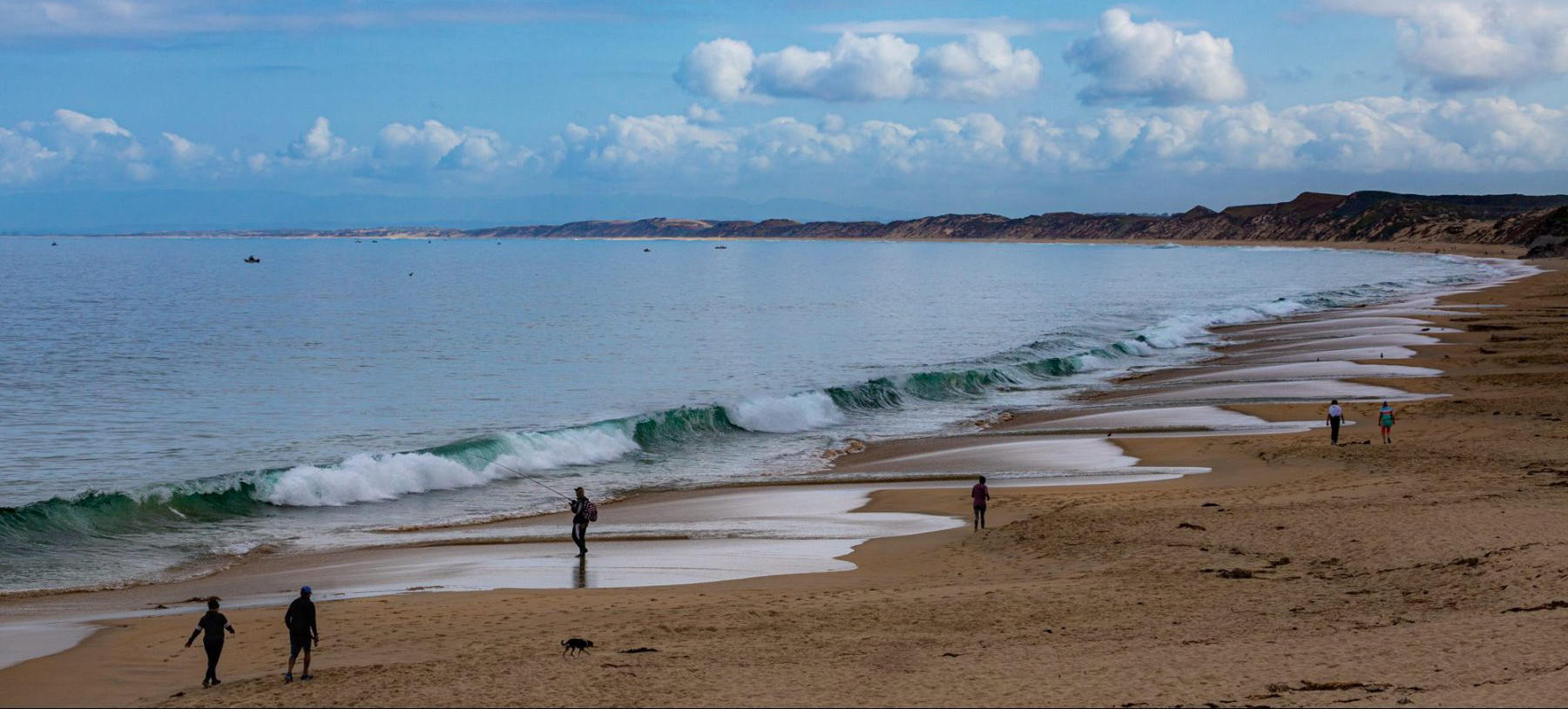
A long walk at low tide
Rain is on its way (winter has barely visited this year) and so I took a long walk to enjoy a pre-stormy bay and this week’s daytime low tides. It was cool, and the sky and ocean were soft gray (not unusual here). 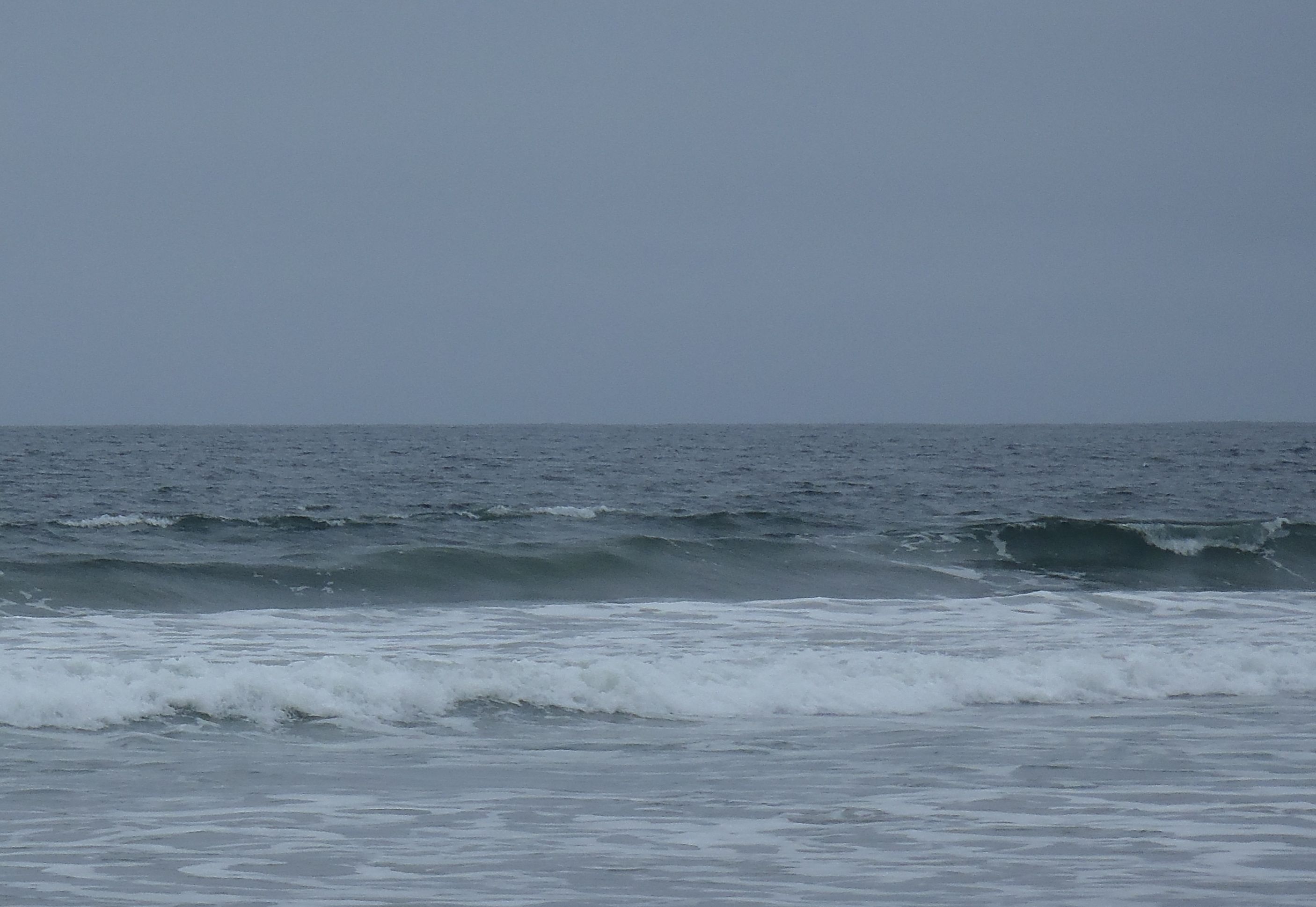 My walk started on the sandy beach below Del Monte Dunes in Monterey and ended on Moss Beach (where Asilomar State Beach meets Spanish Bay) in Pebble Beach — a lovely, easy 10-mile trek. Between the two stretches of beach are the rugged, rocky shorelines of Monterey and Pacific Grove.
The joy of a cloudy Monday in March is that the beaches and shoreline paths are mostly devoid of people. When bay beaches are deserted, turkey vultures are busy inspecting the coastline for a meal. Today was no exception. I happened upon one vulture working on a seal carcass and I stopped to watch it for a while. (Visit an earlier post for more about vultures.) I’m fascinated by such a scene because of its tenuous thread to a time when large animals frequented these beaches, when condors and bears scavenged beached whales. Not that I’d want to encounter a bear on the beach, but I feel the loss of such scenes forever gone. The mood was soon broken when a jogger bounced by, oblivious to the interruption, and the vulture took flight.
At the Monterey Harbor I walked down the Coast Guard pier and breakwater (see an earlier post for more about the harbor) to check on the sea lions and cormorants. 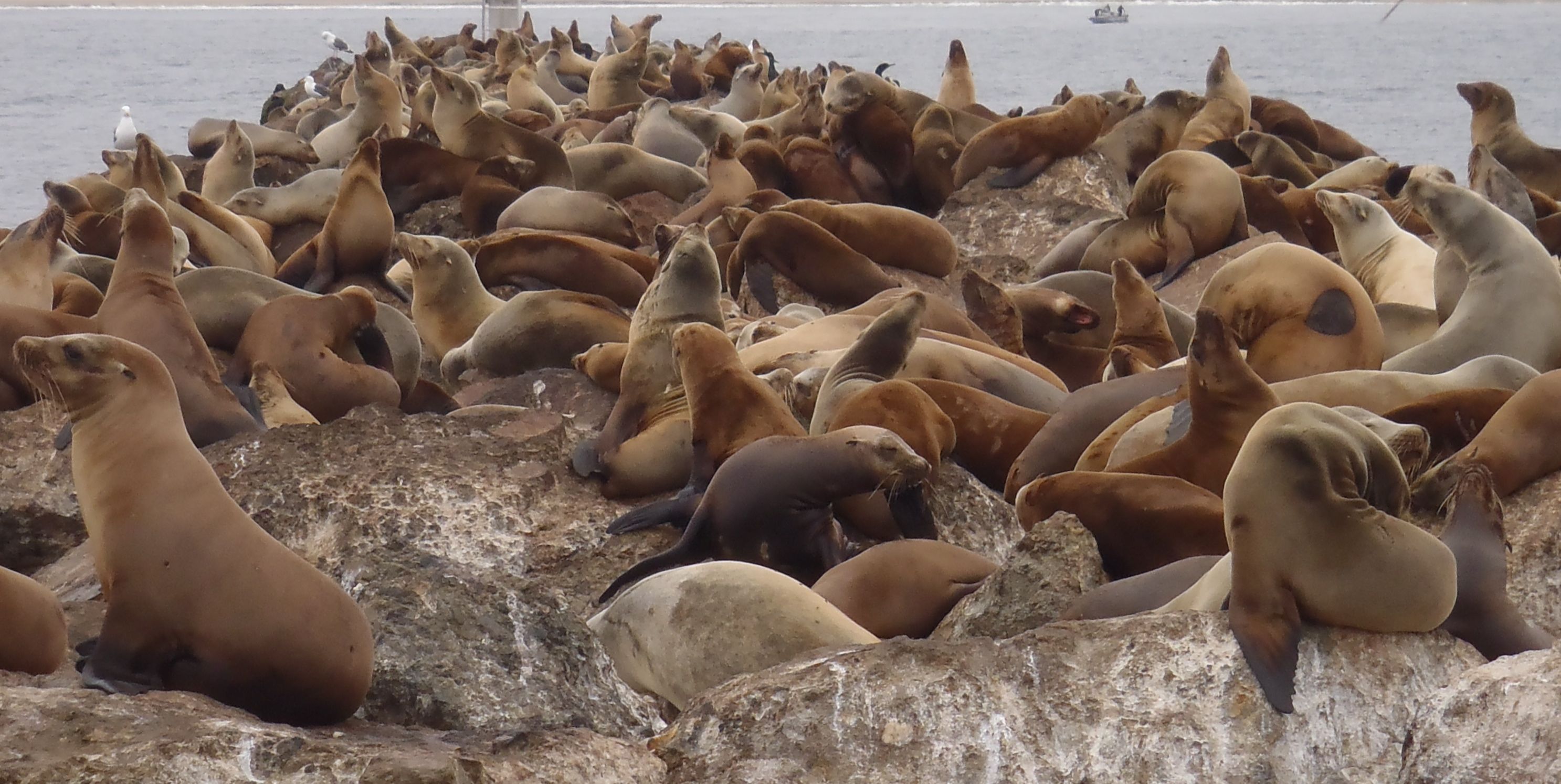 As usual, there was a roiling sea of sea lions, edgily jockeying for space and position. Unlike past weeks though, the rocks sported more gulls than cormorants. This was true for my entire walk and I’m still wondering were the cormorants had gone.
As the tide ebbed all along Monterey’s rocky shoreline, birds searched among rocks for tidbits —  turnstones and surfbirds along the breakwater, snowy egrets in harbor shallows, gulls and crows everywhere. With predators afoot and life-supporting water temporarily gone, sea anemones had collapsed, muscles shut tight, and snails and barnacles closed their doors. It would be a few hours before the invertebrates would be free of the pesky, poking birds. But it offered me great glimpses into the rough and tumble world that I seldom see on the wave-washed rocks.
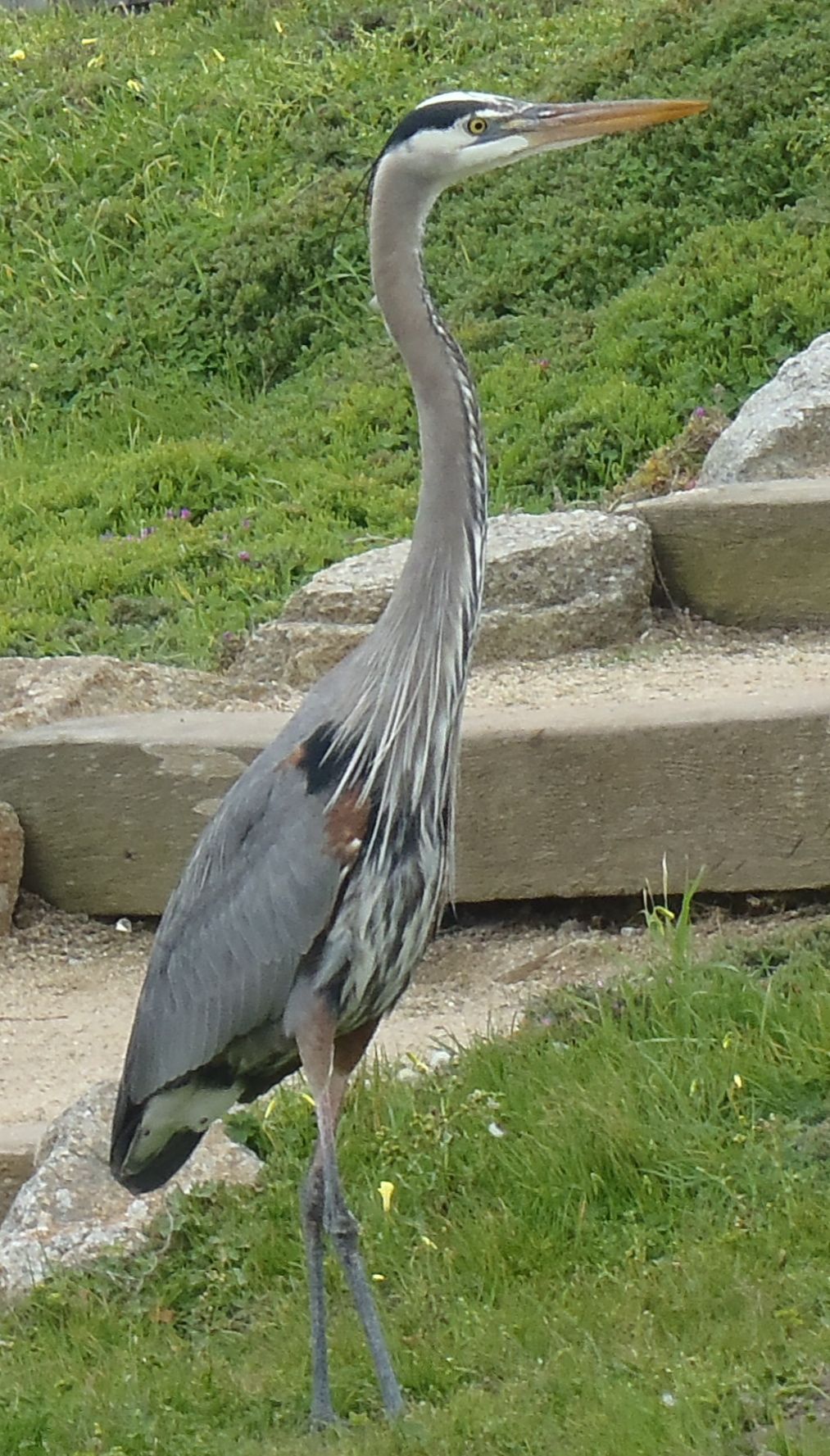 Farther along in Pacific grove, while watching the waves crashing on the rocks to my right, I was surprised by a great blue heron between my path and the coastal road on my left. It strolled majestically, noticing me, but showing no alarm. Cars stopped and took photos. I stopped and took photos. It didn’t seem to mind any of us, as if this was an everyday occurrence. I was delighted to have such a large stately bird beside me. They’re surprisingly tall — growing to 46 inches (117 cm). Normally when I see one, its neck is pulled in and it’s flying away after I’ve interrupted a hunt or disturbed a resting spot.
  The other impressive bird that I encountered was at the Pacific Grove Golf Links, which has a freshwater pond (Crespi Pond) at Hole 17. The pond is normally a haven for American coots, but today a graceful great egret stood at the pond’s edge. I often see them fishing atop the kelp beds as I paddle past in my kayak. Getting this close was a treat. This walk was becoming a great one for sighting wading birds.
Just past the golf course, I officially walked out of Monterey Bay. Point Pinos marks the southern end of our “sheltered” bay (although much of the bay isn’t very sheltered) and the start of a shoreline exposed to the full force of the Pacific.  On a hill overlooking the point is the Point Pinos Lighthouse, the oldest operating lighthouse in California, which began warning seafarers in 1855 and is still working. Around the point and past a few amazingly expensive houses, I picked up a great coast walk trail, part of Asilomar State Beach, that meanders along one of the most beautiful sections of the Monterey Peninsula’s coastline. At low tide, the coves and pools are delightful; at high tide, the winter surf is spectacular. At the end of the trail I was tiring and a chilling wind started to blow, and so, on Moss Beach I ended my walk.
I encourage you, wherever you are, to go out and get to know all that lives around you. Take a short or long walk and a long look. 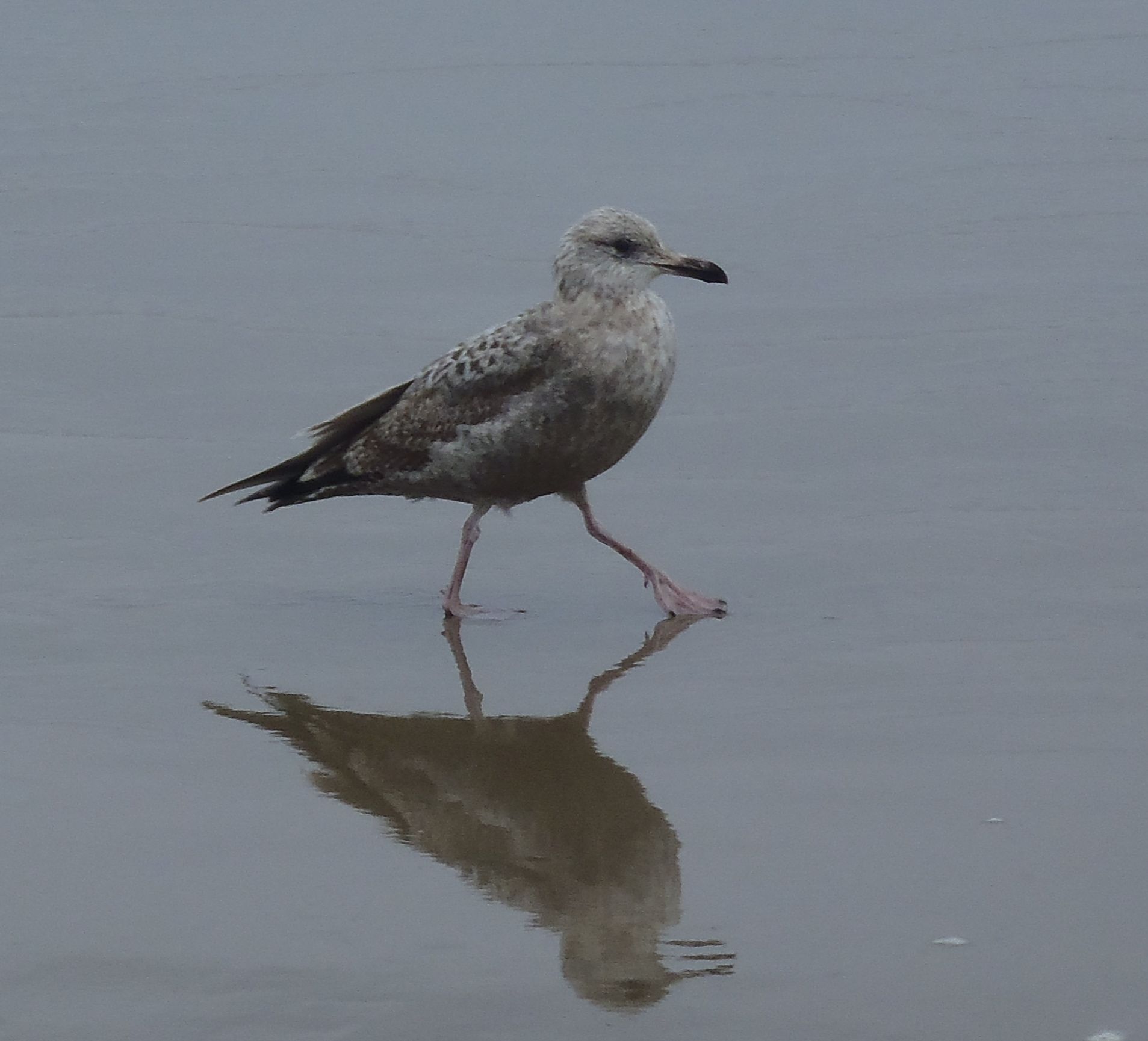 I’ve lived here for nearly 30 years, but with each walk and paddle, I see animals and interactions that are new to me. That’s exciting. Although it’s great to learn about wildlife via books, images, lectures and blogs, it’s not the same as having a heron stand before me, a baby sea otter cry for mom next to me, or a seal catch a fish in front of me. Cherishing our wild neighbors (whether we like them or not) and protecting their homes (which is also our home) is the best hope we have for our future on this planet.
~~~~~~~~~~~~~~
Resources
Monterey County Parks & Beaches: List and interactive map
No news update
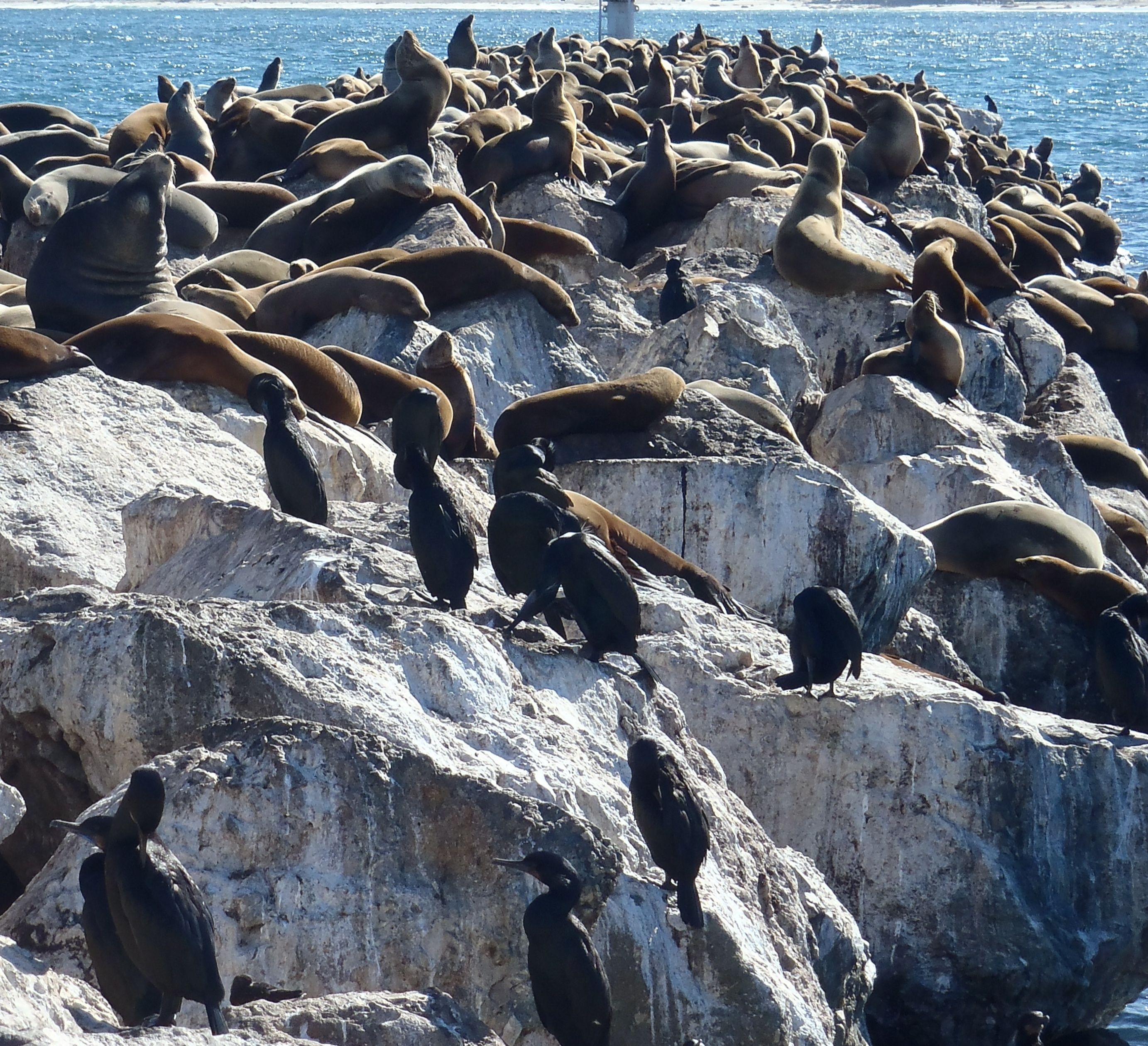 Spring has blown into the bay with strong northwest winds (our springtime signature). For more than a week winds have been fairly steady – at up to 30 mph (26 knots or 48 km/hr). It’s been nice for sailing and kite-flying. Not so for kayaking, hence I enjoyed a beach walk yesterday. First, I checked the breakwater for progress on the sea lion-cormorant tussle, and not much has happened since my last post.
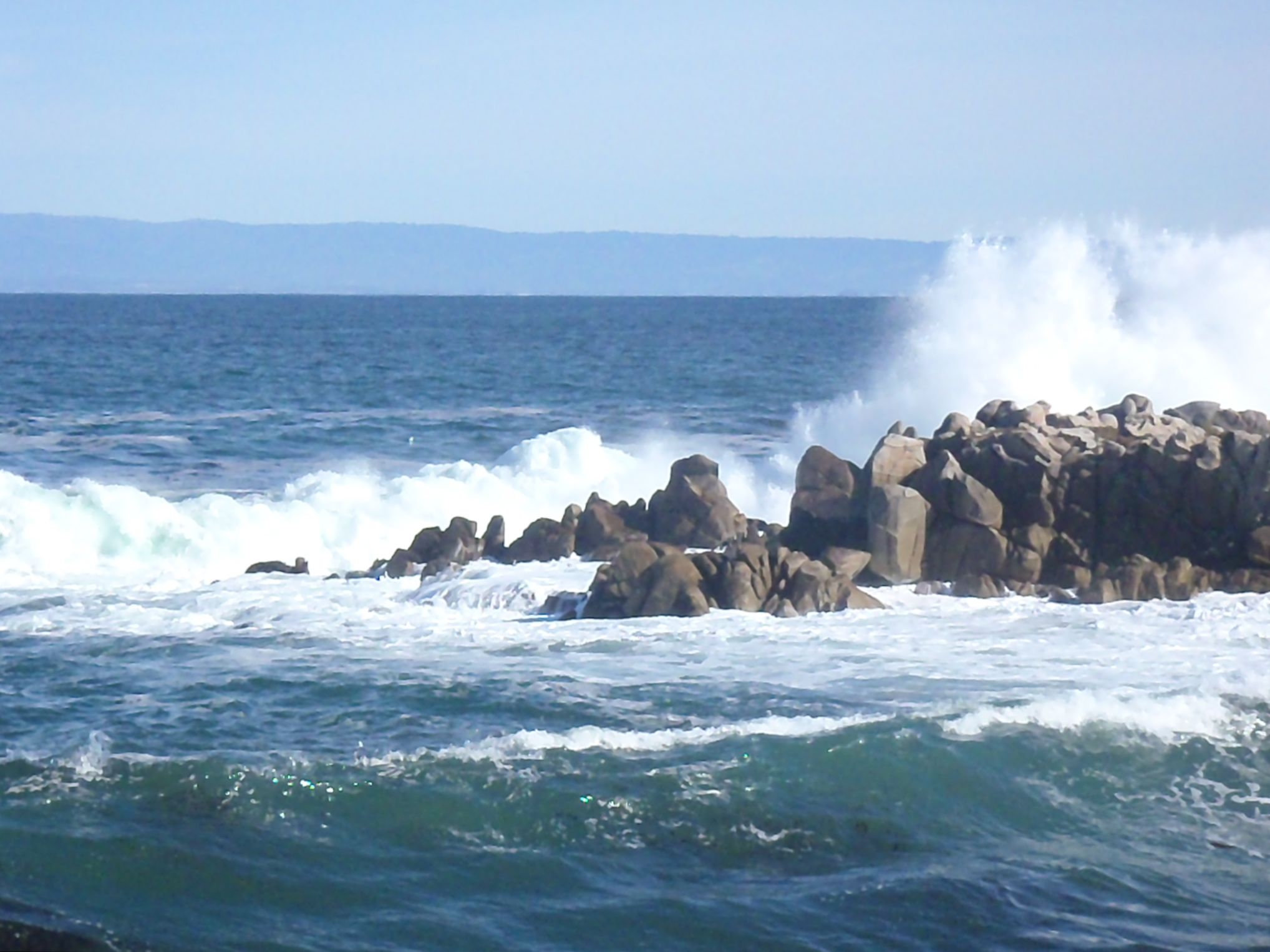 The steady blow, along with large swells, has ruffled the bay, and I think kept the birds grounded. They haven’t been able to gather nesting materials. Winds will be calmer this week, closer to 10 mph (about 9 knots or 16 km/hr). It will also be sunny and there’s no rain in the forecast for a while. The cormorants should be able to get back to work.
I also strolled by the harbor seals on the west beach at Hopkins Marine Station. 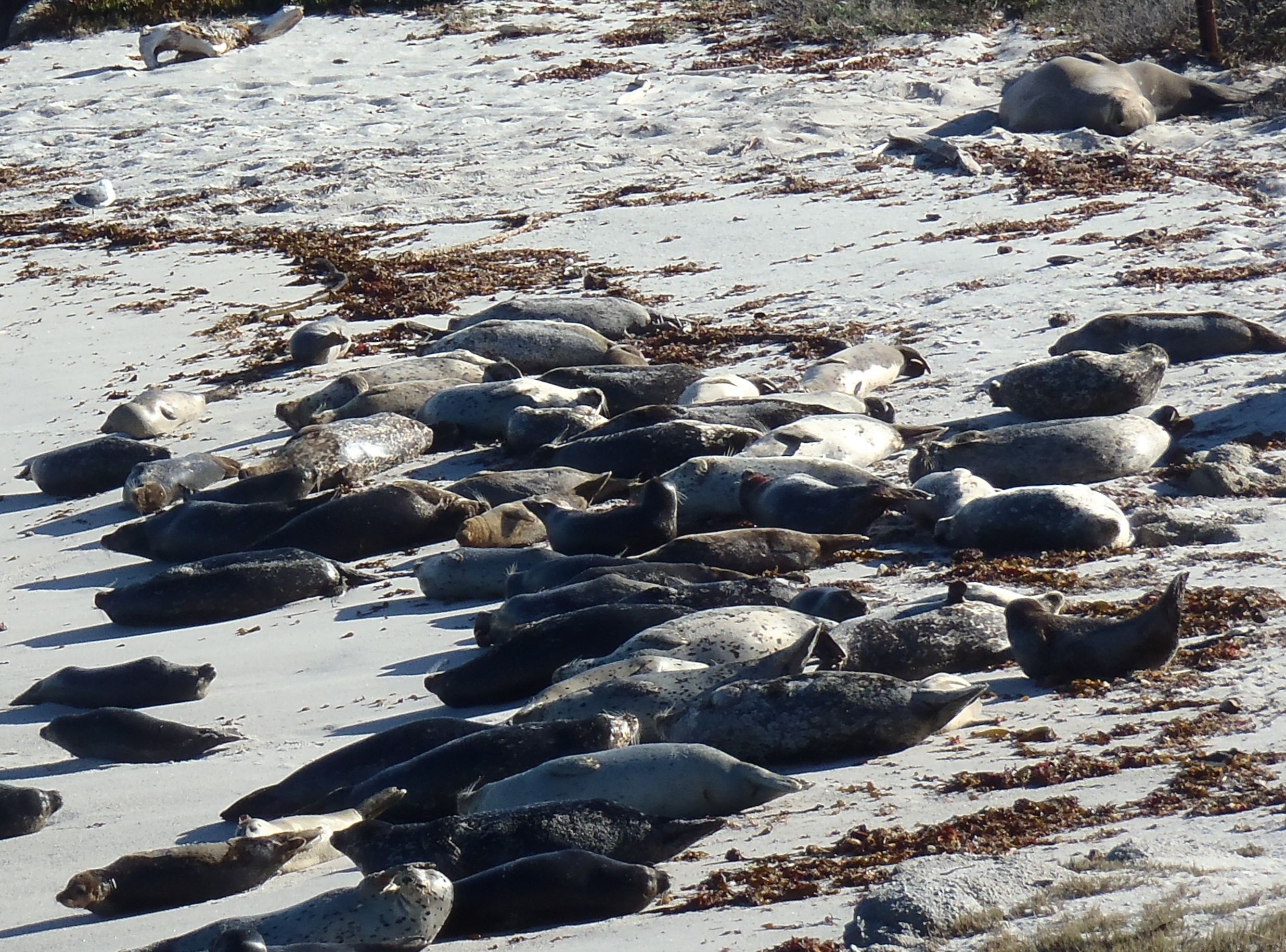 No births yet. It’s still a bit early, but with the sunny, rainless winter we’ve been having, who knows? Sharing the warm beach was the regular lone elephant seal (in the upper right corner), snoozing away. The much smaller harbor seals give him plenty of space.
Even though not much had changed since my last visit, it was a good day for a walk.
Cost $$ of marine debris
As a child, I collected seashells and other interesting objects I found on the beach. These days when I walk the beaches of Monterey Bay, I don’t find the same things. I find bottle caps, plastic bottles, food containers, balloons, shoes, toys… the list goes on. During recent kayak trips, I’ve picked up a floating green tub and a child’s pink crocs shoe.  Sadly, marine debris is everywhere. We know it’s unsightly and harmful, but did you know that it’s also costly?
According to a 2012 study (Stickel et al.), that I just read, combatting marine debris costs the three U.S. West Coast states an estimated US $520 million — more than half-a-billion dollars — each year. (This doesn’t account for waves of debris on the way from Japan’s 2011 tsunami.)
Because everything eventually flows to the ocean, this cost included beach and waterway cleanup, street sweeping, installation of stormwater capture devices, storm drain cleaning and maintenance (Did you see the Dirty Jobs storm drain episode? So gross!), manual cleanup of litter, and public anti‐littering campaigns (to encourage us to be decent citizens).
Just think of all of the other important things we could spend that money on if we weren’t spending it on debris control and cleanup. So please, share this news and watch your waste. Dispose of it properly (check with your local waste management agency), join a cleanup event, and when you encounter debris on the beach, pick it up and trash it. Every little bit you do helps. This has always made environmental and civic sense, and now it makes economical sense, too.
~~~~~~~~~~~~~~
Sources
Stickel, B.H., Jahn, A. & Kier, W. (2012). The Cost to West Coast Communities of Dealing with Trash, Reducing Marine Debris. Report prepared by Kier Associates for U.S. Environmental Protection Agency, Region 9. Report and more information available via the EPA here.
Resources
365 Days of Trash: One man’s attempt to throw nothing away for a year… and beyond. This blog has good tips for reducing waste.
Daily Ocean: A beach cleanup revolution. The next chapter for Sara Bayles who blogged about her collection of over 1,300 pounds of trash off her California beach during 365 beach cleanups.
NOAA Marine Debris Program: Helpful strategies to deal with marine debris.
NOAA. (2008). Interagency Report on Marine Debris Sources, Impacts, Strategies & Recommendations. Congressional Report Developed by Interagency Marine Debris Coordinating Committee. Available at (NOTE: pdf link): http://marinedebris.noaa.gov/about/pdfs/imdccreport.pdf
Sea lions vs. cormorants
Barking, raucous sea lions have been dominating the Monterey breakwater. It’s a perfect spot for young males (mostly) to rest in the winter sun. But that’s about to change.  Yesterday a cormorant carrying a wad of algae and seagrasses flew past me. It was my first sighting this season of them nesting. Soon cormorants (mostly Brandt’s on the breakwater) will take the territory and dominate it through summer. I’ll be watching and keep you posted on this annual cycle. (Visit my bestiary for more about local California sea lions or species of cormorants.)
Discovering surfbirds
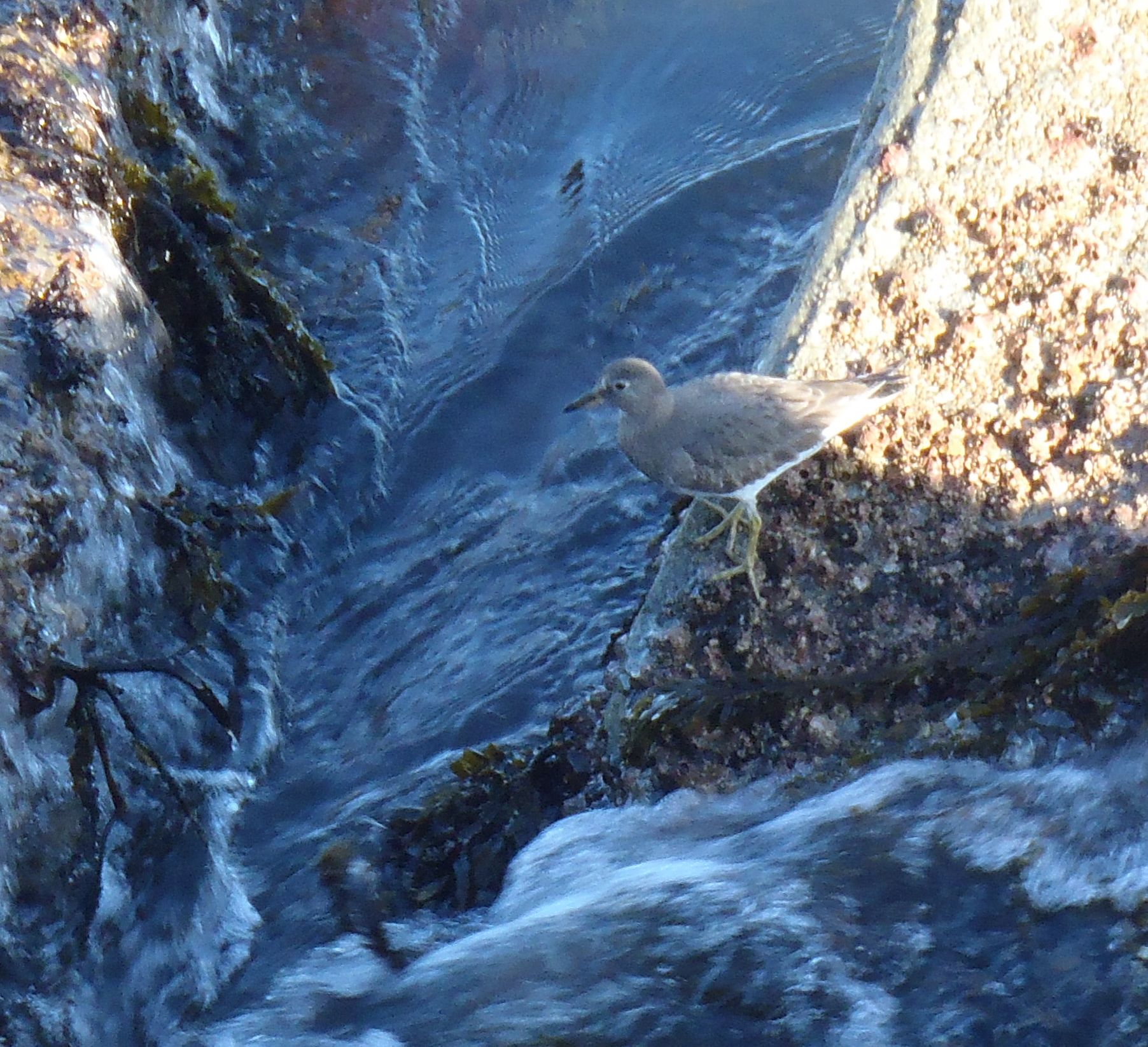 I recently discovered surfbirds (Aphriza virgata) with the help of a local birding group. Unless you’re looking for them,
or watching rocks and one happens by, they’re hard to spot. I’ve seen them at the surfline on Monterey’s Coast Guard breakwater and along our rocky shores. They’re small, stocky gray birds (I know, non-descript) and easy to confuse with turnstones, which share the same space, however surfbirds have yellow legs.
Scientists have had a tough time classifying surfbirds. They’re in their own genus in the sandpiper family (Scolopacidae). But there’s question about whether or not that’s right. They’re viewed as an intermediate between turnstones (genus Arenaria) and knots (genus Calidris) with characteristics of both (Livezey 2010). Some think that they may be more closely related to knots.
Along Monterey Bay, most surfbirds are winter visitors (although some stay on as residents according to the SIMoN species database). They actually winter along the shore from Alaska to Chile. I’m not sure why I’ve never noticed them before, maybe not paying attention or mistaking them for turnstones (this photo shows a surfbird in front of a turnstone — they do look different when side-by-side). 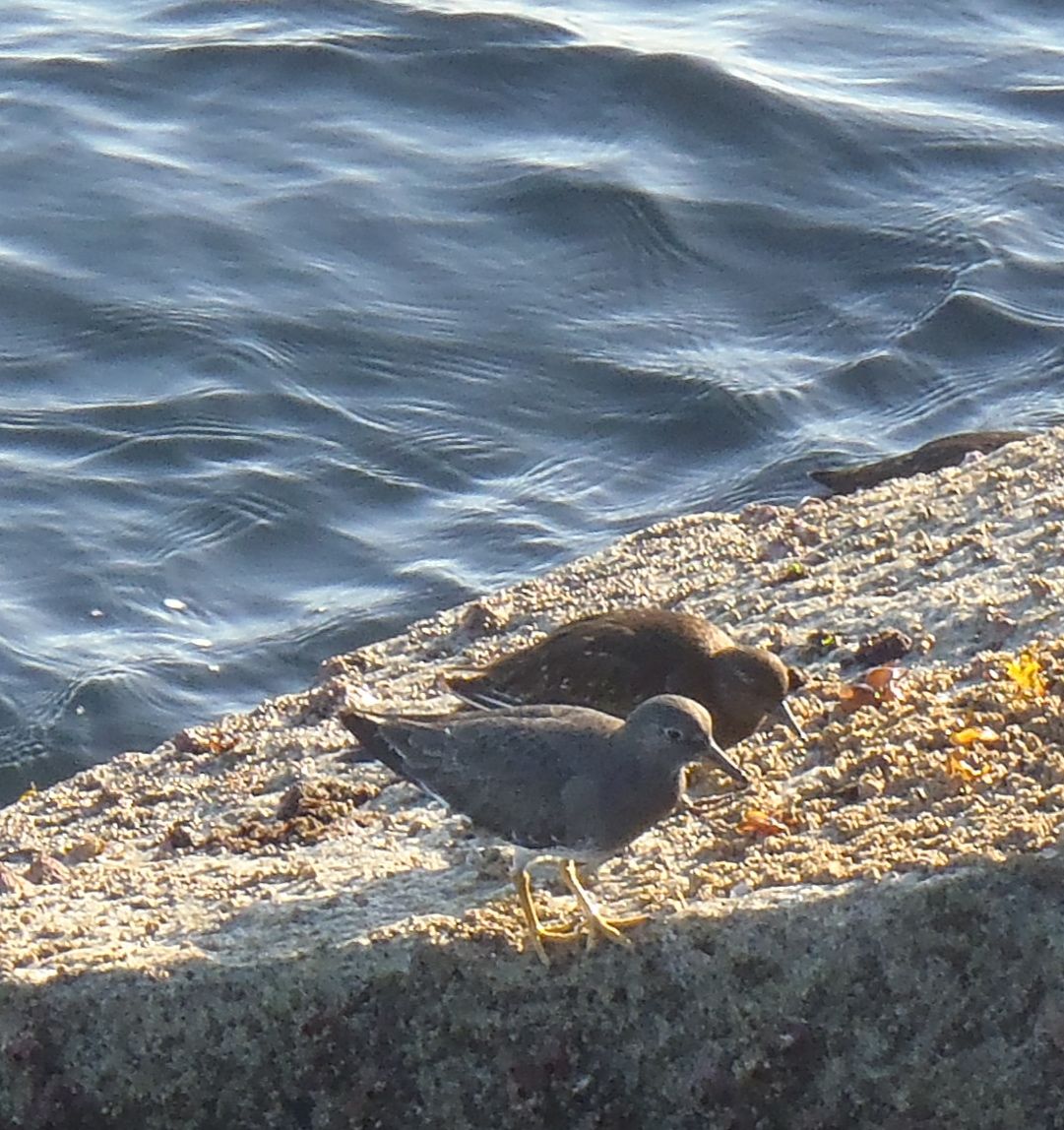 Like turnstones, surfbirds dodge the surf while probing rocks for molluscs (snails, barnacles, etc.) and crustaceans (crabs, etc.) The Cornell Lab All about Birds site says they pull up mussels and barnacles and swallow them whole (one wonders how the rest of the digestive process goes).
I admire anything that can make a living in the intertidal, especially along the surfline. It’s a physically rough place. These small, tough birds, amid the raucous sea lions and gulls, are interesting to watch when you can find them.


 WordCraft.NatureFocus