
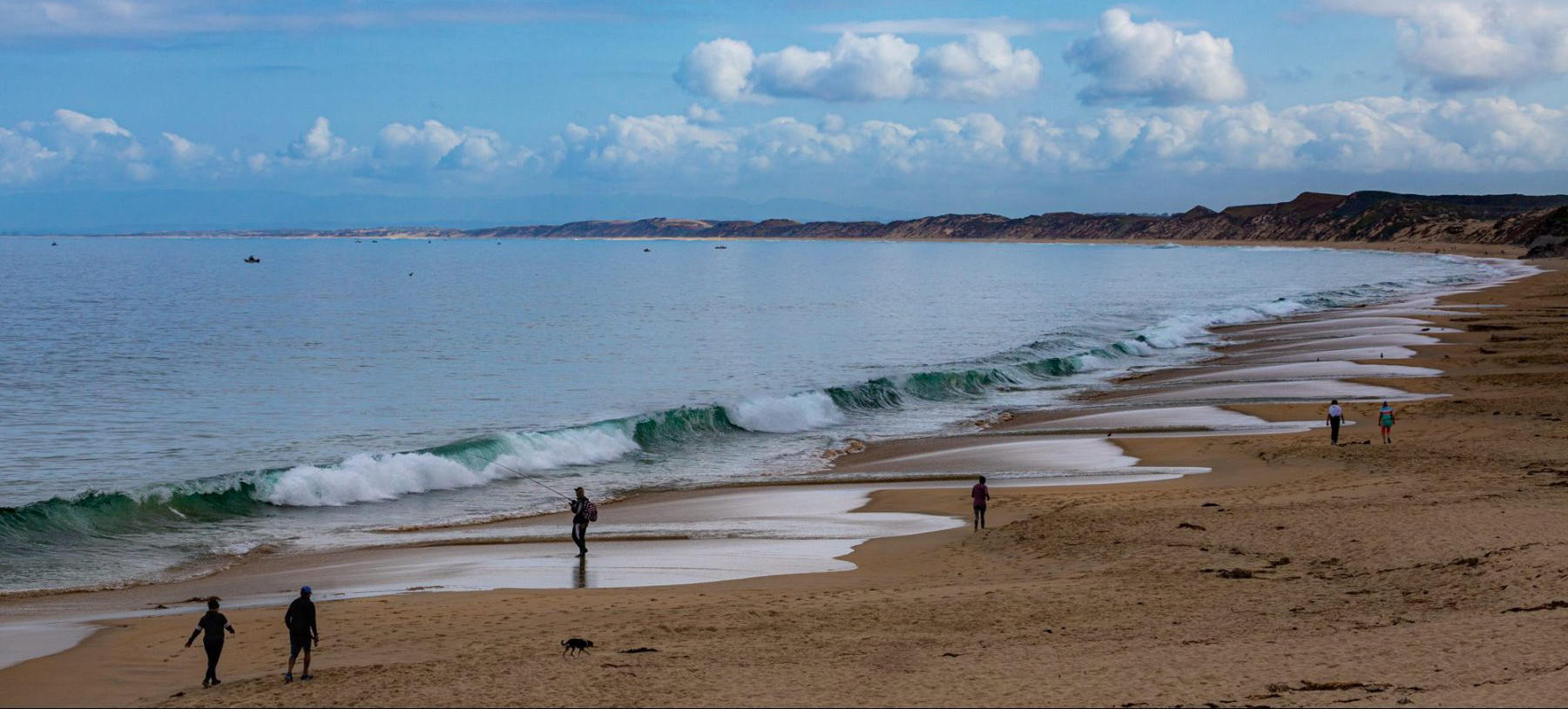
Sea lions vs. cormorants
Barking, raucous sea lions have been dominating the Monterey breakwater. It’s a perfect spot for young males (mostly) to rest in the winter sun. But that’s about to change.  Yesterday a cormorant carrying a wad of algae and seagrasses flew past me. It was my first sighting this season of them nesting. Soon cormorants (mostly Brandt’s on the breakwater) will take the territory and dominate it through summer. I’ll be watching and keep you posted on this annual cycle. (Visit my bestiary for more about local California sea lions or species of cormorants.)
Discovering surfbirds
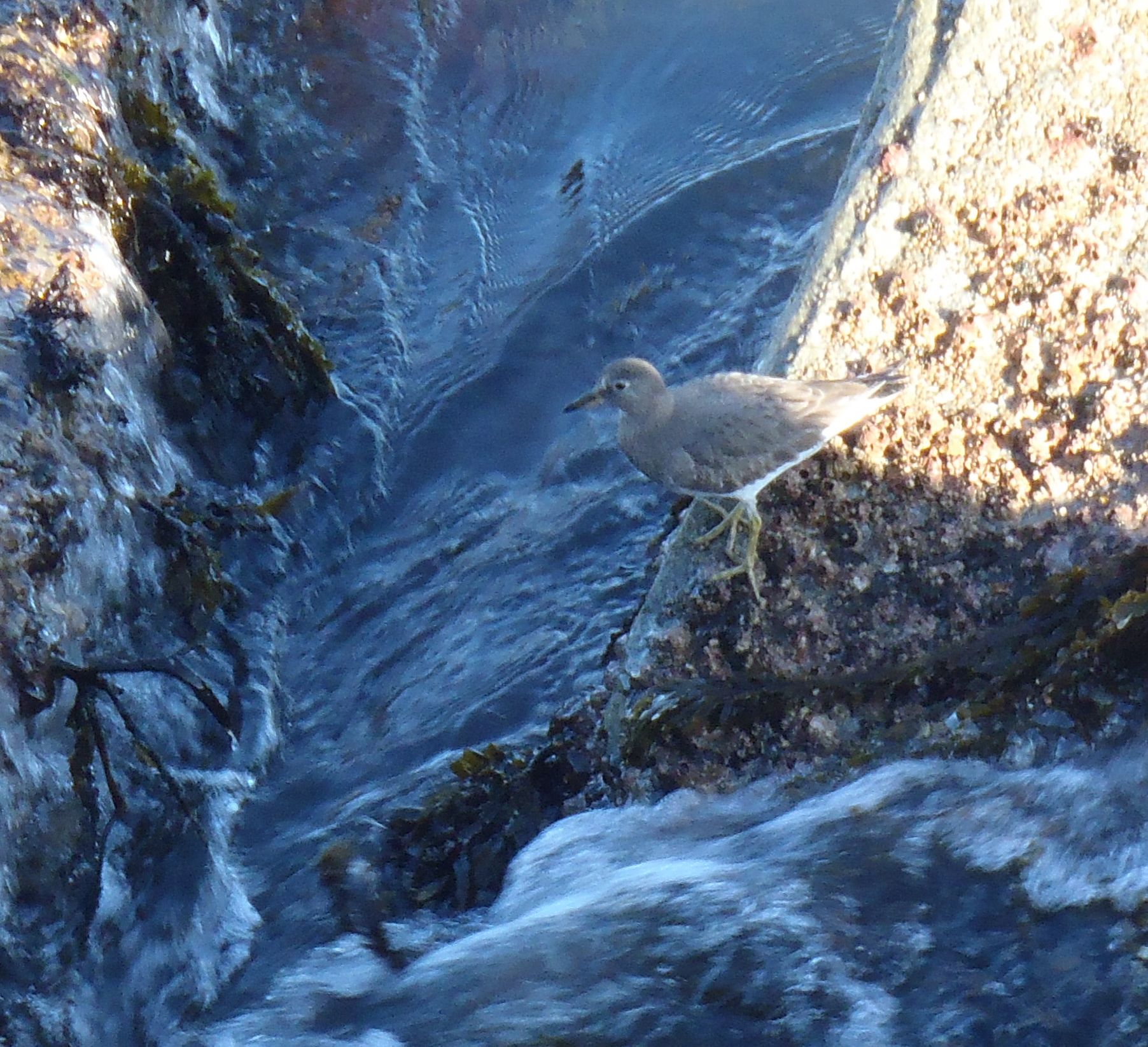 I recently discovered surfbirds (Aphriza virgata) with the help of a local birding group. Unless you’re looking for them,
or watching rocks and one happens by, they’re hard to spot. I’ve seen them at the surfline on Monterey’s Coast Guard breakwater and along our rocky shores. They’re small, stocky gray birds (I know, non-descript) and easy to confuse with turnstones, which share the same space, however surfbirds have yellow legs.
Scientists have had a tough time classifying surfbirds. They’re in their own genus in the sandpiper family (Scolopacidae). But there’s question about whether or not that’s right. They’re viewed as an intermediate between turnstones (genus Arenaria) and knots (genus Calidris) with characteristics of both (Livezey 2010). Some think that they may be more closely related to knots.
Along Monterey Bay, most surfbirds are winter visitors (although some stay on as residents according to the SIMoN species database). They actually winter along the shore from Alaska to Chile. I’m not sure why I’ve never noticed them before, maybe not paying attention or mistaking them for turnstones (this photo shows a surfbird in front of a turnstone — they do look different when side-by-side). 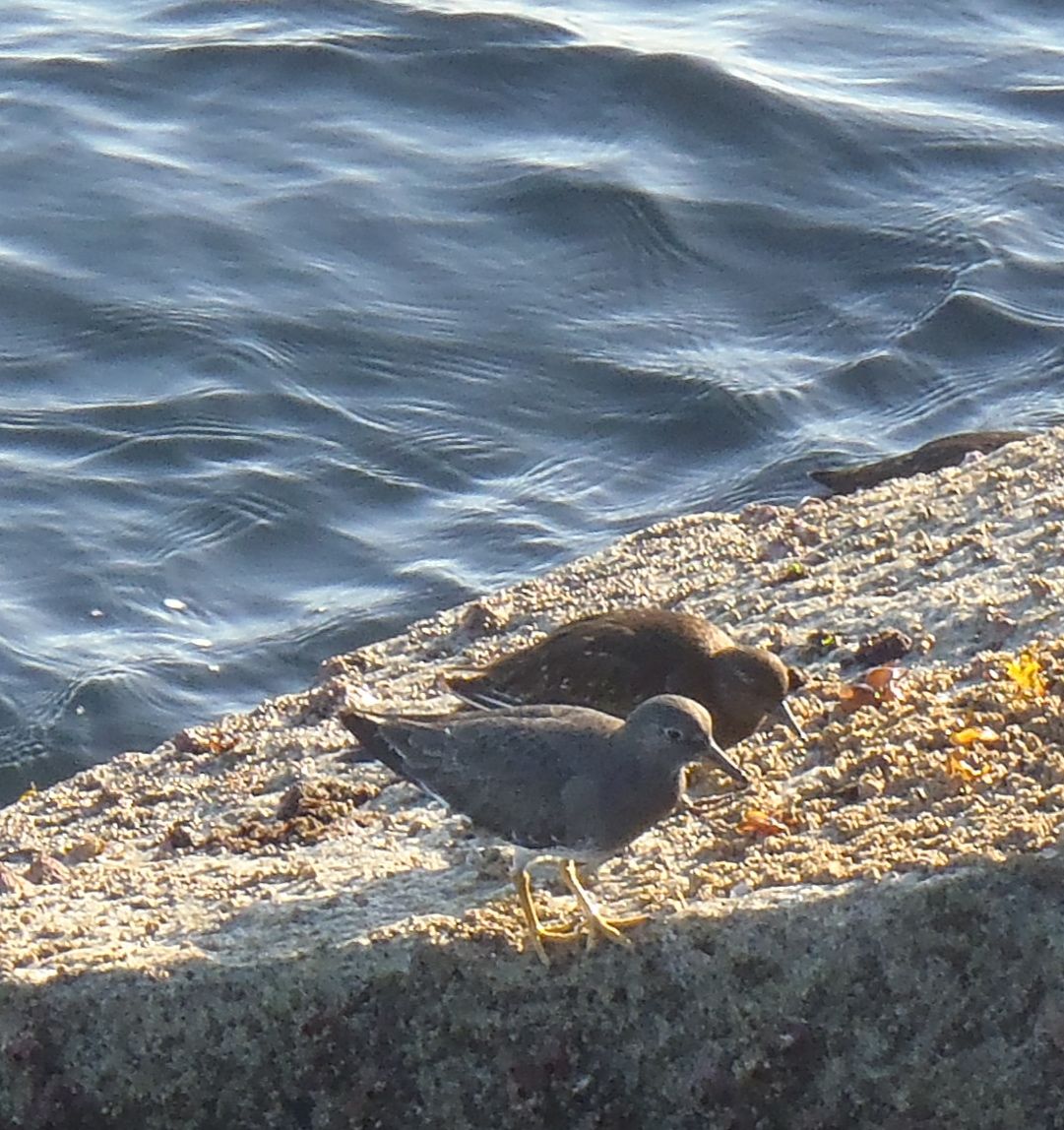 Like turnstones, surfbirds dodge the surf while probing rocks for molluscs (snails, barnacles, etc.) and crustaceans (crabs, etc.) The Cornell Lab All about Birds site says they pull up mussels and barnacles and swallow them whole (one wonders how the rest of the digestive process goes).
I admire anything that can make a living in the intertidal, especially along the surfline. It’s a physically rough place. These small, tough birds, amid the raucous sea lions and gulls, are interesting to watch when you can find them.
~~~~~~~~~~~~~~
Sources
Livezey, B.C. (2010). Phylogenetics of modern shorebirds (Charadriiformes) based on phenotypic evidence: analysis and discussion. Zoological Journal of the Linnean Society, 160: 567–618. doi: 10.1111/j.1096-3642.2010.00635.x
SIMoN (Sanctuary Integrated Monitoring Network) Species Database: Surfbird
The Cornell Lab of Ornithology All About Birds: Surfbird
Birder or not?
I’ve never thought of myself as a birder. I don’t go looking for birds specifically when I kayak or walk the bay. I’m more of a wildlife-watcher who sees birds. They are fascinating and I see a fair share (according to Don Roberson’s Monterey Birds book there are 482 bird species in the Monterey Bay area). I’m entertained by busily nesting cormorants. I’ve chuckled at the bright clown feet of pigeon guillemots.  I admire the zenlike focus of a great egret fishing on an undulating kelp canopy. But I’ve never considered myself a birder. However, this blog is a confession. I’m becoming one.
I decided to learn more about my local birds (an interest but serious weakness) and signed up for a bird-watching class with Brian Weed through the Pacific Grove Adult School. We meet once a week. Most of my classmates are well-seasoned birders and they’ve been very nice and patient with me (especially with identifying little brown birds — it is winter!).
I recently learned that as a non-birder, I’m in a minority group. According to the 2011 National Survey of Fishing, Hunting, and Wildlife-Associated Recreation (which includes wildlife- and bird-watching), 71.8 million people in the U.S. last year spent time watching wildlife and “birds attracted the biggest following” — about 46.7 million people over 16 years of age. (That’s a lot of people.) What I found even more amazing was that wildlife-watchers (including birders) spent about 55 billion U.S. dollars (yes, billions) to watch wildlife — for everything from food and plants at home to equipment, meals and lodging for trips away from home.
After last week’s birding class, I understand why. Our group was standing along the shoreline identifying what we could see.  There were pelagic cormorants flying by, Brandt’s cormorants and Western gulls on the rocks, a pair of red-breasted mergansers in the water with a few small grebes (eared or pied-billed — I know, they’re different). Our teacher, Brian, mentioned that the trees behind us usually host a peregrine falcon, but it wasn’t there. (For those of you who don’t know, peregrines hunt birds, which was what we were watching.) Then Brian spotted the falcon flying toward us. I was thrilled. The magnificent bird flew directly over us, and I have to admit that my binoculars were glued on him/her during the entire brief pass. [One study calculated a peregrine dive at 238 mph, (383 km/h), but cruise speed is more like 25 to 35 mph (40 to 56 km/h)].
This sighting is precious given our history with this species (as well as pelicans and others). Peregrine falcons were gone from our skies by 1970 due to the use of the pesticide DDT, which weakened egg shells. The 1972 ban on the use of DDT in the U.S., along with reintroductions of peregrines, especially in cities where they eat pigeons, have resulted in an amazing comeback. In 1999, the U.S. Fish & Wildlife Service removed the species from the Endangered and Threatened Species List; in 2009, California removed it from the state endangered species list.
When the peregrine we were watching got close to the water, a group of gulls starting mobbing it (a bird harassment tactic). The falcon mostly ignored them and kept circling over the shallow wave wash between offshore rocks and the shoreline. Brian explained that typical peregrine hunting behavior is to circle multiple times over potential prey until the angle and time are right. We were mesmerized. Then boom. In an instant, the peregrine dropped onto the water and lifted off with a little grebe. We were stunned, thrilled and a bit sad (for the grebe). With its catch, the peregrine flew into trees beyond our view. Our lovely morning birding walk had turned dramatic, and this was just the first 10 minutes of class! (For some amazing photos of peregrines catching shorebirds, visit Will James Sooter’s website, but not if you love shorebirds.)
For the next two hours we identified about 25 different seabird and shorebird species, some locals and many migrants. I got to see five different species of gull on one rock so that I could compare and contrast them (one of my goals is to learn my gulls).
I had always been a bit dismissive of birders with binoculars, making notes on life lists, and blocking my walking path. No more. I now have a great appreciation for what birding is all about — and I’m hooked.


 WordCraft.NatureFocus