
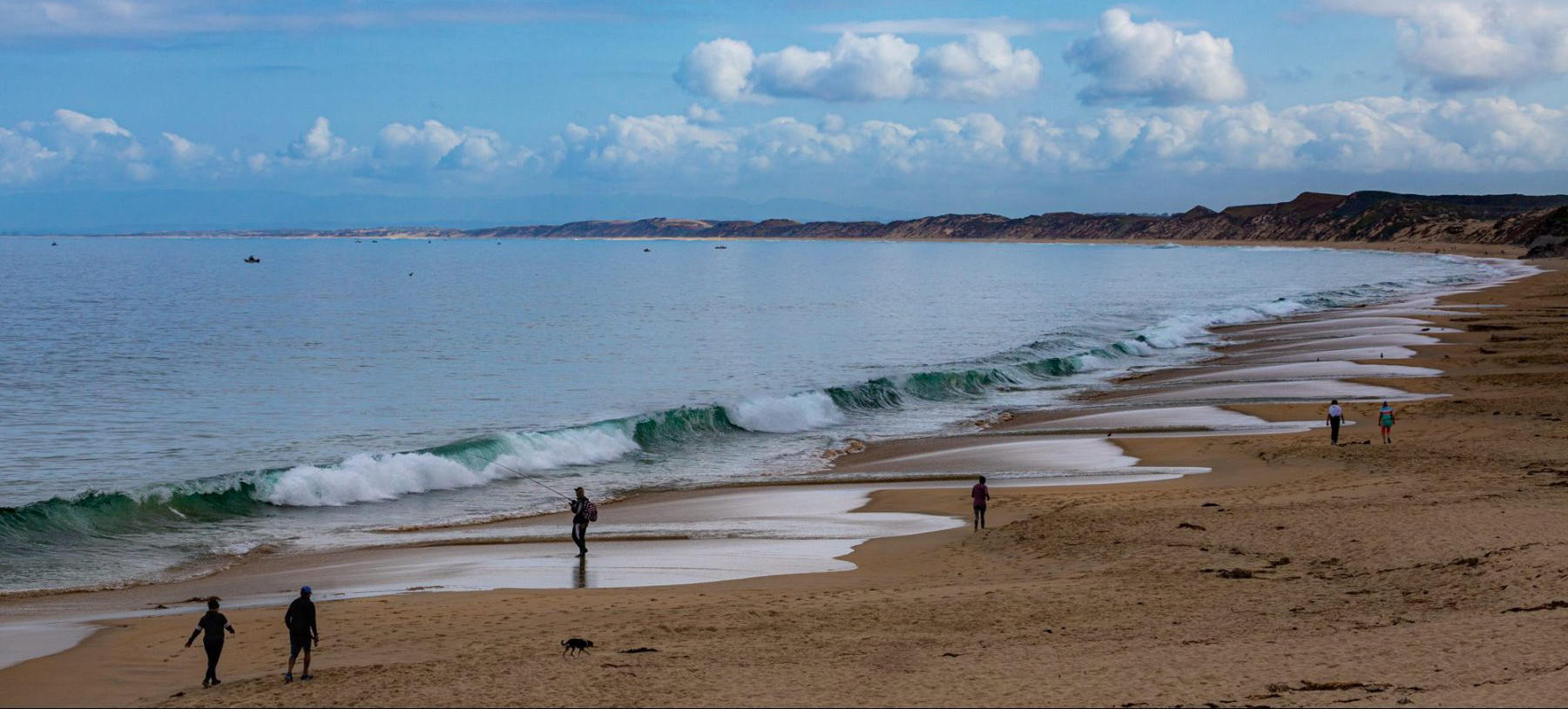
Breakwater spring melee
See my new post on the fence blocking the view of the cormorants at Breakwater blues.
 Now is the time when California sea lions and Brandt’s cormorants battle for control of the Monterey Breakwater. The breakwater is a favored hauling-out hangout for male sea lions during most of the year, but in the spring, Brandt’s cormorants gather for displaying, mating, nesting and rearing young (pelagic and double-crested cormorants choose more private rookery sites).
Right now you can watch the cormorants starting to stake territory with nests while slowing moving the sea lions off the rocks. (It’s a king-of-the-hill game and eventually sea lions lose to the jabs of the cormorants’ pointy bills.)
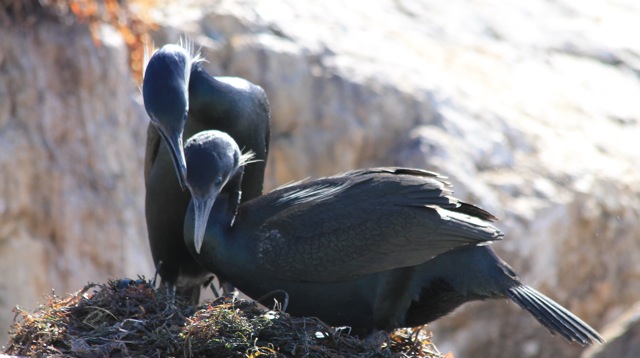 Over the next several months, if this year is typical, the top of the breakwater will change from mostly brown (sea lions) to nearly all black and white (cormorants and guano-covered nests). You can get a great close-up view by taking a short walk from the parking lot down the paved lane to the end where a fence separates people and wildlife.

Surfbirds
While you stroll, observe the divers and anglers, surfbirds, black turnstones, an occasional sea otter and the spectacular view.

Black turnstone

Sea otter
Sea ducks by the seashore
 Just beyond the breakers, dark blotches appear on Monterey Bay during winter (December to March). Sometimes they’re widely scattered, sometimes in patches. Sighted from shore, they’re a monochromatic, homogenous, nondescript sprinkling of floating birds. At least that’s what I thought until I looked closer and found a delightful diversity of sea ducks. Generally, ducks don’t excite me, but this year these captured my curiosity.
 Sea ducks spend much of their time (especially winter) in coastal marine environments and are active diving birds pursuing crustaceans (sand crabs, etc.) and molluscs (clams, etc.). A few species dive for fish and some eat plant material. They visit the bay in winter for the gentle weather and plentiful fresh food (like most of our visitors). During recent walks, I’ve watched and photographed surf scoters, greater scaups, common goldeneyes, buffleheads, red-breasted mergansers and an aerial aquatic predator (more about that later).
 Surf scoters (Melanitta perspicillata) are one of the easiest sea ducks to identify. In this photo a female is bookended by males. As you can see, they’re an all-black bird with a distinctively swollen bill, like a large schnoz. The male’s multi-colored bill brightens up for breeding season and he develops white display patches on the forehead and back of the head. Females remain a nondescript brownish-black with a bit of white at the base of the bill and just below the eye, like a touch of highlighter.
 I especially enjoy watching a surf scoter dive beneath a breaking wave and then surface with a sand crab in its bill (surfacing with food makes watching sea ducks interesting). These birds travel in small groups and very big ones. The worldwide population is large — maybe over a million birds (no one’s sure) — but has been declining. There’s not a lot of concern (see IUCN Conservation Status below), but not a lot is known about them (surprising to me). Researchers are working on tracking birds from wintering sites to forested breeding grounds in Alaska and Canada to learn more about them and determine the reason(s) for the decline. Quality Arctic breeding habitat, food availability and pollution are likely contributing factors.
 Greater scaups (Aythya marila) look like typical ducks to me. In this photo, the female is in the fore and males in back. A mature male has a nearly black head, breast and tail with a whitish body. Female are grayish-brown. You can identify her by the white around the base of her bill. A closer shot (the second photo above) shows the bill is a lovely bluish-gray.
 Greater scaups are omnivores (eating whatever’s edible, like us). I see them diving for sand crabs (abundant along our sandy beaches), but they’ll also take mussels, clams, worms and plants. Because they feed close to shore, they’re susceptible to oil spills and polluting urban runoff. As with the surf scoter, the worldwide population of this species is large (over 1 million) and is in decline.
 Common goldeneye (Bucephala clangula) is one of the lovelier sea ducks, but I’ve found it challenging to get good shots (not their fault although they seem to spend less time here than the others). The male’s body is mostly white and the head is black with a round white spot below the eye. The female’s body is gray and her head is chocolate-brown. While here, they appear to dive for molluscs and crustaceans mostly, but can eat a variety of prey. The estimated population is 2.5 to 4.6 million individuals (wow) and is regarded as stable (nice to relay good news). This species lives throughout the northern hemisphere, breeding around the Arctic then migrating south for the winter.
 The bufflehead (Bucephala albeola) is the smallest bird on this list of sea ducks. I see them on the ocean and in local lagoons. They’re very distinctive, especially the male, and easy to identify. Both males and females have a large rounded head. On the back of the male’s head is a white patch, like ear muffs, and his face is masked in reflective green and purple feathers. His back is black and the rest of the body is mostly white.
 Females are plain gray-brown and adorably petite (not very scientific, I know, but they are). They’re easy to identify by the small white highlight patch on the cheek just below the eye. Buffleheads are very active. As soon as I get one or more in my viewfinder, they quickly disappear, diving for crustaceans, molluscs and fishes. I’ve recently learned that they swallow their food whole while under water, which explains why I don’t usually spot them at the surface with a catch. The good bufflehead news is that the worldwide population is large (more than 1 million) and increasing.
 The red-breasted merganser (Mergus serrator) looks nothing like a duck. However, its behaviors are very much like those of the other sea ducks. They look different because they’re built for spear fishing. Red-breasted mergansers have a sleek, slender body and a long, sharp red bill. They’re easy to identify by the shaggy, spiky crest of feathers that sticks out wet or dry (like a bad haircut). Adult males and females look very similar during the winter. In the spring, breeding males develop a darker head and white neck bank. The global population is estimated at about half-a-million individuals (which helps explain why we see fewer of them than the other sea ducks) and is considered stable.
 These sea ducks aren’t usually alone on the bay. Among them are often grebes (also busy diving for sand crabs), cormorants (diving for nesting material very early this year) and gulls (just chilling). On a January walk the view included an aerial aquatic predator, an
 osprey (Pandion haliaetus) circling overhead. No matter how many times I see one, I’m impressed. The osprey is a fish-eater and so the sea ducks have nothing to fear, except maybe a little competition. They didn’t seem disturbed by this large hawk’s presence. (I have seen a peregrine falcon go after a grebe on the water, but that’s another story.) Ospreys catch fish with their feet. I didn’t get to see a catch on this day, but just watching it circle overhead was a treat. The osprey population has, and continues to, rebound since the U.S. ban on DDT use in 1972, along with efforts to reintroduce birds and provide nest platforms. From a conservation perspective, this is a great success story.
The current conservation news for all of these species is relatively good. Their IUCN Conservation Status is listed as “least concern.” However, the future may not be as bright. Any birds that spend considerable time near urban areas are vulnerable. Ocean diving birds run into deadly problems with fishing nets, lines and other equipment. I’m sure that birds that rely on Arctic breeding grounds are very vulnerable to the changes there due to warming. In a 2011 PLoS One article, buffleheads and osprey were included on a list that ranked California shoreline birds vulnerable to climate change. We all need to be vigilant to keep habitats healthy and to reduce our carbon use/production. I’d like to be able to witness the bay’s winter sprinkling of sea ducks well into the future.
~~~~~~~
Sources & Resources
Avibase (Avian database)
Birds of North America: Waterfowl: Sea Ducks
Diaz-Bastin, R. (2014, Feb. 6). Richardson Bay sets winter bird count record. Bay Nature.
Gardali, T. et al. (2011). A Climate Change Vulnerability Assessment of California’s At-Risk Birds. PLoS ONE 7(3): e29507.doi:10.1371/journal.pone.0029507.
IUCN (International Union for Conservation of Nature and Natural Resources) Red List of Threatened Species
SeaDucks.org
The Sea Duck Joint Venture
Wetlands International: Duck Specialist Group
Elephant seal portraits 2: Females and pups
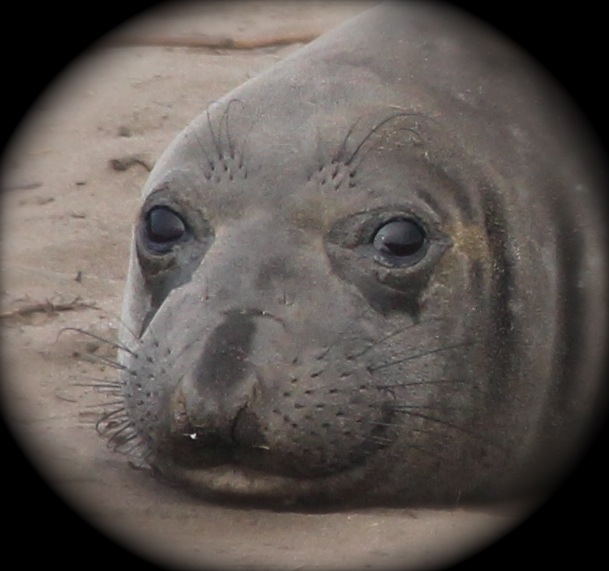 Winter brings elephant seals to the California coast — massive bellicose males and weary pregnant-plump females that deliver baggy newborns. Their annual ritual along remote beaches and among sand dunes starting in December includes battling, birthing, mating and, by April, molting.
We see a few individuals in Monterey Bay (Hopkins Marine Station Beach and recently Del Monte Beach), but don’t have a large colony. The closest is at Año Nuevo State Park about 60 miles (97 km) north of Monterey. For many people, viewing elephant seals while they’re visiting is a winter tradition. It’s quite a sight and these portraits of females and pups are from my January trip to Año Nuevo.
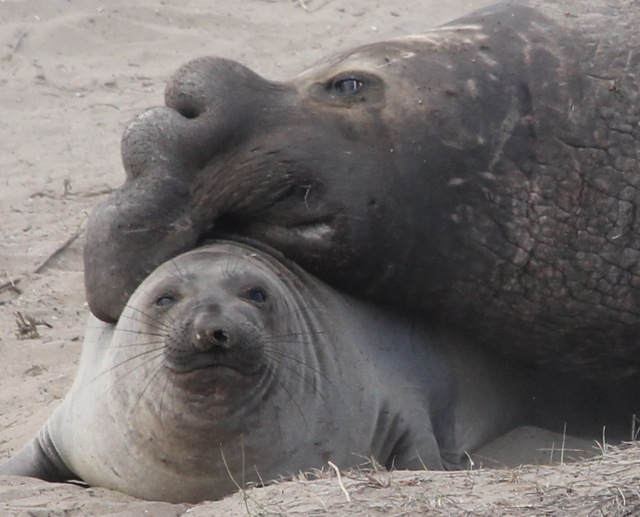
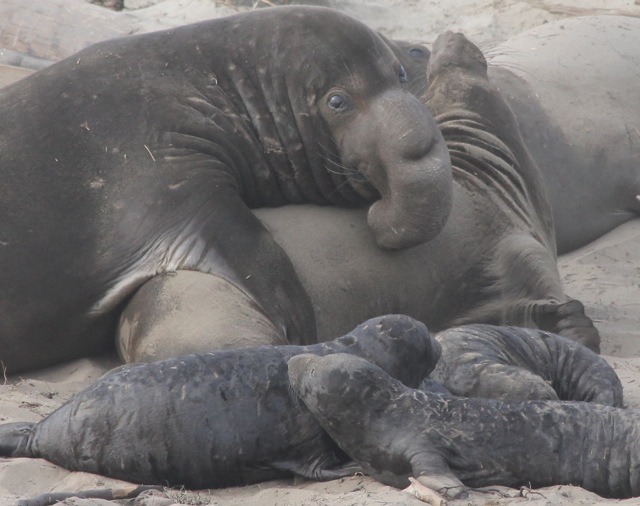
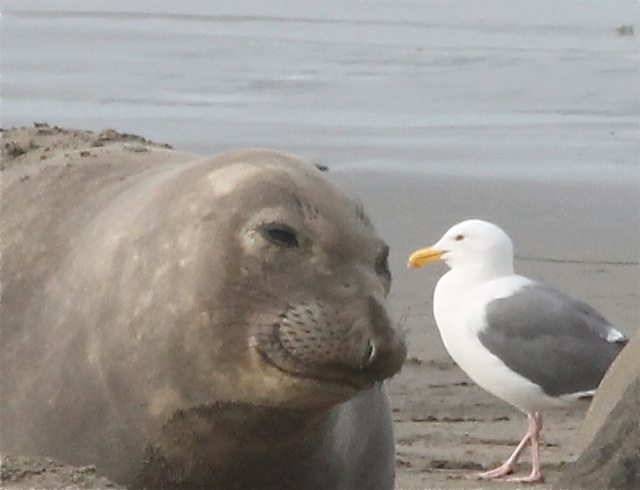 The females usually arrive at the rookery later than the males, often after or while bulls are establishing beachheads. In the colony, females aren’t as showy as the males (sorry gals), but they’re more numerous and noticeably full-figured. An adult female grows to about 10 feet (3.1 m) on average and may weigh nearly 2,000 pounds (900 kg). They need to be that big because they won’t eat anything while on the beach. Early arrivers try to pick a spot near the alpha male, close to his inner circle. This offers some protection from harassment by other males and battles at the edge of the colony.
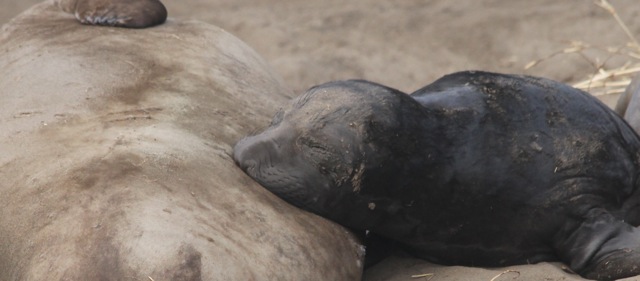 Within days of arrival a pregnant female gives birth to a small, dark pup (newborns appear to be wearing suits three sizes too large). The pup quickly fills out by nursing on mom’s rich milk and within weeks fattens from a weight of about 75 pounds (34 kg) to nearly 300 pounds (136 kg).
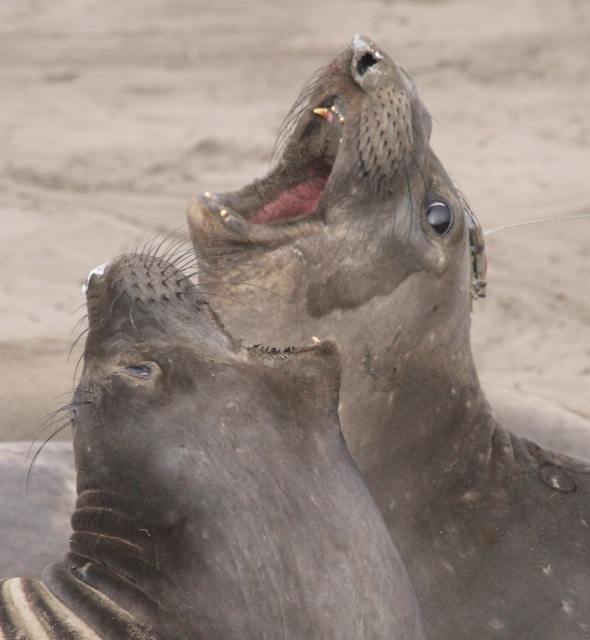 Females don’t fight as violently as the males, but they do quarrel. The colony is crowded and large adults can easily crush a pup. Females battle for prime real estate in the harem and to maintain space between their young ones and other adults.
While a pup is growing, its mother may mate several times (those interactions are another story). Then, at about 4 weeks, she abandons her rotund “weaner” (if all went well) and returns to the sea. The pup remains for a while until it molts and learns to swim.
 Note: For more about the colony, visit my portraits of males or consult the references below.
There’s a considerable amount of scientific research being conducted on elephant seals (in these photos you’ll see numbers on some animals and electronic devices epoxied to the fur, which fall off during the annual molt). 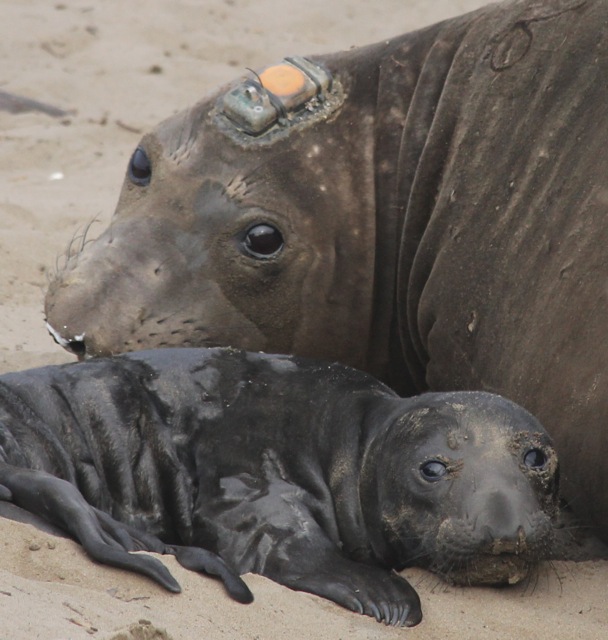
Scientists have learned that the seals’ open-ocean lives are amazing. They travel throughout most of the northeast Pacific Ocean in search of fishes and squid and the current diving record is 5,788 feet (1754 m) — more than a mile. Elephant seals are definitely not the slugs they appear to be on the beach.
The northern elephant seal (Mirounga angustirostris) was thought to be extinct in the late 1880s, hunted for the oil rendered from their copious blubber.  The thousands that we see today were spawned by a small colony on Guadalupe Island off Baja Mexico in the early 1900s. The current population from Mexico to Alaska is estimated to be about 175,000 individuals (although no one is really sure). That number may look good, but the population is vulnerable. Because they are all descendants of a few, their genetic variability is low, which makes the species less adaptable and more vulnerable to disease or environmental changes.
 If you want to see for yourself, here’s a starter list of California spots (from south to north) where you can view elephant seals while they’re ashore. It’s notable that most sites are state or federal parks and protected areas, which we need to continue to support.
Channel Islands National Park & Marine Sanctuary
Piedras Blancas rookery and Friends of the Elephant Seal
Año Nuevo State Park
Farallon Islands (a National Marine Sanctuary and National Wildlife Refuge)
Point Reyes National Seashore
~~~~~~~~~~~~~~
Sources & Resources
Adams, C. & Adams, P. (1999). Elephant Seals (rev ed.). San Luis Obispo, CA: Central Coast Press.
Animal Diversity Web (ADW): Mirounga angustirostris – northern elephant seal
NOAA SIMoN (Sanctuary Integrated Monitoring Network) Special Status Species: Northern elephant seal
Elephant seal portraits 1: Males
 Winter brings elephant seals to the California coast — massive bellicose males and weary pregnant-plump females that deliver baggy newborns. Their annual ritual along remote beaches and among sand dunes starting in December includes battling, birthing, mating and, by April, molting.
We see a few individuals in Monterey Bay (Hopkins Marine Station Beach and recently Del Monte Beach), but don’t have a large colony. The closest is at Año Nuevo State Park about 60 miles (97 km) north of Monterey. For many people, viewing elephant seals while they’re visiting is a winter tradition. It’s quite a sight and these portraits of males are from my January trip to Año Nuevo.
 Males in the colony are the most spectacular and diverse (sorry gals). Their noses, in particular, indicate their development from age 2 to 8 as they grow into the pendulous, inflatable proboscis that’s characteristic of a mature male. (They also make for great portraits.) A fully formed proboscis may overhang the mouth by 8 inches (20 cm) and helps a male intimidate other males (along with his size, posturing and Harley-Davidson motor sounds).
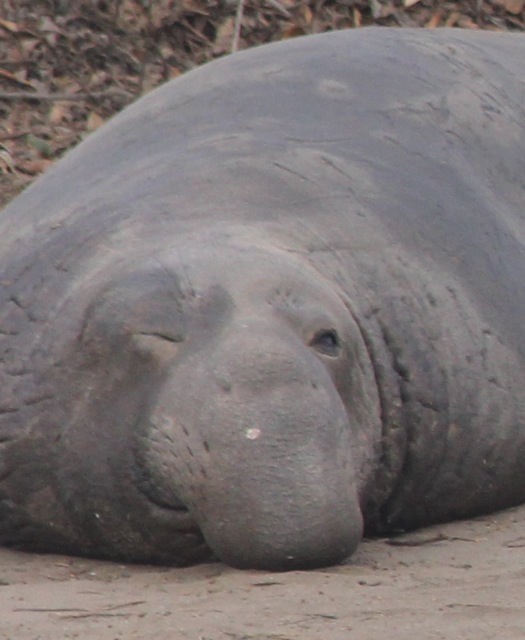 An adult male can grow to 13 feet (4 m) and weigh more than 5,000 pounds (2300 kg) — he’s a huge animal. While at the rookery, a dominant or alpha bull sleeps, defends his harem from other males and mates with the females that have settled near him. Beta bulls cruise the edges of harems for opportunities to mate with females before being run off by the dominant male.
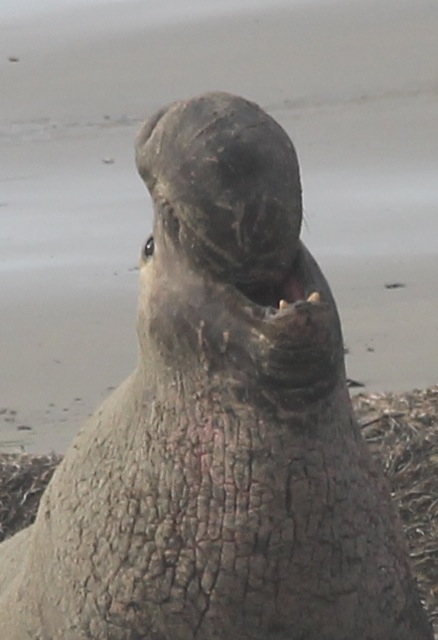 When a beachmaster feels challenged by an interloper, he’ll rear up, throw back his head and bellow his warning. If he can’t scare off the other male, they may engage in a spectacular duel of chest thumping, neck wrestling and biting with long canine teeth. (Younger males fight for position in the hierarchy as well.)
A dominance battle might be bloody, but elephant seals are well-padded and injuries are usually minor. Most battles occur before or as females arrive to give birth. Winning males build and maintain harems and do most of the mating.
Note: For more about the colony, visit my portraits of females and pups or consult the references below.
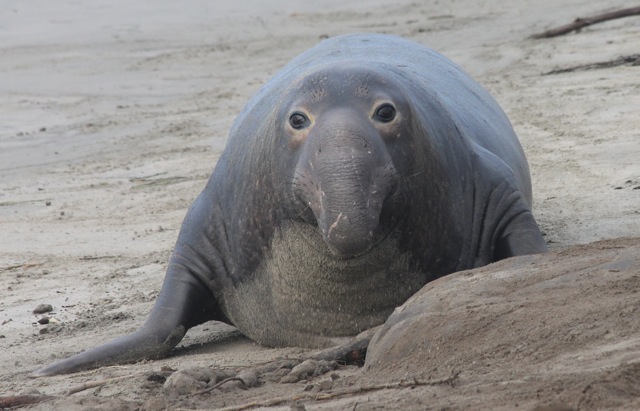 The northern elephant seal (Mirounga angustirostris) was thought to be extinct in the late 1880s, hunted for the oil rendered from their copious blubber. The thousands that we see today were spawned by a small colony on Guadalupe Island off Baja Mexico in the early 1900s.
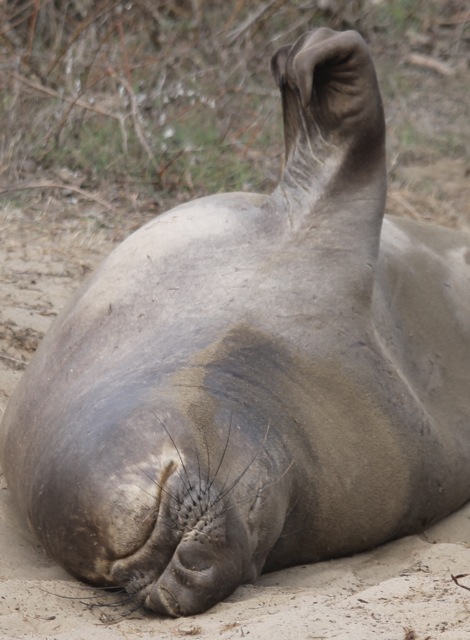 Today, the population from Mexico to Alaska is estimated to be about 175,000 individuals (although no one is really sure). That number may look good, but the population is vulnerable. Because they are all descendants of a few, their genetic variability is low, which makes the species less adaptable and more vulnerable to disease or environmental changes.
If you want to see for yourself, here’s a starter list of California spots (from south to north) where you can view elephant seals while they’re ashore. It’s notable that most sites are state or federal parks and protected areas, which we need to continue to support.
Channel Islands National Park & Marine Sanctuary
Piedras Blancas rookery and Friends of the Elephant Seal
Año Nuevo State Park
Farallon Islands (a National Marine Sanctuary and National Wildlife Refuge)
Point Reyes National Seashore
~~~~~~~~~~~~~~
Sources & Resources
Adams, C. & Adams, P. (1999). Elephant Seals (rev ed.). San Luis Obispo, CA: Central Coast Press.
Animal Diversity Web (ADW): Mirounga angustirostris – northern elephant seal
NOAA SIMoN (Sanctuary Integrated Monitoring Network) Special Status Species: Northern elephant seal
Salps on the sand
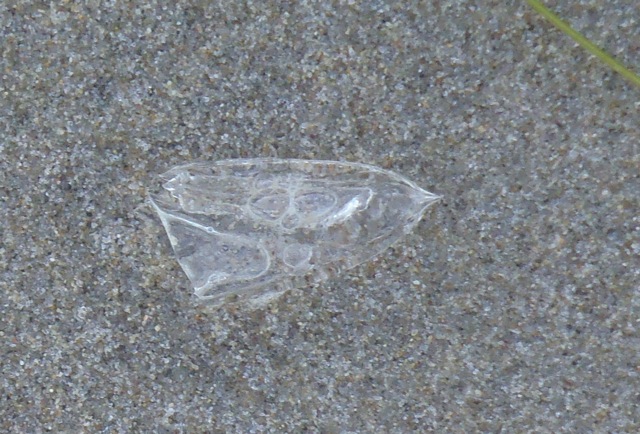 How do you explain a salp? Especially when you find one or more stranded on a sandy beach and don’t know what it is? To start with, a salp is a tunicate (I’m sure that doesn’t mean much to most). Let’s try this. It’s a gelatinous sea animal that looks like a tiny, water-filled, plastic bag. (It feels more like plastic than jelly.)
  Salps are open water (pelagic) sea creatures that swim and feed at the same time — by contracting and pumping water through the body. As the water flows inside, the salp collects bits of living material, especially phytoplankton, for food. Salps can be singular, but also form long lovely chains, or colonies sometimes with many thousands of individuals (see chains in the MBARI photo or YouTube video). They’re most prominent in the waters around Antarctica, but are found in Monterey Bay, too. They’re lovely in the water, but I also found them attractive littering the sand.
 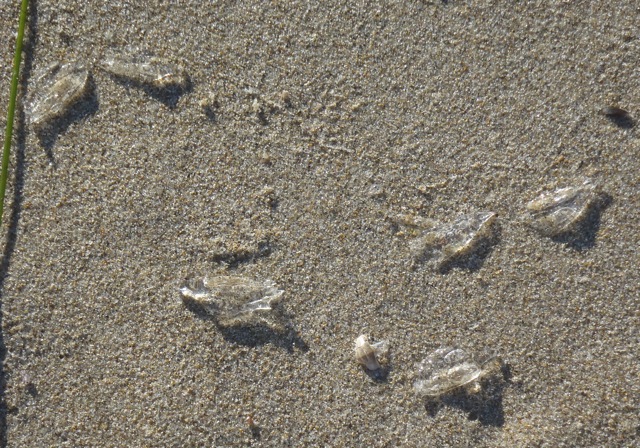 One of the most intriguing things about this simple-looking animal is its complex life cycle. The generations alternate from asexual single individuals producing clones to sexual colonies which include young females that age and grow into males. Offspring of the colony take up the single asexual life, hence closing the life-cycle loop.
 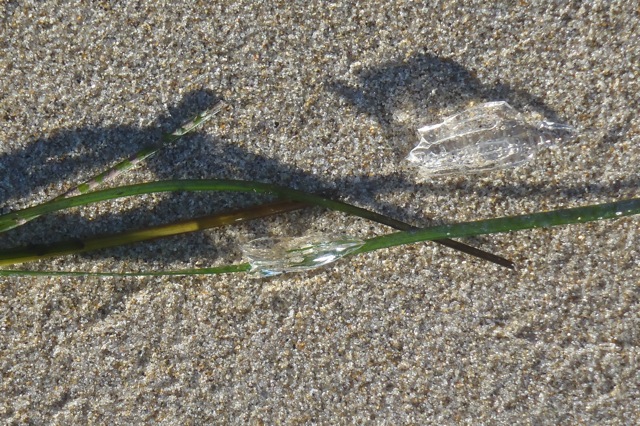 Even though salps appear jellylike, they’re not related to jellies (jellyfish) at all. This brings me back to the earlier reference to tunicates. During early larval development, salps and their tunicate relatives have a rodlike notochord, or very primitive backbone structure. (It’s not present in adulthood.) This structure also appears during the development of vertebrates (animals with backbones). That makes salps and other tunicates more closely related to you and me than to jellies.
 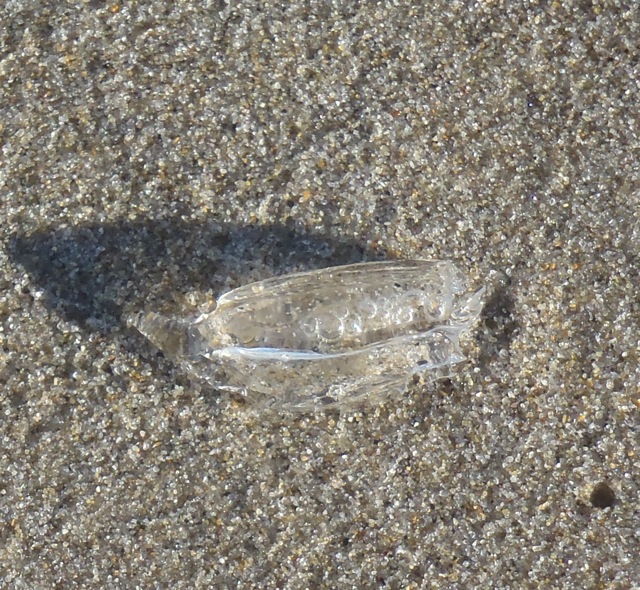 When I first saw these on the beach, I didn’t know what they were. They didn’t look like their living selves. (My thanks to George Matsumoto of MBARI for identifying them, and any errors in this post are mine.) The photos of these inch-long (2.5 cm) individuals and small groups were taken during a warm Sunday morning walk along Del Monte Beach (Monterey) in December. The salps may have been dumped by a current as they fed near the surface nearshore or rolled ashore on a set of large swells. However they ended up on the beach, they offered me a glimpse of the open-water world beyond the waves. Note: Salps are not dying in record numbers and littering the seafloor due to Fukushima radiation, as has been reported on the Internet. For more about the true story, see the MBARI article or Deep Sea News post.
Also check out this article with beautiful images and video of salps’ feeding in Oceanus Magazine: Salps Catch the Ocean’s Tiniest Organisms.


 WordCraft.NatureFocus